Snapdeal wins in Delhi High Court: ₹322.40 crore of advertising is an expense, not capital
AceVector’s filing of 20 November: why a tax officer treated half of Snapdeal’s 2016-17 advertising as a brand asset, what three appeal levels held, and what was at stake.

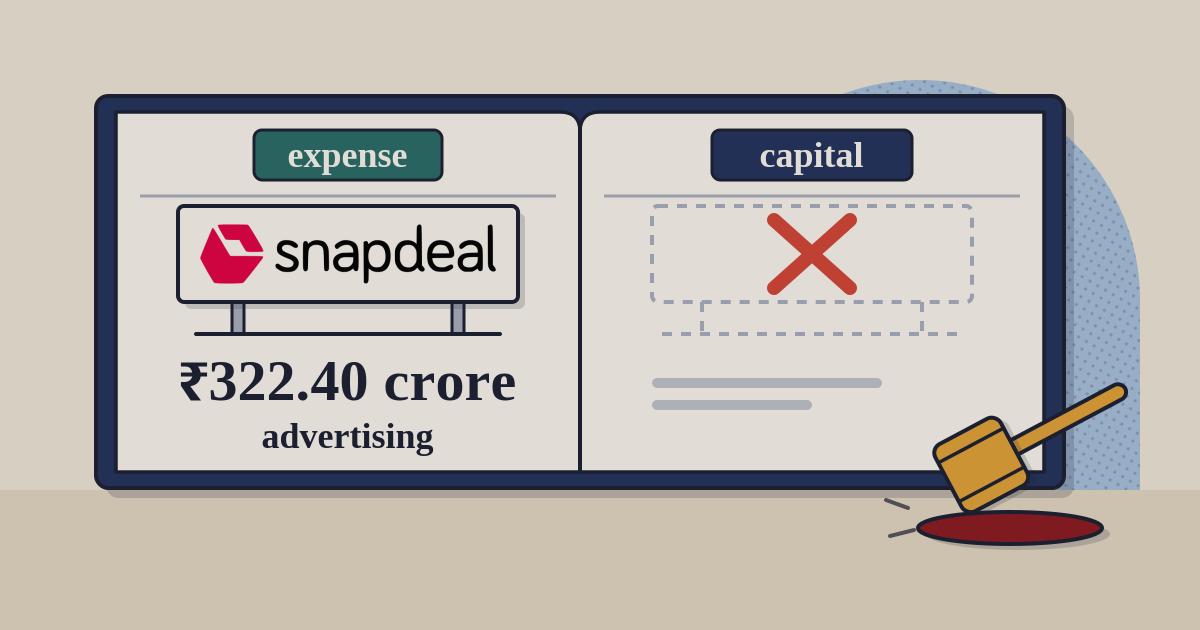
The Delhi High Court on 20 November dismissed the income-tax department’s appeal against AceVector, the listed company that was called Snapdeal Limited, over ₹322.40 crore of advertising and promotion spending from 2016-17. The money stays where Snapdeal put it, as an expense of that year, and not where the tax officer put it, as capital spent on building a brand.1 AceVector says it learnt of the appeal by email on 19 November; the court heard it the next day and dismissed it.1
₹644.79 cr
advertising and business promotion Snapdeal claimed for 2016-17
ITAT order
50%
the share the assessing officer treated as capital: ₹322.40 crore
AceVector filing
₹111.57 cr
the “tax effect stated by Revenue” on that amount
AceVector filing
3
appeal levels that have ruled for Snapdeal: the Commissioner (Appeals), the tribunal, the High Court
AceVector filing
01An expense or an asset
Tax is charged on profit, so what counts as a cost of the year matters. Money spent running a business, such as salaries, rent and advertising, is revenue expenditure and is deducted in full that year. Money spent on something lasting, such as a machine, is capital expenditure and is not. For a company that loses money, the same line sets the size of the loss it can carry forward against later profits.
For the year to March 2017 Snapdeal claimed ₹644.79 crore: ₹430.55 crore of advertisement and publicity and ₹214.24 crore of business promotion, which it described as cashback and discount schemes run on its site.2 In an order of 30 December 2019 the assessing officer held half of it to be capital. “Such aggressive advertisement and business promotion in the nature of blitzkrieg creates an enduring advantage to the Company,” he wrote, and leads to “the creation of the intangible assets being goodwill, reputation and creditability”.2 He disallowed ₹322.40 crore, which cut the declared loss of ₹2,108.61 crore to ₹1,786.22 crore, and began penalty proceedings under Section 270A.1
02Three rulings against the 50% rule
The Commissioner (Appeals) deleted the disallowance on 31 March 2022. The department appealed 242 days late; the Income Tax Appellate Tribunal excused the delay and dismissed the appeal on 26 April 2024.12 “The nature of assessee’s business involves operation in a highly competitive market,” it held. “There is no likelihood of the advantages being enduring in nature.” It followed its own order of November 2021 on Snapdeal’s 2012-13 spending, where an officer had also capitalised 50%, and Delhi High Court rulings that advertisements “do not have a lasting and long term effect”. That earlier order faulted the method too: the officer had applied an “ad-hoc percentage” without saying which spending created an asset.2
The 2019 order that capitalised half of Snapdeal’s advertising has now lost at three levels
Snapdeal’s income-tax assessment for 2016-17 (assessment year 2017-18): orders and appeals, December 2019 to November 2026
Show tableHide table
| Date | Event | Detail |
|---|---|---|
| 30 Dec 2019 | Assessment order | Half of advertising and promotion, ₹322.40 crore, treated as capital |
| 10 Nov 2021 | Tribunal rules on 2012-13 | The same 50% treatment rejected for an earlier year |
| 31 Mar 2022 | Commissioner (Appeals) | Disallowance deleted |
| 26 Apr 2024 | Tribunal dismisses appeal | The department’s appeal, filed 242 days late, fails |
| 5 Oct 2026 | AceVector lists | Shares begin trading on NSE and BSE |
| 20 Nov 2026 | High Court dismisses appeal | Decided on the day of the hearing |
Source: AceVector filing, 20 November 2026; ITAT order in ITA No. 184/Del/2023, 26 April 2024 · as of 20 November 2026
The High Court’s judgment was not on the court’s published list when we checked on 24 November, so its reasons are not yet public. AceVector’s filing is the only account of it.15
03What was at stake
Snapdeal owed no tax for the year either way: even the officer’s figure was a loss. The department’s ₹111.57 crore is the tax the disallowed amount would bear, 34.608% of it, which is the company rate that year with surcharge and cess. The live exposure was the penalty. Section 270A, new that year, counts an assessment that reduces a loss as under-reported income, and sets the penalty at 50% of the tax on it, or 200% for misreporting.14 The filing gives no penalty amount.
AceVector runs Snapdeal and owns the software company Unicommerce. It listed on 5 October after an IPO of ₹420 crore, of which ₹287 crore was new money. It lost ₹45.87 crore on revenue of ₹510.38 crore in the year to March 2026, so the disputed tax effect is more than twice its annual loss.3 Its marketing is far smaller now than the ₹644.79 crore of 2016-17: it was 7.7% of Snapdeal’s ₹1,093 crore of net merchandise value in 2025-26, about ₹84 crore.6 The shares closed at ₹19.27 on Monday 23 November, the first session after the Friday-evening filing, up 2 paise. Indian markets were shut on Tuesday.7 The filing does not say whether the department will go to the Supreme Court, as it did without success in one of the earlier advertising cases the tribunal cites.12
Sources
- AceVector Limited (formerly Snapdeal Limited), disclosure under Regulation 30: Delhi High Court dismisses the Revenue’s appeal for assessment year 2017-18 (NSE) — 20 November 2026
- Income Tax Appellate Tribunal, Delhi Bench G, ACIT Circle 22(2) v. Snapdeal Ltd., ITA No. 184/Del/2023, assessment year 2017-18 — 26 April 2024
- AceVector Limited, outcome of board meeting: unaudited results for the quarter ended 30 June 2026 and the quarter and half year ended 30 September 2026 (NSE) — 26 October 2026
- Finance Bill, 2016: clause inserting section 270A of the Income-tax Act, and the rates of income-tax for 2016-17 — 29 February 2016
- High Court of Delhi, list of judgments (no income-tax appeal dated 20 November 2026 was listed when read) — 24 November 2026
- AceVector Limited, investor presentation for the quarters ended 30 June and 30 September 2026 (NSE) — 26 October 2026
- National Stock Exchange of India, daily price files for the cash market (ACEVECTOR, series EQ) — 23 November 2026
Disclosure. TechBag is a software reseller: it earns when companies buy through it, including from vendors named here. The analysis is TechBag’s own; no vendor paid for or saw this piece before publication. Facts are labelled reported, TechBag count or our view. How the Journal works.
Keep reading