Urban Company prices its QIP at ₹156, 3.12% below the floor
Urban Company’s ₹2,500 crore placement closed on 19 November: 16.03 crore new shares to 33 investors, over ₹15,000 crore of demand, and four fund houses with 8.8% each.

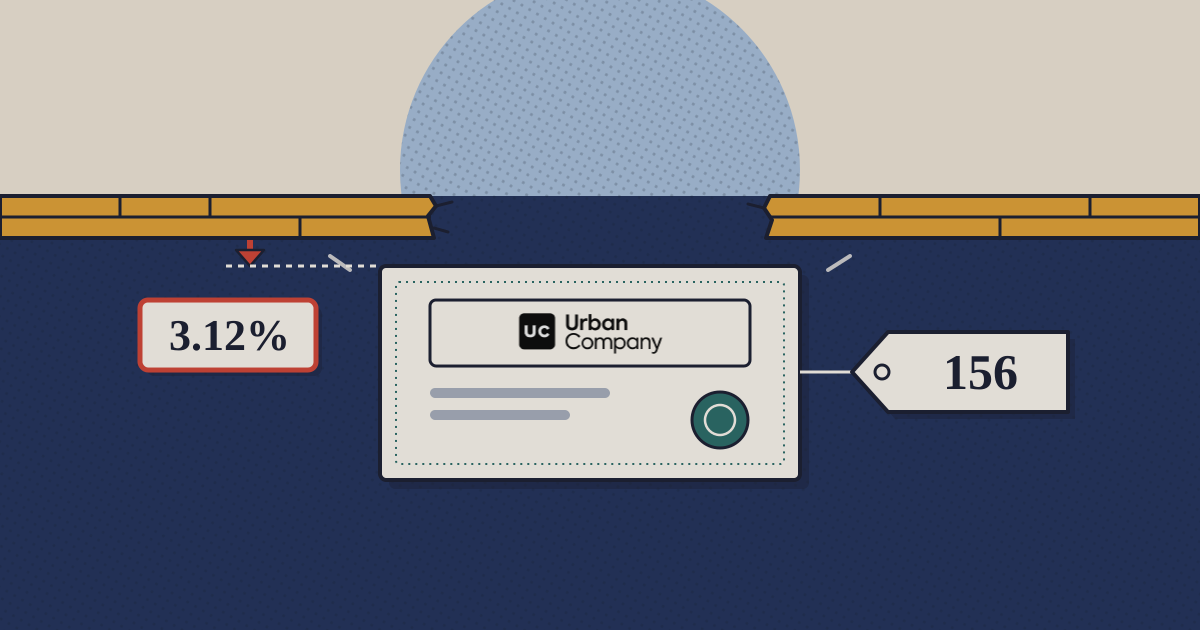
Urban Company sold 16,02,56,410 new shares to institutional investors at ₹156 each on 19 November, ₹5.03 or 3.12% below the ₹161.03 floor price it set when the sale opened three days earlier, and raised about ₹2,500 crore.1 SBI Mutual Fund, ICICI Prudential Mutual Fund, Mirae Asset Mutual Fund and Invesco India Mutual Fund were each allotted 8.8% of the new shares through their schemes; Prazim Trading and Investment Co. took 6.0% and HDFC Life Insurance 5.0%.1 The company says bids passed ₹15,000 crore, about six times the issue.3
₹156
issue price a share, 3.12% below the ₹161.03 floor
NSE filing
16.03 cr
new shares; the share count rises 10.4%, to 170.2 crore
NSE filing
₹15,000 cr+
of demand, about six times the ₹2,500 crore issue
Urban Company
33
investors allotted shares, 13 of them new to the stock
Urban Company
01Who bought
A qualified institutions placement sells new shares only to institutions such as mutual funds and insurers, at no less than a floor that SEBI’s formula sets from recent trading prices. The rules allow up to 5% off that floor where shareholders have approved it, and Urban Company’s notice provided for 5%.4 Its fund-raise committee fixed the price under Regulation 176(1) of SEBI’s issue rules at a five-minute meeting from 7pm on 19 November and approved the allotment at 10:48pm.21
The allotment filing names every buyer given more than 5%, counting all the schemes of one fund house together. SBI’s 8.8% is spread over seven schemes, the largest SBI Midcap Fund at 3.5%; ICICI Prudential’s over eight, including three of its ISIF long-short funds; Mirae Asset’s and Invesco India’s over four each. The single largest scheme allotment was Invesco India Small Cap Fund’s, at 5.0%. The filing classes Prazim Trading as a systemically important NBFC.1 The company’s release says 13 fund houses together took over half the issue, names Goldman Sachs Asset Management, Pictet, Amundi, Norges Bank Investment Management and Millennium among the foreign buyers, and Premji Invest among the domestic ones.3
02What the price means
At ₹156 the company needed 16.03 crore shares to reach ₹2,500 crore, against about 15.5 crore at the floor. Its shares in issue rise from 154.2 crore to 170.2 crore, 10.4% more; the new shares are 9.4% of the enlarged company.1 The price is 51% above the ₹103 at which Urban Company sold shares in its IPO in September 2025. Of that ₹1,900 crore offer, ₹472 crore was new shares for the company and the rest was sold by existing shareholders.5 This placement brings in 5.3 times what the IPO raised for the company itself.
The shares rose while the sale was open. After falling 5.9% on 17 November, the day after it opened, they closed at ₹176.05 on 19 November, 9.3% above the floor, so the issue price was 11.4% below that day’s close. On 20 November, the first session after the allotment, they fell 4.0% to ₹168.95, still 8.3% above the issue price.7 Where that leaves Urban Company against last year’s other listings is in our count of India’s tech IPOs a year on.
03What the money is for
The release lists six uses “as set out in the placement document”: building the “supply ecosystem” of InstaHelp, its house-help service; brand marketing; technology and cloud infrastructure; training infrastructure for service professionals; research on its Native products; and acquisitions and general corporate purposes. It gives no amounts.3 The 16 November filing set ceilings: up to ₹600 crore for InstaHelp, ₹540 crore for marketing, ₹200 crore for technology and cloud and ₹50 crore for Native, with general purposes capped at 25% of the proceeds. It also listed up to ₹85 crore of office rent, which the release does not mention, and no training line.4
Before the raise, Urban Company held ₹1,901 crore of cash and treasury investments at 30 September.6 InstaHelp lost ₹306 crore on the company’s adjusted EBITDA measure in April–September, as our note on the opening of the sale set out. What to watch: the October–December results, the first with the new money on the balance sheet, and how fast the InstaHelp ceiling is drawn down.
Sources
- Urban Company, allotment of equity shares in the qualified institutions placement, with Annexure A: allottees above 5% (NSE) — 19 November 2026
- Urban Company, outcome of Fund Raise Committee meeting: closure of the issue and issue price (NSE) — 19 November 2026
- Urban Company, press release: Urban Company raises ₹2,500 crore through Qualified Institutions Placement (NSE) — 20 November 2026
- Urban Company, in-principle QIP filing: issue size, discount provision and objects of the issue (NSE, XBRL) — 16 November 2026
- Urban Company, IPO basis of allotment announcement: offer price ₹103, fresh issue and offer for sale (NSE) — 16 September 2025
- Urban Company, Q2 FY27 shareholders’ letter and unaudited results — 16 October 2026
- Yahoo Finance, URBANCO.NS daily prices, 16 to 20 November 2026 (quote data, not a primary source) — 20 November 2026
Disclosure. TechBag is a software reseller: it earns when companies buy through it, including from vendors named here. The analysis is TechBag’s own; no vendor paid for or saw this piece before publication. Facts are labelled reported, TechBag count or our view.
Keep reading