Tucows sells Ting’s owned fibre markets for US$1 and will shed US$301.5m of debt
Tucows’s 8-K and release of 17 November: what the buyer takes, who gets paid, the debt that goes and the debt that stays, and what Ting’s fibre business was.

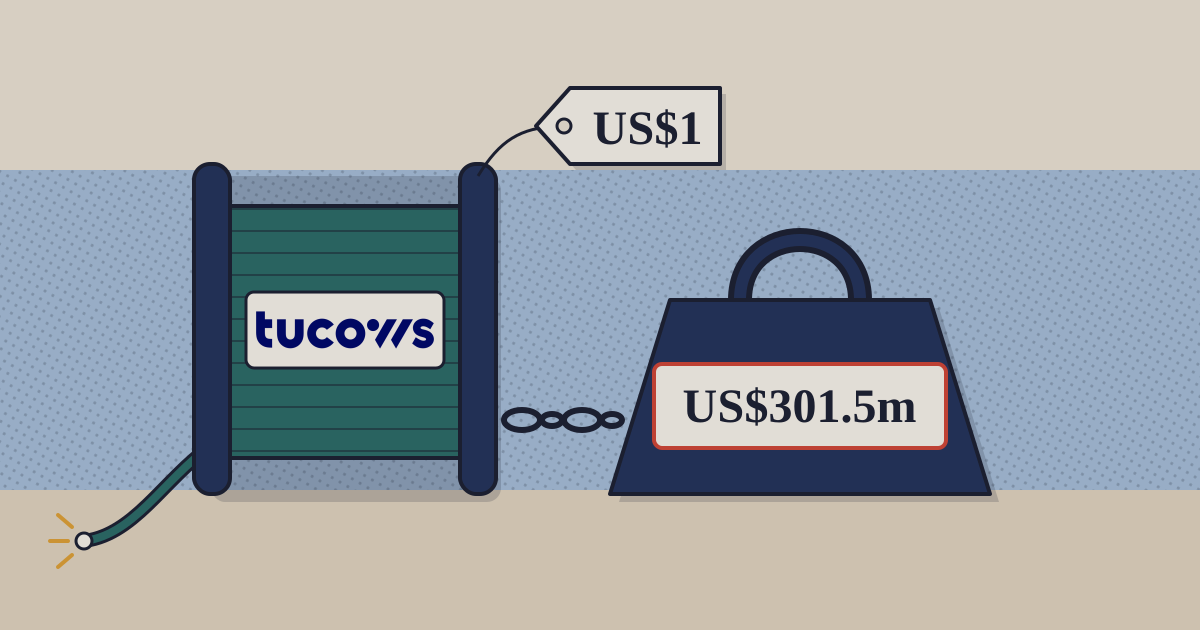
Tucows, the Toronto company whose largest business is domain names, has agreed to sell the fibre networks its Ting subsidiary owns for US$1.00. The buyer takes Ting Holdco LLC, which holds those networks and the securitised notes that paid for them, so about US$301.5m of debt leaves Tucows’s balance sheet when the deal closes.1 The buyer is Point Broadband Acquisition, LLC, which Tucows’s release calls Clearwave, a fibre internet provider backed by the private-equity firms GTCR and Berkshire Partners. The notes were never a claim on Tucows itself, and Tucows will put US$3.0m of cash into the business on the way out.12 The agreement was signed on 16 November and announced at 7:30am New York time on 17 November; Tucows expects it to close in January–March 2027.2
US$1
purchase price for Ting Holdco, which owns Ting’s own fibre markets
Tucows 8-K
US$301.5m
of securitised notes that go with it, off Tucows’s balance sheet at closing
Tucows 8-K
US$3.0m
cash Tucows puts into the business it is selling
Tucows 8-K
US$184.4m
bank debt Tucows keeps, its syndicated credit facility at 30 September
Tucows
01What moves, and who gets paid
The US$301.5m is two securitisations: US$238.5m of notes issued in May 2023 at 5.95% to 9.95%, and US$63.0m issued in August 2024.13 The buyer will pay US$26.0m to Generate TF Holdings for the most junior 2023 slice, the 9.95% Class C notes, which were US$46.9m when issued; a 2024 Class C slice held inside Tucows’s own group is cancelled. The buyer also pays US$12 for each internet address it takes over, and puts US$1.65m into escrow until working capital is settled.1 The 2023 notes are due to be repaid or refinanced by April 2028, after which they carry at least 5 percentage points of extra interest a year.3
Ting’s partner markets, where other companies build the network and Ting sells the service (Memphis, Westminster in Maryland and Laguna Woods Village in California), stay with Tucows. So does Colorado Springs, whose network lease Tucows agreed in October to transfer.1 Closing needs the Federal Communications Commission, state utility commissions, noteholders’ consents and rating agencies. There is no termination fee; if the buyer walks away in breach, it owes at most US$23.0m.1 Tucows’s July promise to invest up to US$12.5m more in Ting falls away, and it expects tax losses carried forward to absorb most of the taxable gain.2
Tucows’s debt, preferred units and guarantees fall from US$956.8m to US$190.4m if every step completes
Tucows’s debt, Ting’s preferred units and Tucows’s material guarantees, principal amounts, US$m, end of 2025 and after each step
Source: Tucows, Investor Update, November 2026 (exhibit to the 8-K of 17 November 2026) · as of 17 November 2026 · Tucows’s illustration at 31 December 2025 balances, before cash; not a pro forma. Bank debt was US$184.4m at 30 September
02What Ting was
Tucows began building Ting’s fibre network in 2015.4 At 30 September Ting could connect 126,000 premises on networks it owns and 161,400 on partners’ networks, and had 64,000 subscribers under management, from 52,000 a year earlier. Tucows carried its fibre network at a cost of US$277.6m before depreciation. Ting’s revenue rose 27% to US$63.3m in January–September and its segment adjusted EBITDA, Tucows’s measure, turned to US$2.6m from a loss of US$5.4m.3 In its first- and second-quarter accounts this year Tucows disclosed substantial doubt about Ting’s ability to meet its obligations within a year; in July it retired Ting’s preferred units, held by Generate, in a transaction it accounted for as a troubled debt restructuring.3
Upon closing, it is expected to remove more than $300 million in principal amount of securitized debt and the capital demands that came with building fiber networks.
What is left is Tucows Domains, which manages more than 21 million domain names, and Wavelo, its billing and subscriber software for telecom operators.2 Tucows’s shares closed at US$11.45 on 16 November, which its own deck puts at an equity value of US$128.5m and an enterprise value of US$301.7m.4 What to watch: the regulators’ and noteholders’ consents, and the gain or loss Tucows books on the sale, which it says it is still working out.1
Sources
- Tucows Inc., Form 8-K: Membership Interest Purchase Agreement for Ting Holdco LLC (SEC EDGAR, accession 0000909494-26-000016) — 17 November 2026
- Tucows, Tucows Agrees to Sell Ting’s Owned Fiber Markets to Clearwave; Expected to Remove $301.5 Million of Securitized Debt at Closing (PR Newswire) — 17 November 2026
- Tucows Inc., Form 10-Q for the quarter to 30 September 2026 (SEC EDGAR) — 5 November 2026
- Tucows Inc., Investor Update, November 2026 (exhibit to the 8-K) — 17 November 2026
Disclosure. TechBag is a software reseller: it earns when companies buy through it, including from vendors named here. The analysis is TechBag’s own; no vendor paid for or saw this piece before publication. Facts are labelled reported, TechBag count or our view.
Keep reading