Vishay pays US$56.4m for 49% of Kaynes Semicon, valuing it at about US$115m
Vishay’s US filing and Kaynes’s NSE letter of 12 November: what the Indian chip-packaging venture will make, what Vishay controls, and what is still to be signed.

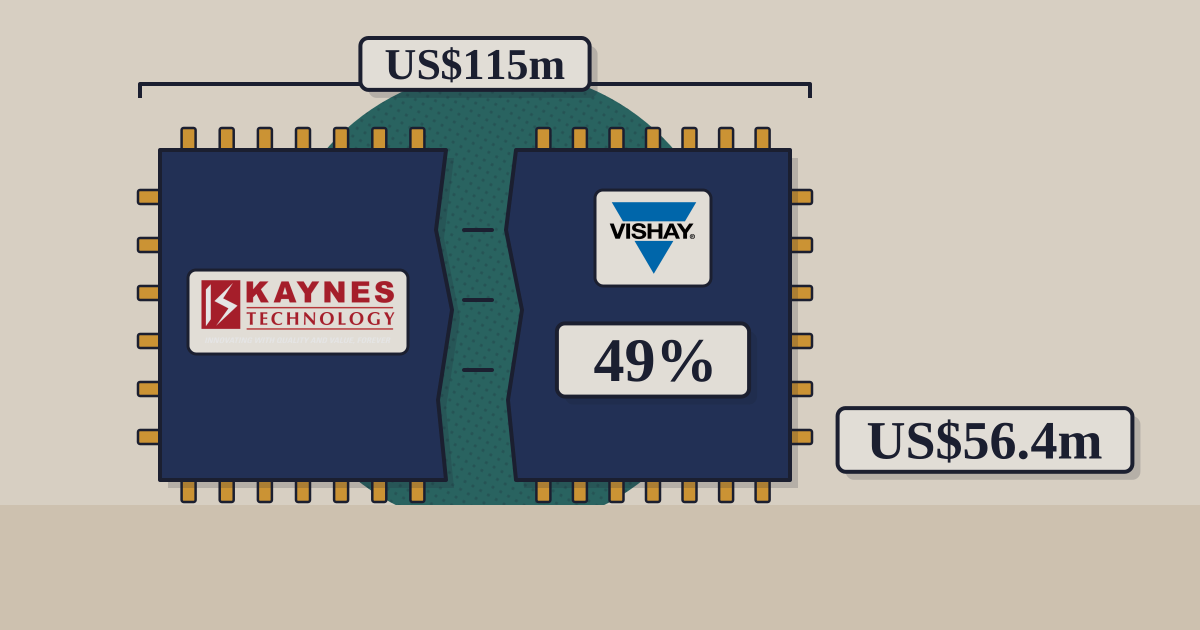
Vishay Intertechnology, the US maker of discrete semiconductors and passive electronic components, will invest US$56.4m for 49% of Kaynes Semicon, the chip-assembly subsidiary of Kaynes Technology India, under a binding term sheet the two signed on 12 November.1 At that price the whole of Kaynes Semicon is worth about US$115m. The amount appears only in Vishay’s report to the US Securities and Exchange Commission; Kaynes’s letter to the NSE and BSE the same evening names the 49% stake and gives no value.2
US$56.4m
Vishay’s investment, in its US filing of 12 November
Vishay 8-K
49%
Vishay’s stake in Kaynes Semicon; Kaynes Technology keeps 51%
Vishay, Kaynes
US$115m
what the price values all of Kaynes Semicon at
From Vishay’s 8-K
60 lakh
chips a day, the capacity approved for Kaynes Semicon’s Sanand unit in 2024
Cabinet
01What the joint venture will make
A fab prints circuits onto silicon wafers. The back end, which Kaynes’s filing calls OSAT (outsourced semiconductor assembly and test), turns those wafers into parts that can be soldered onto a board: it processes the finished wafer, cuts it into chips, packages each one and tests it.2 The joint venture will do that work through Kaynes Semicon, run a captive production line for Vishay in India, and may also take third-party customers. Vishay describes the plan as “captive semiconductor back-end manufacturing capabilities for Vishay”.12
Vishay’s chips are discrete parts: MOSFETs (power switches), diodes and optoelectronic components. They brought in US$467.7m of its US$978.9m revenue in the quarter to 3 October; resistors, inductors and capacitors made up the rest.3 Kaynes Semicon is the company whose packaging unit in Sanand, Gujarat, the Cabinet approved on 2 September 2024, with ₹3,300 crore of investment and capacity for 60 lakh chips a day.4 By July 2026 it was one of three first-round chip projects in commercial production, with Micron and CG Semi.5 Neither company’s filing says whether the Vishay line will be built at Sanand. Raghu Panicker will be Kaynes Semicon’s managing director and chief executive.2
02What Vishay controls, and what is still to be signed
Holding a minority, Vishay still gets to decide several things: the auditors, internal controls and IT systems, which vendors and equipment are bought, and whether the venture may take customers outside the Vishay group. Other reserved matters need both partners’ approval, and any later funding is to come from both in proportion to their stakes.1 The two will apply jointly for central and state support under India Semiconductor Mission 2.0, the second chip programme, which opened for applications on 6 November with ₹1,27,500 crore.1
The term sheet binds the two to the deal, but the deal itself is not done: the definitive agreements, the required approvals and other closing conditions are still ahead, and Kaynes adds that terms are still to be finalised.12 For Vishay the sum is small: it held US$1.14bn of cash at 3 October, after a share sale on 1 July, and expects to spend US$350m to US$400m on equipment and plants this year, saying it modulates that spending partly in response to “increases in subcontractor capacity”.3 What to watch: the signed agreements, the Semicon 2.0 application, and where the captive line goes.
Sources
- Vishay Intertechnology, Form 8-K, Item 8.01: binding term sheet with Kaynes Technology India for a semiconductor joint venture (SEC EDGAR) — 12 November 2026
- Kaynes Technology India, disclosure under Regulation 30: binding term sheet among Kaynes, Kaynes Semicon, Vishay and Ecomal Nederland (NSE) — 12 November 2026
- Vishay Intertechnology, Form 10-Q for the quarter ended 3 October 2026 (SEC EDGAR) — 4 November 2026
- Cabinet (PIB): Cabinet approves one more semiconductor unit under India Semiconductor Mission, Kaynes Semicon, Sanand — 2 September 2024
- Cabinet: Cabinet approves Semicon 2.0 (PM India) — 15 July 2026
Disclosure. TechBag is a software reseller: it earns when companies buy through it, including from vendors named here. The analysis is TechBag’s own; no vendor paid for or saw this piece before publication. Facts are labelled reported, TechBag count or our view.
Keep reading