Workday’s total backlog grew 6.1% while subscriptions grew 12.8%
Workday’s results for August to October: contracted revenue beyond the next 12 months grew about 3%, what its 10-Q says about renewals, and a 10% guide for next quarter.

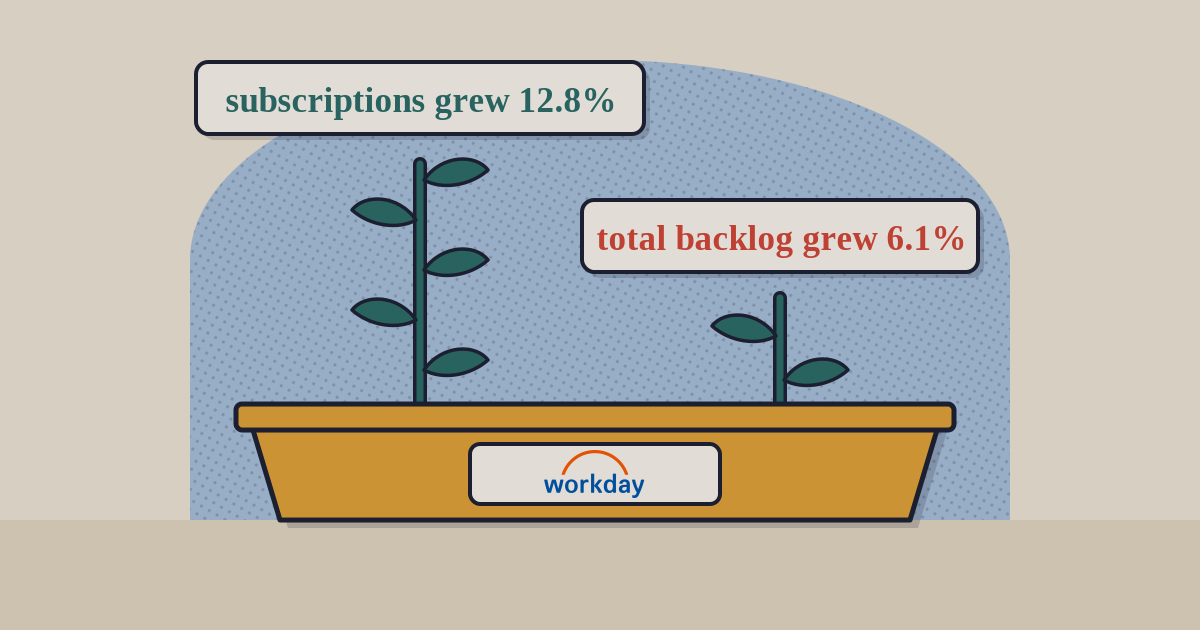
Workday’s subscription revenue rose 12.8% to US$2.532bn in its fiscal third quarter, the three months to 31 October, but the contracted revenue it has yet to earn grew less than half as fast. Its total subscription revenue backlog was US$27.548bn, up 6.1%; the 12-month backlog, the part due within a year, was US$9.216bn, up 12.3%.1 Total backlog growth has slowed every quarter for a year, from 17.0% at the end of October 2025.1 6 7 8 9
01Two backlogs, two speeds
Workday sells subscriptions to its HR and finance software, usually for several years at a time. Its backlog, which accountants call remaining performance obligations, “represents contracted subscription services revenues that have not yet been recognized and includes billed and unbilled amounts”. Of the US$27.5bn, it expects to recognise about US$9.2bn within 12 months and US$16.2bn within 24 months.2
Subtract the 12-month figure from the total and what is left is revenue contracted for more than a year ahead: US$18.33bn, against US$17.76bn a year earlier, a rise of about 3.2%. The near part of the book is growing; the far part barely is. A gap like this can come from customers renewing for shorter terms, from fewer long renewals falling due in the period, or from slower new multi-year deals.2
Workday does not say which. Its 10-Q says the backlog “may fluctuate from period to period due to a number of factors, including the timing of renewals and overall renewal rates, new business growth, average contract duration, industry and product mix, business combinations, and seasonality”. It credits the year’s increase to expansion among existing customers, new customers and the timing of renewals, and says it has seen “reduced growth in headcount-level commitments upon renewals of existing customers” and longer sales cycles, “particularly evident in the government, higher education, and healthcare industries”.2 Its renewals are tied to the size of the customer’s workforce: the 10-Q warns that customers may renew “for a lower headcount”. Customers are still staying: gross revenue retention, which leaves out expansion, was about 97%.2
Workday’s total backlog growth fell from 17.0% to 6.1% in a year; the 12-month backlog held up better
Workday subscription revenue backlog, growth on a year earlier, %, at each quarter end, October 2025 to October 2026
- 12-month backlog
- Total backlog
%
Show tableHide table
| 12-month backlog | Total backlog | |
|---|---|---|
| Oct 2025 | 17.6 | 17 |
| Jan 2026 | 15.8 | 12.2 |
| Apr 2026 | 15.5 | 10.9 |
| Jul 2026 | 14.2 | 8 |
| Oct 2026 | 12.3 | 6.1 |
Source: Workday earnings releases (Exhibit 99.1 to Form 8-K) for the five quarters · as of 24 November 2026 · October 2025 and January 2026 include the acquisitions of Paradox and Sana, as Workday notes
Sources
- Workday, Workday Announces Fiscal 2027 Third Quarter Financial Results (Exhibit 99.1 to Form 8-K), SEC — 24 November 2026
- Workday, Form 10-Q for the quarter ended 31 October 2026, SEC — 24 November 2026
- Workday, Form 8-K, Items 2.02 and 2.05: reorganisation and charges, SEC — 29 September 2026
- Nasdaq, WDAY historical prices: closes of 23 and 24 November 2026 — 24 November 2026 quote data, not a primary source
- Nasdaq, WDAY pre-market quote, 25 November 2026 — 25 November 2026, 8:45am ET pre-market quote, not a primary source
- Workday, fiscal 2027 second-quarter results (Exhibit 99.1 to Form 8-K), SEC — 27 August 2026
- Workday, fiscal 2026 third-quarter results (Exhibit 99.1 to Form 8-K), SEC — 25 November 2025
- Workday, fiscal 2026 fourth-quarter and full-year results (Exhibit 99.1 to Form 8-K), SEC — 24 February 2026
- Workday, fiscal 2027 first-quarter results (Exhibit 99.1 to Form 8-K), SEC — 21 May 2026
Disclosure. TechBag is a software reseller: it earns when companies buy through it, including from vendors named here. The analysis is TechBag’s own; no vendor paid for or saw this piece before publication. Facts are labelled reported, TechBag count or our view. How the Journal works.
Keep reading