SecurityRisk & complianceAnalysis
Attackers stole prompts at 3 AI inference providers; some were marked zero retention
Dragos’s test of 19 November, about two million baited prompts sent from July, and what OpenRouter, Together AI, Phala, Novita and Atlas Cloud have said since.

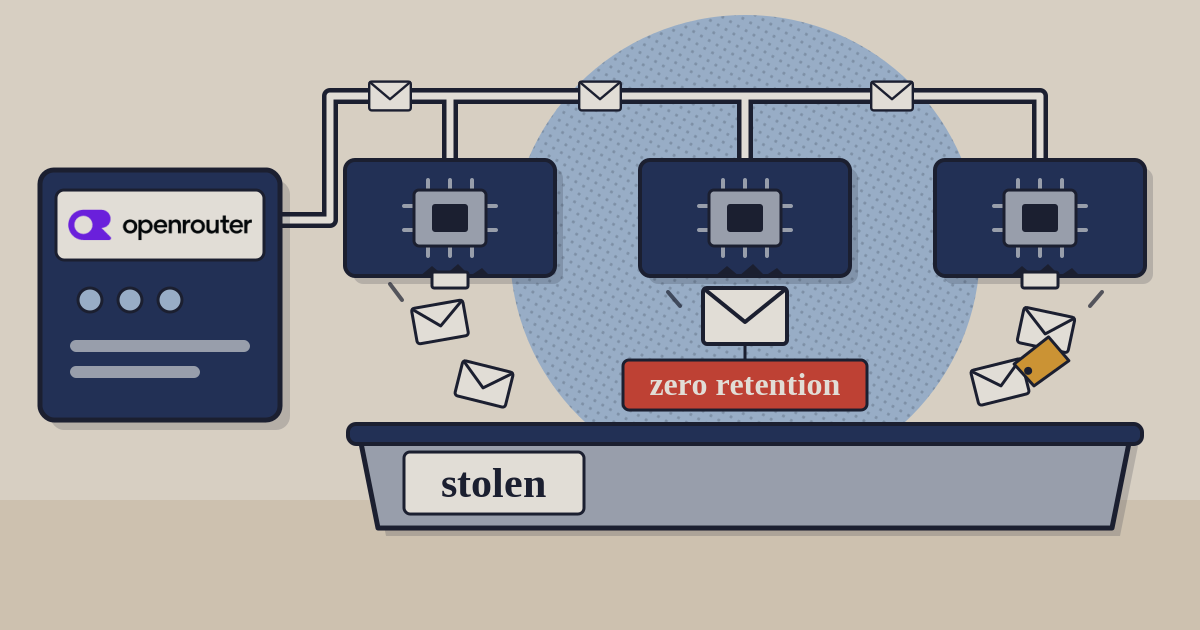
A company that sends its code, contracts or customer records to an AI model through a router is trusting a chain it rarely sees: the router, the provider that won the request, and whatever that provider runs or forwards to. Dragos’s test, published on 19 November, is a measured look at what happens along that chain, and it found three break-ins, sellers reading prompts from their own logs, and privacy settings that did not hold.1 This piece walks through how a request travels, what was stolen and how it was used, what each provider says went wrong, and what a company can check.
01How a prompt reaches a GPU, and who can read it on the way
A router offers one API for hundreds of models. The customer sends a request to the router, which forwards it to one of several companies hosting that model, often the cheapest or fastest; the provider’s front door accepts it and hands it to a server with GPUs, which runs the model and returns the answer. Dragos’s point is that “every hop can see the entire prompt and response”, and that a path often passes through “more than one router”.1
Every hop between a customer and the GPU sees the whole prompt
The path of one request through an AI router, and what each hop can do with it, as described in November 2026
- 01
The customer
Sends a prompt with a privacy setting: by account, by key or, at OpenRouter,
zdr: trueon the request. - 02
The router
Picks an endpoint whose listed policy fits the setting. A ZDR request goes only to endpoints listed as zero retention.
- 03
The provider’s front door
Accepts, logs and queues the request. A reseller here may itself forward to another router or to the model’s maker.
- 04
The inference server
Holds the prompt in memory while the model runs. An intruder on this machine sees requests in flight.
Source: Dragos (19 Nov); OpenRouter documentation, Zero Data Retention · as of 23 November 2026
Zero Data Retention (ZDR), in OpenRouter’s definition, means “no routine storage of prompts or responses after processing”. OpenRouter tracks a policy for each endpoint, working “with providers to understand each of their data policies”, and treats an endpoint it cannot pin down as one that retains and trains on data. A request with zdr: true, or an account with ZDR enforced, is then “only routed to ZDR endpoints”.7 For retention more generally, OpenRouter shows each provider’s policy “as reflected in each provider’s terms”.8
Dragos also traced the hops themselves, with an image link that each fetching system reveals and with slightly broken requests whose nested error messages name each layer. Of about two thousand routes traced, several hundred included a system it could not identify, and a handful sent the image to a company not on the advertised path. One marketplace seller added about a thousand hidden tokens to every prompt.1
02Two million baited prompts, three break-ins
The method is a canary: a secret that exists in one place only, so any use of it proves that place leaked. From July, Dragos put an AWS key, a DNS name and a never-used URL into each prompt, later generating credentials for web, git, SSH, database and mail services it ran itself. Its AWS keys were real keys to empty accounts with full logging, and every touch was tied back to the prompt, model, router and privacy setting that carried it.1
Bait keys stolen from AI providers were used for tens of thousands of AWS API calls
Dragos's canary test of AI inference providers, July to November 2026
~2m
prompts carrying unique keys and links, sent from July to November
3
hosting providers where attackers were copying requests
~200
AWS keys stolen in the largest breach, all seeded in late October
10,000s
AWS API calls made with the stolen bait keys, in total
Source: Dragos, Three breaches, endless leaks (19 Nov) · as of 19 November 2026
In the largest breach, each key went in exactly one request to one provider, “and every request we sent during those windows was stolen”. Some came from requests the provider rejected before any model ran, which, Dragos says, puts the copying at “the provider’s front door”, not deeper in the stack. Its prompts were bait, but they travelled with real customer requests, “and those were almost certainly copied too”.1
What the attackers did next is the sequence a cloud team can look for. They tested each key, in some cases within hours; listed S3 buckets and searched Secrets Manager and Parameter Store; then tried to switch on hosted models in AWS Bedrock, create Bedrock API keys and add their own IAM users to keep access. One key seeded on 21 October was first used the next day and still in use three weeks later. One attacker appears to have been inside two providers at once, using their secrets together from a single rented server, and on 1 November added an AI-driven penetration-testing tool whose user agents, artex-agent and artex-judge-r121, Dragos says appear in no public indicator list.1
A separate finding needed no break-in. On an inference marketplace, where the lowest-priced seller wins a request, sellers who turned on request logging could read prompts. Dragos caught individuals on home connections opening its secret links and guessing logins by hand, while prompts for the same model sent through other sellers were never touched: “the leak follows the seller and not the marketplace as a whole”.1
03Who knew, and when: the one timeline published
Dragos says “none of the three providers knew about their breach until we notified them”. The earliest dates to mid-July; that provider first took it for an internal tooling misconfiguration, then a partner’s data processing, before finding its internal credentials had been taken too. As of 19 November it had not disclosed the incident publicly. For the second batch, in late October, Dragos says it reached out as soon as it confirmed third-party access, and that one of those providers had already published a preliminary notice.1
Phala’s report of 10 November is the only notice with a timeline of a break-in. Phala detected unauthorised activity on one server on 5 November and rotated the root key of its key management system the next day. It learned that prompt data was exposed only on 8 November, from “a third-party security researcher”, and traced it to a new GPU server “serving production traffic without our full production security hardening”.3
Phala found an intruder on 5 November; it learned prompts were exposed only on 8 November
Dates in Dragos's test and the providers' own notices, July to November 2026
Show tableHide table
| Date | Event | Detail |
|---|---|---|
| 1 Jul 2026 | Canaries begin | Dragos starts seeding prompts with unique keys and links |
| 21 Oct 2026 | Phala window opens | Attacker reaches management interfaces on one server |
| 5 Nov 2026 | Phala detects | Unauthorised activity on one server; access paths blocked |
| 8 Nov 2026 | Phala told | Researcher's evidence received; model taken offline |
| 10 Nov 2026 | Phala report | Preliminary incident report published |
| 19 Nov 2026 | Dragos publishes | Three breaches, about two million prompts |
| 21 Nov 2026 | Together AI | Prompt samples from June and July downloaded |
| 22 Nov 2026 | OpenRouter, Novita | Three providers dropped; Atlas Cloud's notice follows on 23 Nov |
Source: Dragos (19 Nov); Phala (10 Nov); Together AI (21 Nov); OpenRouter (22 Nov); Novita (22 Nov); Atlas Cloud (23 Nov) · as of 23 November 2026
Phala treats every request to its DeepSeek V4 Flash 0731 deployment that OpenRouter routed to it between 21 October and 05:35 UTC on 8 November as exposed. The canary evidence itself is narrower: of canaries Dragos sent to Phala from 1 July to 7 November, only those from 21 and 22 October were misused, first at 05:41 UTC on 22 October and last on 9 November. Phala keeps the wider window because the test “sampled requests rather than monitoring every request”.3
04What each provider says went wrong
Four providers have published notices, and OpenRouter keeps a live list of them, adding that “not all affected providers have posted publicly”. It says the findings “did not show any breach or unauthorized access of OpenRouter”.2 Dragos does not name the three breached providers, and the notices do not all describe break-ins: two describe requests forwarded to a model maker.1
Four notices, three kinds of failure: a break-in, a leaked credential and forwarding to a model maker
What each provider's own notice says happened, the exposure window it gives, and what it changed, 10 to 23 November 2026
Show tableHide table
| Provider | What it says happened | Requests affected | What it changed |
|---|---|---|---|
| Phala | An attacker chained a legacy internet-facing service with management interfaces that trusted local access, then took control of an inference server | DeepSeek V4 Flash 0731 via OpenRouter, 21 Oct to 8 Nov | Server taken offline, root key rotated, service restored with monitoring |
| Together AI | An AI coding agent committed a credential to its public GitHub repository; someone used it to download stored prompt samples | Samples from MiniMax M3, GLM-5.2 and Kimi K2.6 requests, mainly 24 Jun to 14 Jul | ZDR the default for new accounts; short-lived credentials; every pull request checked |
| Novita | A forwarding path meant for specific customers applied more broadly, sending requests to MiniMax's official API | MiniMax models, direct or via OpenRouter, 28 May to 11 Nov | Affected models suspended; following up with MiniMax on deletion |
| Atlas Cloud | Links in prompts sent on to MiniMax's official API were opened by a third party, after the requests reached MiniMax | MiniMax M3 and M2.7 in Q3 and early Q4 | Stopped sending requests to MiniMax's API; took all its models off OpenRouter |
Source: Phala (10 Nov); Together AI (21 Nov); Novita (22 Nov); Atlas Cloud (23 Nov) · as of 23 November 2026
Together AI’s case shows a newer way in. It had stored prompt samples “authorized for that use” in a private Hugging Face repository for testing; while developing a public repository, “an AI coding agent committed a credential” that opened it. Its scanning caught the commit and reverted it, but an unauthorised party had already obtained the credential, downloaded the samples, searched them for other credentials and tested them. Five were Dragos canaries.4
The forwarding cases are where zero retention broke without a break-in. Dragos says a Chinese AI lab’s systems fetched the secret links in more than half of the prompts sent to its models from July to October, including roughly two-thirds of requests marked “no data collection” or ZDR, usually two or three days later; prompts sent to US providers reselling the lab’s models triggered the same fetcher.1 Dragos does not name the lab. Novita and Atlas Cloud name the destination of their own customers’ requests as MiniMax’s official API, and Novita says the access pattern suggests “automated content review may have been involved”.56 Dragos adds that two large US providers also came back for its links, one more than two months after a single request.1
OpenRouter has off-boarded three providers, without naming them, removed 125 endpoints from ZDR eligibility (the flagged ones “plus additional endpoints” as a precaution), and notified affected customers. Restoring an endpoint will need “assurances and validation”, and it is adapting Dragos’s tests to run continuously.2
05What to check before the next prompt leaves
Inference providers were already the way in this autumn: Fireworks AI’s breach reached 149,346 Uber drivers, Notion and Cursor, and a key Cursor had given Fireworks led to a fake Claude Code extension. It fits a wider run of breaches confirmed through suppliers. Each check below answers one failure in the notices.
Each failure in the notices has a check a customer can run
Failures described by Dragos and the providers, paired with the steps they recommend, November 2026
What failed
- A ZDR flag honoured by the router, but not behind the provider
- Requests forwarded to a hop the route never named
- Credentials pasted into prompts, then tested within hours
- Intruders unseen until an outsider called
- A coding agent committing a live credential
What to check
- Pin the providers yourself; do not accept the default pool
- Read the router's ZDR list and each provider's own terms, again after this week's removals
- Turn on secret filtering, and keep keys short-lived so a leaked one expires
- Seed your own canary key in agent and pipeline context; treat any use as an incident
- Scan every commit and pull request for credentials
Source: Dragos (19 Nov); OpenRouter (22 Nov); Phala (10 Nov); Together AI (21 Nov); Novita (22 Nov); Atlas Cloud (23 Nov) · as of 23 November 2026
Dragos ranks the options by exposure: hosting models yourself, the only way “nobody else gets to read your prompts”; going straight to a first-tier provider, “one company, one contract, and one privacy policy”; and using routers with chosen upstreams, staying away from reseller marketplaces. Every provider notice asks customers to rotate any credential, token or private link that was in a prompt during its window.1356 In AWS, CloudTrail is where the attackers’ tools showed themselves, though in only “a small fraction of traffic”.1
Sources
- Dragos (HD Moore): Three breaches, endless leaks: Your AI supply chain needs canaries — 19 November 2026
- OpenRouter: Data Processing Incidents on Inference Providers — 22 November 2026
- Phala: November Preliminary Incident Report — 10 November 2026
- Together AI (Vipul Ved Prakash): Security event: Prompt leakage for requests in June and July of 2026 — 21 November 2026
- Novita AI: Privacy Notice Regarding MiniMax Requests on Novita — 22 November 2026
- Atlas Cloud: Security notice: MiniMax's official API and how we protect your data — 23 November 2026
- OpenRouter documentation: Zero Data Retention — undated page
- OpenRouter documentation: Provider Logging (data retention and logging table) — undated page
- OpenRouter API: ZDR-eligible endpoints — live list, counted 23 November 2026, 8:45pm IST
- CERT-In: Directions under section 70B(6) of the IT Act, 2000 (reporting of cyber incidents) — 28 April 2022
- Digital Personal Data Protection Act, 2023, section 8 (duties of a Data Fiduciary) — 11 August 2023
- Press Information Bureau: DPDP Rules, 2025 notified (backgrounder) — 17 November 2025
Disclosure. TechBag is a software reseller: it earns when companies buy through it, including from vendors named here. The analysis is TechBag’s own; no vendor paid for or saw this piece before publication. Facts are labelled reported, TechBag count or our view.
Keep reading