SecurityRisk & complianceAnalysis
KARTE breach leaked customer data from 570 companies, 6.5m at MUFG Bank
What Plaid, MUFG Bank and 12 other clients disclosed from 13 to 20 November: what one marketing platform held, what left, data kept after contracts ended, and a January restart.

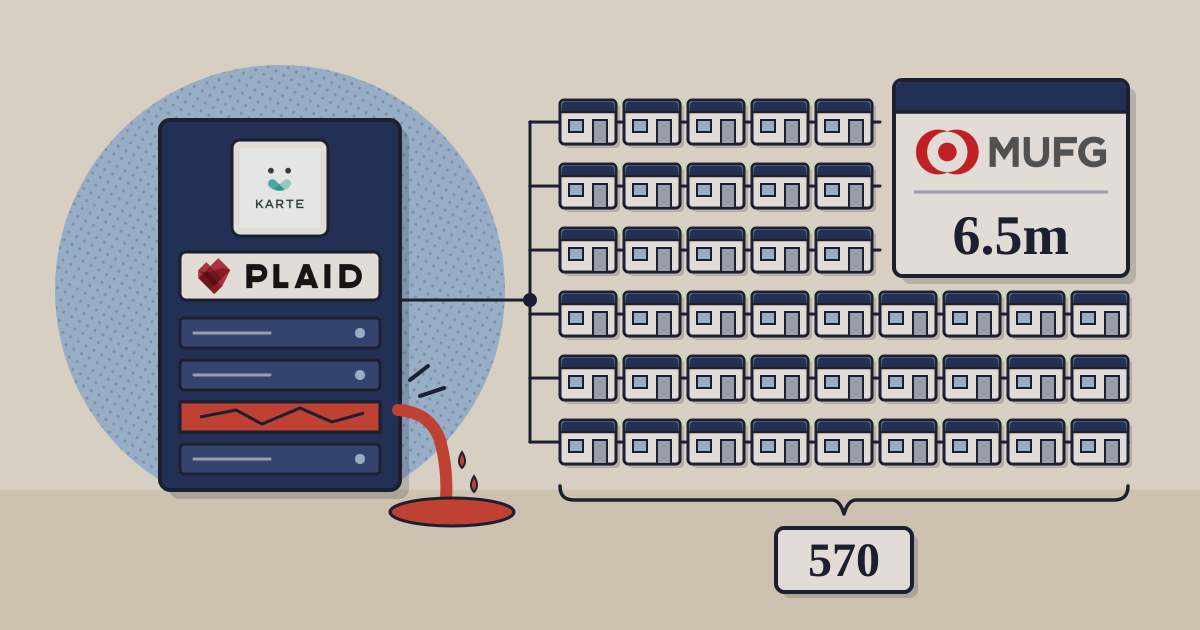
A bank that shows a customer the right notice in its app, or a retailer that emails a member about a sale, often does it through a platform it does not run. In Japan, hundreds of companies did it through one: KARTE. We read Plaid’s three notices, its two exchange filings of 20 November and the notices of 13 clients, in Japanese, to answer four questions: what KARTE held and why, what each client lost, how the attacker got in and what should not have been there, and what a company using such a platform can check.
01570 companies' customer data, 754 companies' keys
Plaid says it finished its own investigation by 19 November and fixed the scope and the counts. The data entrusted to it by companies that leaked, or may have leaked, falls into four groups, and how much of each a company lost “differs by company”. The first group is the one KARTE’s clients chose to send: data a company holds about its own customers, such as membership records, linked into KARTE to be used there. That reached 570 companies. The widest group is the integration credentials, the keys and passwords that connect KARTE to other services such as email delivery: 754 companies. They contain no personal data.4
Four kinds of client data left KARTE, each touching hundreds of companies
Companies affected by each category of data that leaked or may have leaked from KARTE, as Plaid counted them by 19 November 2026
570
Customer data the companies linked into KARTE (member records and the like)
Plaid
487
Analytics data: end users' clicks and views, and data built from them
Plaid
409
Cache data with end-user identifiers, an estimated maximum
Plaid
754
Credentials connecting KARTE to other services; no personal data
Plaid
Source: Plaid, investigation results (TDnet and plaid.co.jp, 20 Nov 2026) · as of 20 November 2026 · A company can sit in several categories; Plaid says the counts do not add to a total
The analytics group is the record of what end users did on a company’s website or app, such as pages viewed and buttons clicked, and data created from it, such as a member’s rank: 487 companies. The cache group is the hardest to count. A cache is temporary data KARTE generates to process events in real time; it is overwritten within a short time, so the contents during the attack cannot be rebuilt, and no log shows which entries were read. Plaid therefore treats everything that may have been in the cache at the time as possibly leaked, up to 409 companies.34
Plaid’s footnote matters: “Some companies fall into more than one category, so the sum of the companies in each category does not match the total number of companies affected.” It gives no total. Some Japanese coverage has added the four to a cumulative “2,200 companies”; that counts category entries, not companies.423
02What KARTE does, and why one breach reached so many
Plaid describes KARTE, launched in March 2015, as a service that lets a company understand each end user’s situation and respond to it across its website, app and email, the way a shop assistant reacts to a customer at the counter. Its examples: a travel company sending pre-departure guidance matched to a booking, or a retailer pointing an app user to a nearby store that has the item in stock. To do that, KARTE processes behaviour data as it happens and, depending on each client’s settings, links in the client’s own member data. So it holds both what companies entrust to it and what it records and generates from their users’ behaviour.34
KARTE held four kinds of client data, and each was a separate way to lose it
How customer data reaches a platform such as KARTE, with the companies Plaid counts in each category, November 2026
- 01
A tag on the site
KARTE records what each visitor views and clicks on the client’s website or app, and builds data from it, such as a member’s rank. Analytics data: 487 companies.
- 02
Member data linked in
The client uploads fields it chooses from its own customer records, through KARTE’s “linking table” and similar features. Linked data: 570 companies.
- 03
A real-time cache
To answer fast, KARTE keeps short-lived working data carrying end-user identifiers. Nobody can tell which entries were read. Cache data: up to 409 companies.
- 04
Keys to other services
Secret keys and access tokens let KARTE drive email delivery and other tools on the client’s behalf. Credentials: 754 companies.
Source: Plaid, notices of 16 and 20 Nov 2026 · as of 20 November 2026
The scale sits in Plaid’s own results. On 12 November, the day before the attack, it reported that KARTE analysed the behaviour of more than 1.2 billion monthly active users in September, summed across every site and app running it, so it is not a count of people. Revenue in the twelve months to September was ¥16.41bn, up 22.5%.67 The clients’ notices show what they used it for: MUFG Bank for guidance to customers on its website and apps, SMBC for displaying and sending notices in its website and app, JINS for newsletters, Shimamura for email and LINE messages, WealthNavi for pop-up notices in its app.911131520
03Each client's count is its own, and so is what left
Plaid names no clients; the clients named themselves. From 16 November dozens of companies published notices, from banks and a newspaper to retailers, a crowdfunding site and a mobile operator. Their counts use different units. DHC counts records (件), JINS counts registered accounts as a maximum, ZOZO and WealthNavi count people, and GDO says its 6,974,506 includes duplicates.1011121620
Nine clients each report more than 5 million customer records lost through KARTE
Largest count in each client's own notice, millions, published 17 to 20 November 2026; units differ by company
Show tableHide table
| Company (notice) | Count, as stated | What left | Not in it, as stated |
|---|---|---|---|
| DHC (18 Nov) | About 19.11m records | Name, email, date of birth, age, gender, member ID, newsletter settings | Card data, shop password |
| JINS (17 Nov) | About 18.29m accounts, all registered; a maximum | Member ID, email, surname, date of birth, age, gender, postcode, prefecture | Passwords, card data |
| ZOZO (20 Nov) | ZOZOTOWN about 15.18m people, incl. former members; WEAR about 13.93m | Member ID, age, gender, postcode; for about 47,000 also display name, email, phone | Passwords |
| SMBC (20 Nov) | Up to about 14m | Date of birth, age band, gender, whether a phone is registered, notice flags | Name, contact details, account numbers, PINs, logins |
| Marui Group (20 Nov) | Marui about 8.83m; Epos Card about 8.5m | Marui: name, gender, date of birth, email. Epos: customer number, gender; about 60,000 may include name, age, income, cash-advance limit | Card numbers, PINs |
| Shimamura (17 Nov) | About 7m members; about 50,000 family entries | Date of birth, gender, prefecture, postcode; children's birth year and month | Name, phone, full address, card data (never in KARTE) |
| GDO (17 Nov) | Up to 6,974,506, incl. duplicates | Identifier, birthday or birth month, age group, postcode, mail preferences | Name, email, phone, payment data |
| MUFG Bank (18 Nov) | About 6.5m | Gender, age, region (prefecture or major city) | Anything that identifies or contacts a customer |
| CAMPFIRE (18 Nov) | 5,819,779 | Email address, hashed user ID | Name, address, phone, password, card and account data (never sent) |
| Canon Marketing Japan (20 Nov) | About 3.66m, may have leaked | Member ID, prefecture, city, postcode, age, date of birth, gender, newsletter status | Name, phone, email, card data |
| Optage, mineo (18 Nov) | Up to 1.42m | Email, gender, age group, postcode, prefecture, birthday or anniversary, option start dates | Payment data, ID documents, logins (never sent) |
| WealthNavi (18 Nov) | About 910,000 people | Customer code, birth year and month, prefecture | Name, address, email, phone, ID images, logins (never sent) |
Source: Each company's own notice (sources 9 to 20) · as of 20 November 2026 · Not additive: one person can be a customer of several clients; labels as each company gives them
The column that decides how much harm a leak can do is the third. MUFG Bank’s 6.5 million records are gender, age and region, which it says “do not include information that lets a third party identify a customer or contact them”. SMBC’s cannot be tied to names; WealthNavi sent only a customer code, birth month and prefecture; Nikkei and CAMPFIRE hashed what they sent. DHC and Marui sent names and email addresses, and those left with the rest.9101314172021
04How the attacker got in, and data that should have been gone
Plaid has described the entry twice. On 16 November: in the early hours of 13 November a third party exploited a vulnerability in its servers to steal credentials for connecting to its systems and databases, read data out of them, and used the stolen credentials to take over Plaid’s own accounts and reach KARTE’s management screens. On 20 November, more precisely: the attacker tried several routes intermittently, and finally exploited a flaw in the internal processing of part of a public route used to retrieve data. Plaid detected the access at 08:59, began shutting servers down at about 14:27 and had cut off the attacker’s traffic and revoked the stolen credentials by about 15:23. It has seen no new access since. It names no attacker, and neither do we.24
Clients learned their data had left two days after the shutdown; Plaid's counts came a week after it
Steps in the KARTE breach from Plaid's and its clients' notices, Japan time, 13 to 24 November 2026
Show tableHide table
| Date | Event | Detail |
|---|---|---|
| 13 Nov 2026 | Intrusion found; KARTE shut down | Detected 08:59; servers stopped from about 14:27; contained by about 15:23 |
| 14 Nov 2026 | WealthNavi cuts its link | Data link stopped, KARTE credentials revoked; DHC, ZOZO and GDO say they acted on the 13th |
| 15 Nov 2026 | Clients told data left | JINS, ZOZO, GDO and Nikkei say Plaid reported it that day |
| 16 Nov 2026 | Plaid confirms a leak | 79,249 login emails, integration keys, linked customer data; no counts yet |
| 17 Nov 2026 | Clients publish | JINS up to about 18.29m accounts; Shimamura about 7m; GDO |
| 18 Nov 2026 | MUFG Bank: about 6.5m | DHC: about 19.11m records |
| 20 Nov 2026 | Plaid: 570, 487, 409, 754 | Former clients' data included; restart mid-January; forecast cut |
| 24 Nov 2026 | Detailed data to clients | Plaid's planned start of company-by-company files |
Source: Plaid, notices of 13, 16 and 20 Nov; JINS, ZOZO, GDO, WealthNavi, MUFG Bank, DHC notices · as of 20 November 2026
The 20 November notice also corrected the 16 November one. That had called the affected companies “client companies”; in fact they include companies whose contracts had ended in whole or in part.4
Under our terms of use, this information should have been deleted once the contract or use ended, but it was kept because of failings in human operations and in our management system.
Plaid has not deleted that data yet: it says the records must be preserved for the forensic investigation by an outside body that will precede the restart, and that it will delete them when that investigation ends. It has not said how many of the 570 companies were former clients, or how long their data had stayed. It warns that its contact details for former clients may be out of date and asks them to write to a dedicated address.4
The keys are the other open risk. Plaid asked every client using KARTE’s integrations to revoke the credentials, warning that otherwise an attacker could reach the connected services and cause “unintended writing or leaking of data” there. Plaid gives no count of keys, only of companies: 754.24
05A January restart, fees waived, a ¥2.6bn swing to loss
Plaid has decided that blocking the route in is not enough: it says KARTE needs a rebuild of its system structure to stay hardened over the longer term, with verification by a third party, and has set mid-January 2027 as the target for a phased restart. It will not charge for November or for the rest of the shutdown. Its measures to prevent a repeat, including deletion after contracts end, will follow the investigation.34 Some clients have set their own terms: Optage says it will not use KARTE again until it has confirmed its safety, and WealthNavi says it will review what it links before any restart.1920
The same afternoon Plaid cut its forecast for the 15 months to 31 December 2026, a longer year while it moves its year-end from September. Revenue: ¥18.5bn, down from ¥20.8bn. Operating result: a ¥900m loss instead of a ¥1.6bn profit. Net result: a ¥2.0bn loss instead of a ¥600m profit, a swing of ¥2.6bn. It gives the waived fees as the reason.5
Plaid closed Friday at ¥338, down 13.1% on the day, on 14.43 million shares traded against 1.22 million on 13 November; Kabutan puts its market value at ¥14.0bn.22
Three things to watch: the company files Plaid starts sending on 24 November, and the notices they will prompt; whether the mid-January restart holds; and how many of the 570 were former clients. The same shape of breach ran through ARARA’s mailing service and its 380 clients, through one booking system and ten airlines, and through the vendor breaches at Chase, Visa and Mastercard.
Sources
- Plaid: report on unauthorised access to our service (Japanese) — 13 November 2026 Last updated 20 November 2026.
- Plaid: apology and notice on the leak of information possibly including personal data through unauthorised access (Japanese) — 16 November 2026
- Plaid: results of our investigation into the unauthorised access to KARTE, and the outlook for restarting the service (Japanese) — 20 November 2026
- Plaid: investigation results on the unauthorised access to KARTE and the outlook for restart (TDnet, Japanese) — 20 November 2026
- Plaid: notice of revision to the earnings forecast for the period to December 2026 (TDnet, Japanese) — 20 November 2026
- Plaid: summary of consolidated results, fourth quarter of the period to December 2026 (Japanese) — 12 November 2026
- Plaid: results presentation, fourth quarter of the period to December 2026 (Japanese) — 12 November 2026
- Plaid: progress updates on the unauthorised access (Japanese) — 17 to 19 November 2026
- MUFG Bank: unauthorised access to a service provided by our contractor (Japanese) — 18 November 2026
- DHC: apology and notice on the leak of customer information through unauthorised access to KARTE (Japanese) — 18 November 2026
- JINS Holdings: personal data leak through unauthorised access at a subsidiary's contractor (TDnet, Japanese) — 17 November 2026
- ZOZO: unauthorised access to the external service KARTE used by the company (Japanese) — 20 November 2026
- Sumitomo Mitsui Banking Corporation: information leak through unauthorised access at a contractor (Japanese) — 20 November 2026
- Marui Group: partial leak of customers' personal data through unauthorised access to KARTE (Japanese) — 20 November 2026
- Shimamura: leak of some member information through unauthorised access to KARTE, first report (Japanese) — 17 November 2026
- Golf Digest Online: leak of customer information through unauthorised access to KARTE (Japanese) — 17 November 2026
- CAMPFIRE: unauthorised access to the KARTE mail system, second report (Japanese) — 18 November 2026
- Canon Marketing Japan: unauthorised access to a service provided by our contractor (Japanese) — 20 November 2026
- Optage: customer information leak following unauthorised access at Plaid (Japanese) — 18 November 2026
- WealthNavi: unauthorised access at our contractor (Japanese) — 18 November 2026
- Nikkei Inc.: possible leak of personal data through unauthorised access to a contractor's external service (Japanese) — 17 November 2026
- Kabutan: Plaid (4165) daily share prices and market value (Japanese; TSE data) — read 21 November 2026 Closes to Friday 20 November.
- isotop news: Plaid's information leak reaches a cumulative 2,200 companies (Japanese) — 21 November 2026
- Digital Personal Data Protection Act, 2023, sections 8(1), 8(5), 8(6), 8(7) — 11 August 2023
- MeitY, Digital Personal Data Protection Act, 2023 and DPDP Rules, 2025 (notified 13 November 2025; Rule 7 from 13 May 2027) — 13 November 2025
- CERT-In, Directions under section 70B(6) of the IT Act (six-hour reporting; Annexure I items xi and xii, Data Breach and Data Leak) — 28 April 2022
Disclosure. TechBag is a software reseller: it earns when companies buy through it, including from vendors named here. The analysis is TechBag’s own; no vendor paid for or saw this piece before publication. Facts are labelled reported, TechBag count or our view.
Keep reading