Korea’s KOSPI is 48% below its June high; Taiwan 26%, Japan 22%, India 3.7%
Exchange closes to Monday 23 November: how far four Asian markets have fallen from their 2026 highs, how far each rose first, and what Seoul and Taipei did about it.

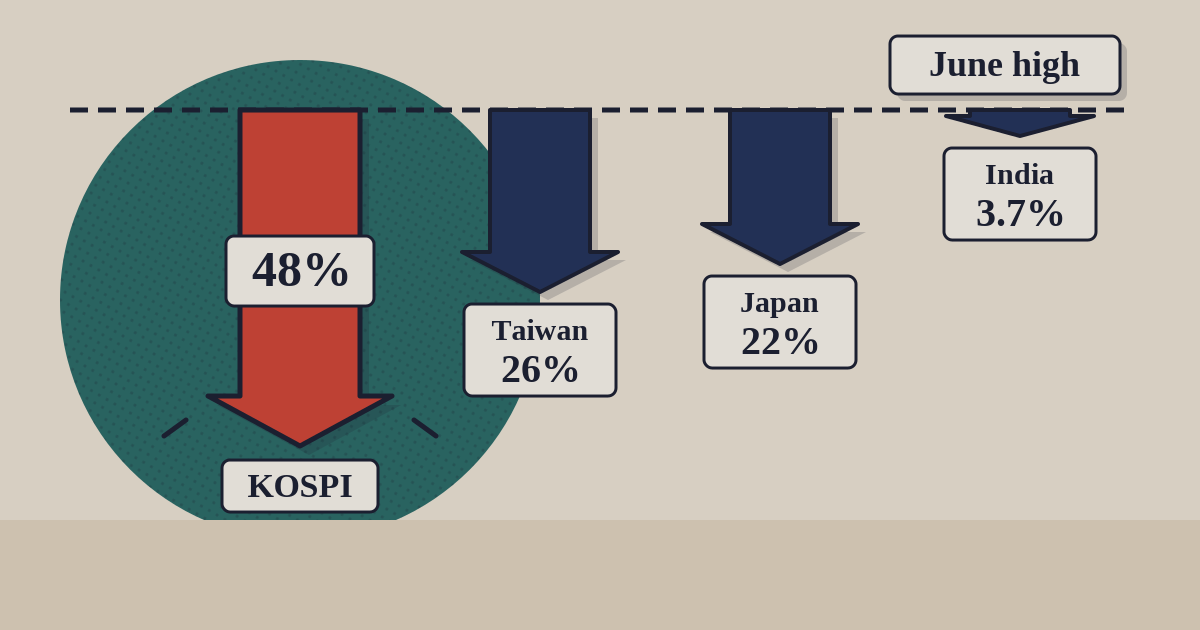
Last week, as our Trend on AI stocks’ worst week set out, the Nasdaq fell 10% and every large Asian market fell with it. On Monday Asia split again: Seoul fell, Taipei rose under its new short-selling curbs, Mumbai fell and Tokyo was shut. A single day says little. The useful measure is how far each market now sits below its own high for the year, and how far it climbed to get there. We put the four on one scale: each index as a share of its 2026 closing high.
01Four markets on one scale
The KOSPI ended 2025 at 4,214.17 and more than doubled in under six months, to 9,114.55 on Monday 22 June. The next day it fell 9.99%, and it has not been back. Monday’s close is its lowest since 13 January, when it ended at 4,692.64, so the index has given back almost everything it gained this year.12 The Nikkei peaked in the same week, at 72,366.34 on 25 June.6 Taiwan kept climbing until 6 October, to 49,822.55; most of its fall since then came in November.5
Korea's KOSPI has fallen to half its June high; India's Nifty is back near its January peak
KOSPI, TAIEX, Nikkei 225 and Nifty 50, weekly closes as a share of each index's 2026 closing high (high = 100), 2 January to 23 November 2026
- KOSPI
- TAIEX
- Nikkei 225
- Nifty 50
Show tableHide table
| KOSPI | TAIEX | Nikkei 225 | Nifty 50 | |
|---|---|---|---|---|
| 2 Jan | 47.3 | 58.9 | 69.6 | 100 |
| 9 Jan | 50.3 | 60.8 | 71.8 | 97.5 |
| 16 Jan | 53.1 | 63 | 74.5 | 97.6 |
| 23 Jan | 54.7 | 64.2 | 74.4 | 95.1 |
| 30 Jan | 57.3 | 64.4 | 73.7 | 96.2 |
| 6 Feb | 55.8 | 63.8 | 75 | 97.6 |
| 13 Feb | 60.4 | 67.5 | 78.7 | 96.7 |
| 20 Feb | 63.7 | 67.5 | 78.5 | 97.1 |
| 27 Feb | 68.5 | 71.1 | 81.3 | 95.6 |
| 6 Mar | 61.3 | 67.4 | 76.9 | 92.9 |
| 13 Mar | 60.2 | 67 | 74.4 | 87.9 |
| 20 Mar | 63.4 | 67.3 | 73.8 | 87.8 |
| 27 Mar | 59.7 | 66.5 | 73.8 | 86.7 |
| 3 Apr | 59 | 65.4 | 73.4 | 86.3 |
| 10 Apr | 64.3 | 71.1 | 78.7 | 91.3 |
| 17 Apr | 67.9 | 73.9 | 80.8 | 92.5 |
| 24 Apr | 71 | 78.1 | 82.5 | 90.8 |
| 1 May | 72.4 | 78.1 | 82.2 | 91.1 |
| 8 May | 82.3 | 83.5 | 86.7 | 91.8 |
| 15 May | 82.2 | 82.6 | 84.9 | 89.8 |
| 22 May | 86.1 | 84.8 | 87.5 | 90.1 |
| 29 May | 93 | 89.8 | 91.7 | 89.4 |
| 5 Jun | 89.5 | 90.5 | 92 | 88.8 |
| 12 Jun | 89.1 | 88.7 | 91.2 | 89.7 |
| 19 Jun | 99.3 | 93.3 | 98.5 | 91.2 |
| 26 Jun | 92.3 | 89.5 | 95.8 | 91.4 |
| 3 Jul | 88.7 | 93.9 | 96.4 | 92.2 |
| 10 Jul | 82 | 91 | 94.7 | 91.9 |
| 17 Jul | 74.8 | 85.6 | 88.6 | 92.4 |
| 24 Jul | 73.4 | 87.6 | 89.3 | 90.3 |
| 31 Jul | 72.4 | 86.5 | 88.9 | 92.6 |
| 7 Aug | 68.7 | 88.8 | 90.7 | 93.3 |
| 14 Aug | 76.6 | 91.9 | 95 | 92.5 |
| 21 Aug | 75.8 | 90.8 | 91.2 | 92.1 |
| 28 Aug | 74.5 | 93 | 91.8 | 91.8 |
| 4 Sep | 73.4 | 93.4 | 89.8 | 90.8 |
| 11 Sep | 75.8 | 92.7 | 88.5 | 88.9 |
| 18 Sep | 75.6 | 94.7 | 89.8 | 88.7 |
| 25 Sep | 77.7 | 96.4 | 91.7 | 87.9 |
| 2 Oct | 76.8 | 97.3 | 94.4 | 85.2 |
| 9 Oct | 72.7 | 99 | 95.4 | 85.5 |
| 16 Oct | 62.2 | 94.6 | 90.3 | 87.9 |
| 23 Oct | 60.9 | 92.4 | 86.6 | 85.8 |
| 30 Oct | 62.9 | 90.7 | 87.5 | 87.6 |
| 6 Nov | 55.5 | 79.7 | 79.4 | 95.1 |
| 13 Nov | 58 | 87.7 | 84.5 | 95.5 |
| 20 Nov | 53.4 | 72.3 | 78 | 98 |
| 23 Nov | 51.7 | 73.9 | 78 | 96.3 |
Source: Naver Finance (KRX-derived KOSPI series); Taiwan Stock Exchange; Nikkei Inc.; NSE · as of 23 November 2026 · last close of each week, plus Monday 23 November; Tokyo was shut on 23 November and 2 January, so the Nikkei carries its previous close. Peaks reached mid-week show just under 100
India’s line runs the other way. The Nifty 50 closed at its 2026 high, 26,328.55, on 2 January, fell to 22,231.80 on 8 October, and has since risen 14.0%, most of it in November, while the other three fell.8 Our Trend on November’s foreign buying shows foreign funds bought a record ₹1,22,265 crore of Indian shares in the month to 20 November, on NSDL’s data.
02Monday, market by market
Seoul. The KOSPI opened 2.77% lower and fell as far as 4,586.80. At 11:33am program trading in KOSPI shares was suspended for five minutes, a “sidecar” the Korea Exchange triggers when KOSPI 200 futures fall 5% or more for a minute; it was the second session in a row.3 Decliners outnumbered gainers 823 to 69; Samsung Electronics fell 3.06% to ₩177,500 and SK hynix 2.52% to ₩1.09m, Yonhap reported.2 Foreign investors were net sellers for a seventh straight session.4
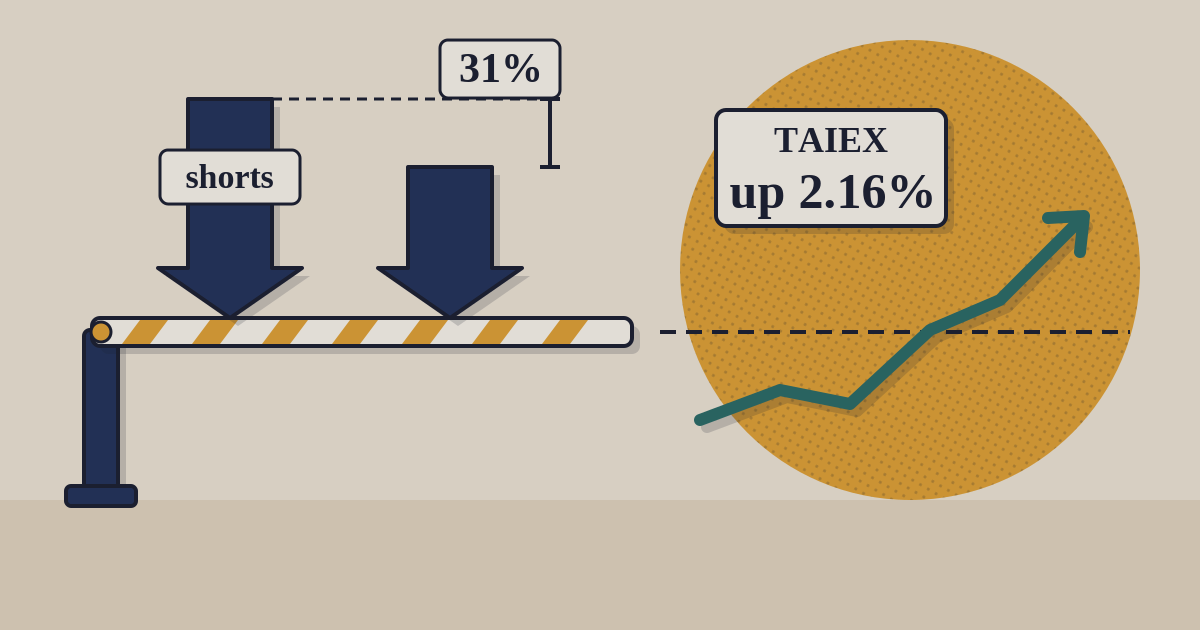
Taipei. The TAIEX rose 2.16% to 36,811.89 on the first day of the ban on short sales priced below the previous close, after a low of 35,442.41.5 Our Note on the day has the short-sale figures. Tokyo was shut for Labor Thanksgiving Day, so the Nikkei’s latest close is Friday’s 56,436.65.67 Mumbai. The Nifty 50 fell 1.75% to 25,349.65 and the Nifty Bank 3.17% to 62,585.35, while the Nifty IT index rose 1.69% to 31,850.80.8
The KOSPI is 48% below its 2026 high, nearly twice Taiwan's fall and 13 times India's
Fall from each index's 2026 closing high to its latest close, %, as of 23 November 2026 (Nikkei 225: 20 November)
Source: Naver Finance (KRX-derived KOSPI series); Taiwan Stock Exchange; Nikkei Inc.; NSE · as of 23 November 2026 · TechBag arithmetic on closing levels
03What officials did, and what to watch
Korea’s government held an emergency market meeting on Sunday 22 November. In its own words, markets had turned more volatile “due to concerns and uncertainties over the global artificial intelligence and semiconductor industries and potential interest rate hikes in the U.S.” On Monday the Financial Services Commission lifted the daily limit on listed companies buying their own shares from 24 November to 23 February 2027.9 Until now a company buying directly could buy each day no more than the smaller of 1% of its issued shares and the larger of “10% of acquired shares” and 25% of its daily trading volume in the month before the board resolution. For those three months the only limit is the total the board approved; buybacks through a trust are limited by the money entrusted, not 1% of the shares.9 Yonhap reported that about ₩10tn of a stock stabilisation fund is ready to be used if needed, which would be its first use since 2008.10
In Taipei, the stock exchange said that from Tuesday it will send margin calls only when an account’s collateral falls below 120% of its borrowing, not 130%, and will cancel calls already issued under the old line, so brokers will not sell those investors’ shares.11 That works on the forced selling that our Analysis of Taiwan’s worst week since 1991 found in the exchange’s tables: margin loans fell 18.9% in that week.
What to watch.
- The KOSPI’s start-of-year level. At 4,708.54 the index is 11.7% above its 2025 close of 4,214.17; below that, Korea’s year turns into a loss.
- Buybacks in Seoul. Whether companies file buyback plans from Tuesday, which their disclosures will show, and whether the stabilisation fund is switched on.
- Tokyo on Tuesday. The Nikkei’s first session since Friday will put Japan on the same date as the others.
- India’s gap. Whether foreign buying in India continues while Seoul and Taipei fall: NSDL publishes it daily.
Sources
- Naver Finance, KOSPI daily index series (KRX-derived), 2 January to 23 November 2026 — 23 November 2026 quote data, not a primary source
- Yonhap News Agency, (2nd LD) Seoul shares plunge over 3 pct on AI jitters — 23 November 2026, 4:36pm KST
- Yonhap News Agency, Bourse operator activates sell-side sidecar for KOSPI on sharp fall — 23 November 2026, 11:38am KST
- Yonhap News Agency, Korean won hits 2-week low against U.S. dollar on risk aversion sentiment — 23 November 2026, 4:17pm KST
- Taiwan Stock Exchange, TAIEX historical data (MI_5MINS_HIST), monthly tables January to November 2026 (November shown) — 23 November 2026
- Nikkei Inc., Nikkei Stock Average daily data (CSV) — 20 November 2026
- Japan Exchange Group, market holidays calendar — 2026
- NSE Indices, closing values of all indices, 23 November 2026 (with the files of 31 December 2025, 2 January, 8 October and each week's last session) — 23 November 2026
- Financial Services Commission (Korea), FSC eases rule on daily buying order limit on treasury stock buyback of listed companies for three months — 23 November 2026
- Yonhap News Agency, Daily share buyback limit to be lifted for 3 months amid market rout — 23 November 2026, 2:50pm KST
- Taiwan Stock Exchange, 自115年11月24日起,信用交易擔保維持率最低標準由130%調降至120% (minimum margin maintenance ratio cut from 130% to 120% from 24 November; Chinese) — 23 November 2026, 2:50pm Taipei
- Yahoo Finance, Nifty 50 (^NSEI) daily history, used to locate the 2026 high — 23 November 2026 quote service, not a primary source
Disclosure. TechBag is a software reseller: it earns when companies buy through it, including from vendors named here. The analysis is TechBag’s own; no vendor paid for or saw this piece before publication. Facts are labelled reported, TechBag count or our view.
Keep reading