Buying software in IndiaAnalysis
Only 25 of 449 business tools we track start free; Dropbox's payers are 2.6%
TechBag's count of free tiers across 449 products in its category guides, Dropbox's Q2 2026 paying-user figures, and where free plans stop, as of September 2026.

In April 2023 this blog explained the freemium model from the seller’s side: attract a large free base, convert some of it, mind the costs. It named Dropbox, HubSpot and Hootsuite as examples. The question an Indian business actually brings to a free plan is the buyer’s version: can we run on this, and what happens when we cannot? This piece answers it with a count of where free tiers exist in the software TechBag tracks, one public company’s conversion arithmetic, and the four places free plans stop.
01Free tiers live in IT operations and developer tools, not in security
TechBag’s category guides carry a row for every product they compare, each with a published price, a pricing unit or “quote”. We read every row as the guides stood on 30 September 2026 and marked those that name a free tier, a free edition or a price starting at zero.
A quarter of service desks and a fifth of developer tools start free; fourteen guides have no free tier at all
Share of product rows naming a free tier or free edition, by TechBag category guide, as of 30 September 2026, %
Source: TechBag count of its category guides at the 30 September 2026 commit · as of 30 September 2026 · a product listed in two guides is counted in each
The security rows that do start free are mostly open source or open core: Wazuh, Elastic Security and Elastic Defend, Xcitium OpenEDR, HashiCorp Vault, and Cloudflare’s zero-trust plan. None of the identity, privileged-access, email-security, DLP, DSPM or managed detection products in the guides offers one.1
The opposite of freemium is the more common model. Nearly half of all rows, 225 of 493, print no price at all and ask the buyer to request a quote. Between the two sits the large middle: a published per-seat or per-device price, sometimes with a time-limited trial, which lets a team test the product without the vendor committing to support free users for ever.1
02The funnel is narrow, and it is supposed to be
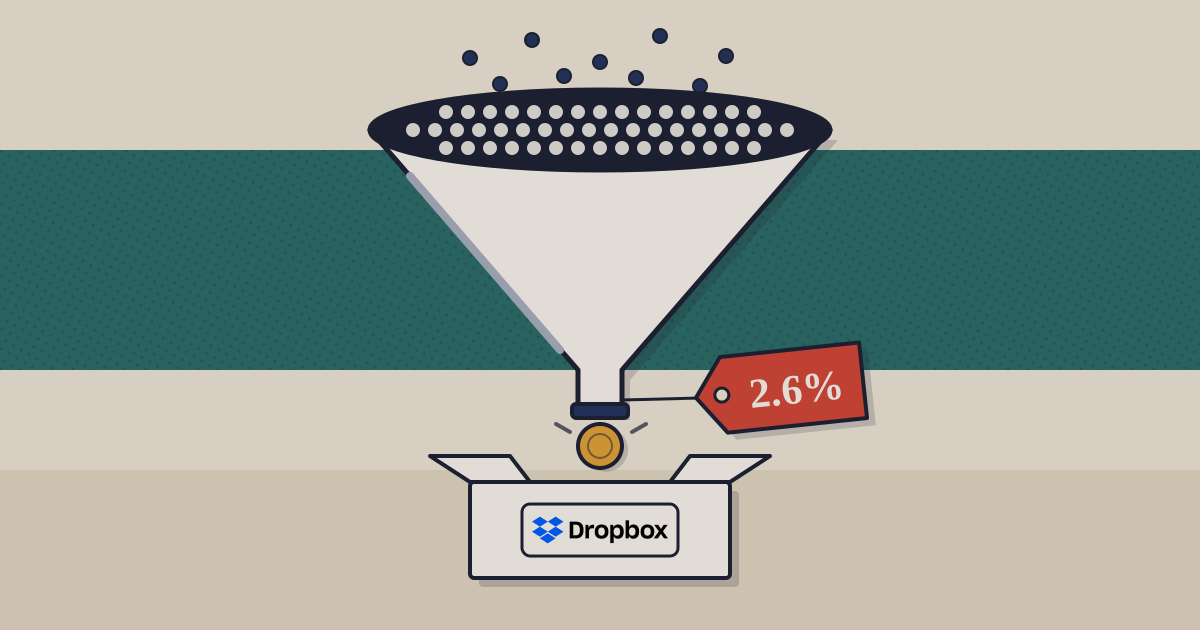
Dropbox is the rare freemium company that publishes both ends of its funnel. Its second-quarter 2026 results reported 18.19 million paying users, against 18.13 million a year earlier, at an average of US$139.68 a year each; the same release describes more than 700 million registered users.2 The free plan, Dropbox Basic, is 2 GB of storage on up to three devices.3
At most one Dropbox registered user in 38 pays; the other 97 squares are the shop window
Dropbox paying users as a share of registered users, quarter to 30 June 2026, % (upper bound)
2.6%
Registered users who pay, at most
18.19m paying (18.13m a year earlier) of 700m+ registered; US$139.68 a year each
Source: Dropbox, second-quarter 2026 results (Form 8-K, exhibit 99.1) · as of 6 August 2026 · paying share is TechBag arithmetic: 18.19 million ÷ 700 million; one square is 1%
The 2023 post listed “revenue constraints” as a drawback of freemium. Dropbox shows what that means in practice: a free base of hundreds of millions, a paying base that grew by about 60,000 in a year, and total revenue up 0.9% to US$631.5 million for the quarter. The free base is no longer the growth engine; it is the shop window.2
HubSpot, the second 2023 example, runs a different kind of funnel. Its free CRM is not a cut-down product to be outgrown on storage; it is the database the paid hubs are sold on top of. Two users and 1,000 contacts is enough to put a small sales team’s pipeline in it.4 Once the pipeline lives there, the paid tiers for marketing, sales and service are upgrades to a system the team already depends on, which is a stronger position for the vendor than any storage cap. The cost of leaving grows with every record, and that is the part of a free CRM a buyer should price.
03Where the free tier stops
Every free tier ends somewhere, and the line is the vendor’s real price list. In the rows we counted, the limits fall into four kinds. Knowing which kind you are on tells you when the invoice arrives.
Free plans stop at a seat, a volume, a storage line, or the vendor's decision
Free-tier limits printed by vendors in TechBag's guides and on their own pages, as of September 2026
- 01
Seats
Postman’s API client is free for one user, then US$19 a user on Team. HubSpot’s free CRM allows two users and 1,000 contacts.
- 02
Volume
Action1 is free to 200 endpoints; HCP Terraform to 500 managed resources; SonarQube Cloud to 50,000 lines and five members.
- 03
Storage and history
Dropbox Basic stops at 2 GB and three devices. Sonatype’s free Nexus pauses new components past its 40,000 cap.
- 04
Withdrawal
Hootsuite ended its free plan on 31 March 2023, a month before our post named it as a freemium example.
Source: TechBag developer tools, RMM & patch and remote access guides; Dropbox, HubSpot; Canadian Press · as of 30 September 2026
Seat limits are the friendliest: you know the day you hire the next person. Volume limits arrive with growth and are easy to miss, because nobody watches the endpoint or resource count until the tool stops. Postman, Terraform, SonarQube and Sonatype’s figures come from TechBag’s developer tools guide6; Action1’s from the RMM and patch guide7; and the ManageEngine Remote Access Plus free edition, for ten computers, from the remote access guide.8 HubSpot’s free CRM terms are on its own pricing page.4
Three habits keep a free tier from becoming a surprise. First, write down the limit that will bind first, whether seats, endpoints, contacts or storage, and the month you expect to reach it. Second, find out what happens at the limit: some tools stop, some pause new data, some keep working and bill you. Third, export something once, early, so you know the way out works before you need it. None of this costs money; all of it is easier while the account is small.
04The three 2023 examples, re-checked
The original post named three companies that ran freemium well. Read against their own pages in 2026, two still do, and the third had already stopped.
One of the three freemium examples we cited in 2023 had already ended its free plan
Free plans of Dropbox, HubSpot and Hootsuite, as described in April 2023 and as they stood in September 2026
What the 2023 post said
- Dropbox: a free version with limited storage
- HubSpot: free marketing and sales software with limited features
- Hootsuite: a free version of its social media tool
What holds in September 2026
- Dropbox Basic: 2 GB on up to three devices; at most 2.6% of registered users pay
- HubSpot: free CRM for two users and 1,000 contacts; paid tiers per seat
- Hootsuite: free plan ended 31 March 2023; paid plans only
Source: Dropbox and HubSpot pricing pages; Canadian Press on Hootsuite · as of 30 September 2026
Hootsuite’s decision, reported in February 2023, is the useful one. The company said it removed the free plan so its plan structure would match the product’s growth, and free users had to pay or leave.5 A team that learned of it from those February reports had about five weeks to move a social media workflow or start paying. That is the buyer’s version of the freemium risk the 2023 post did not discuss.
Sources
- TechBag count, product rows in the /browse category guides (493 rows, 449 products, 28 rows with a free tier) — guides as of 30 September 2026
- Dropbox, Second Quarter 2026 Results (18.19m paying users; ARPU US$139.68; more than 700m registered users) — 6 August 2026
- Dropbox, Dropbox Basic (2 GB, up to three devices) — undated page
- HubSpot, CRM pricing (free for up to two users; 1,000 contacts) — undated page
- The Canadian Press via Energeticcity, Hootsuite to ditch free plan, begin charging users — 24 February 2023
- TechBag, Developer tools guide (Postman, HCP Terraform, SonarQube Cloud, Sonatype free tiers) — reviewed 24 August 2026
- TechBag, RMM & patch guide (Action1 free to 200 endpoints) — as of 30 September 2026
- TechBag, Remote access guide (ManageEngine Remote Access Plus free edition for ten computers) — as of 30 September 2026
- India Briefing, OIDAR services: GST and reverse charge — 29 September 2023
- CERT-In, Directions under section 70B(6) of the IT Act (180-day log retention; six-hour reporting) — 28 April 2022
- MeitY, Digital Personal Data Protection Act, 2023 and the DPDP Rules, 2025 (notified 13 November 2025; substantive duties from 13 May 2027) — 13 November 2025
Related on TechBag: the developer tools guide has the strongest free tiers we track; the RMM & patch guide shows where an endpoint allowance ends.
Disclosure. TechBag is a software reseller: it earns a margin when a reader buys through it, including from vendors named here. The analysis is TechBag’s own; no vendor paid for or saw this piece before publication. Facts are labelled reported, TechBag count or our view.
Keep reading