Buying software in IndiaAnalysis
Microsoft's cheapest seats rose the most: F1 +33%, E3 +8%, bundled VMware ends 31 October
Microsoft's 1 July 2026 list, the 1 October 5% uplift on monthly-billed CSP software, and the 31 October Azure VMware deadline, priced for a 500-seat Indian company.

Most Indian companies renew Microsoft in the October to December quarter, which is why three separate changes are landing on one purchase order this year. The question a finance or IT head is actually asking is not “did Microsoft raise prices?” but “by how much, for which seats, on which billing term, and what else moved while I was not looking?” We went through Microsoft’s own price list, its Partner Center notices and its Azure VMware Solution licensing reference, and priced the result for a 500-seat company. Three levers are pulling at once: the list price plus what is bundled into it, financing sold as a price, and a channel that has been removed.
01The cheapest seats rose the most
Microsoft announced the July 2026 change on 4 December 2025 and published the full table on its licensing site. Every enterprise suite went up by a round US$3 a seat: E3 from US$36 to US$39, E5 from US$57 to US$60, Office 365 E3 from US$23 to US$26. Because the base prices differ, the same US$3 is an 8% rise on E3, 5% on E5 and 13% on Office 365 E3.1
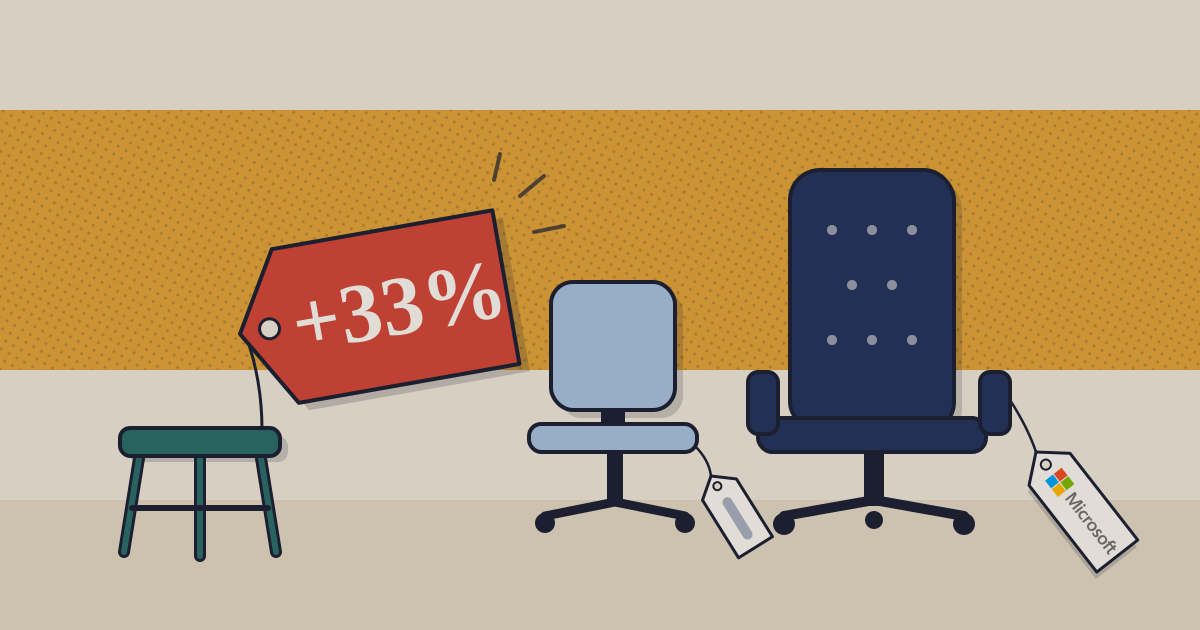
The frontline and small-business SKUs did not get a flat US$3; they got a larger share. F1 went from US$2.25 to US$3.00, a 33% rise, and the no-Teams variant from US$1.75 to US$2.50, a 43% rise. F3 rose 25%, Business Basic 16%, Business Standard 12%, Apps for business 21%. Of the 26 commercial SKUs with a stated percentage, only two moved by less than 8%: Microsoft 365 E5 and its no-Teams twin.1
The lower the seat price, the larger the rise: F1 up 33%, E3 up 8%, E5 up 5%
Percentage change in Microsoft 365 commercial list price per user per month, effective 1 July 2026 at renewal
Source: Microsoft, 2026 Microsoft 365 packaging and pricing updates (USD list); 12 of 26 priced SKUs shown · as of 16 February 2026 · the 14 SKUs not shown moved between 6% and 29%; prices may vary by country and currency
Microsoft’s justification is bundling. E3 now carries Defender for Office Plan 1, Intune Plan 2, Intune Remote Help and Intune Advanced Analytics; E5 adds Security Copilot, Endpoint Privilege Management and Cloud PKI on top. The features are real and they are rolling out through the summer of 2026.1 The buyer’s problem is that they are not optional. A company that already pays a third-party email filter and a third-party device-management tool is, from July, paying for both twice. TechBag’s UEM and MDM guide puts third-party device management at roughly US$2 to US$8 per device a month on published list prices, which is the size of the overlap a Microsoft-committed shop should now go and find.7
02A 500-seat company pays 11% more, and frontline seats drive a third of it
Here is the arithmetic for a company we would call typical of TechBag’s enquiries: 500 people, a head office of knowledge workers, two or three branches, and a field or shop-floor workforce. We have assumed 200 seats of Microsoft 365 E3 for the people who need Intune and Defender, 100 seats of Business Standard for branch and back-office staff who need desktop Office and little else, and 200 seats of F3 for frontline workers. Business plans are capped at 300 seats a tenant, so the mix is permitted. All prices are Microsoft’s USD list on an annual commitment, per user per month.1
Every seat type moved, but a frontline seat moved by a quarter and an enterprise seat by a twelfth
Microsoft 365 commercial list price, US$ per user per month on annual commitment, before and after 1 July 2026
- Before 1 Jul 2026
- From 1 Jul 2026
Table view
| Before 1 Jul 2026 | From 1 Jul 2026 | Change | |
|---|---|---|---|
| Microsoft 365 E5 | 57 | 60 | 5% |
| Microsoft 365 E3 | 36 | 39 | 8% |
| Business Standard | 12.5 | 14 | 12% |
| Microsoft 365 F3 | 8 | 10 | 25% |
| Business Basic | 6 | 7 | 17% |
| Microsoft 365 F1 | 2.25 | 3 | 33% |
Source: Microsoft, 2026 Microsoft 365 packaging and pricing updates (USD list) · as of 16 February 2026 · Microsoft India's INR list was not readable when we checked; INR prices differ and carry 18% GST
11.4%
The rise in the 500-seat company's annual Microsoft 365 bill: US$120,600 to US$134,400
TechBag arithmetic on Microsoft's USD list; the workings are below.
Two things follow. First, the blended rise on a real estate is higher than the 8% headline because few Indian companies are all-E3; the frontline and small-business seats that make up the long tail rose two to four times as fast. Second, the increase is largest exactly where the per-seat value of the bundled additions is smallest: an F3 user gets no Intune Plan 2 and no Defender for Office Plan 1 for the extra US$2, because those were added to E3 and E5, not to F3.1
031 October: paying monthly became a 5% price, and the E7 discount went away
The second lever is quieter. On 12 August 2026 Microsoft told its Cloud Solution Provider partners that “starting October 1, 2026, Microsoft applies a 5% cost of capital uplift for Cloud Solution Provider (CSP) software subscriptions (such as SQL Server, Windows Server, Client Access Licenses, and System Center) with annual-term commitments billed monthly.” There is “no change to annual billing or month-to-month subscriptions”, and for existing subscriptions the uplift “takes effect at renewal on or after October 1, 2026.”2
5%
Uplift on an annual-term CSP software subscription billed monthly, at renewal
Partner Center, 12 Aug 2026
0%
Change for annual-upfront or month-to-month terms
Partner Center, 12 Aug 2026
15%
E7 one- and three-year promotions retired on 1 Oct 2026
Partner Center, 3 Aug 2026
20%
E3 one-year targeted promotion still open to 31 Dec 2026
Partner Center, 3 Aug 2026
Read it as a finance person would. You commit to a year, you pay in twelve instalments, and Microsoft charges 5% for carrying the receivable. That is a financing charge presented as a licence price, and it is invisible unless your reseller quotes both billing terms side by side. Note the scope precisely: the notice names software subscriptions, not Microsoft 365 or Dynamics online services, and Microsoft’s FAQ on which subscriptions are in scope sits behind a partner login, so we could not read it.2 If your SQL Server or Windows Server CALs are on a monthly-billed annual term through a partner, ask for the annual-upfront quote before you renew; on a ₹10,00,000 annual software subscription the difference is ₹50,000 before GST, which is arithmetic, not a price claim.
The growth-margin point matters to a buyer because it changes what your reseller is paid for. Until September a partner earned on the sale and on the promotion; from October it earns on your usage growing. Expect more adoption workshops and fewer discounts, and treat the E3 offers that survive to December as the last transactional discount of this cycle.
0431 October: the VMware licence leaves the Azure bill and lands on a Broadcom one
The third lever is a channel being removed. Broadcom no longer lets hyperscalers resell VMware Cloud Foundation inside their own services. Microsoft’s licensing reference, updated 27 October 2026, states that “as of November 1, 2025, Microsoft no longer includes a VCF license or subscription with new Azure VMware Solution node purchases”, that on 31 October 2026 “license-included pay-as-you-go deployments must transition to portable VCF to remain compliant”, and that by 30 August 2027 holders of license-included reservations “must exchange their reservations for VCF BYOL reservations or transition those workloads off Azure VMware Solution.”3 Google required portable VCF on its VMware Engine from 1 November 2025.5
Five dates in 22 months: the list rises, monthly billing gets a price, and the VMware licence moves to Broadcom's invoice
Microsoft and Broadcom licensing milestones affecting an Indian Microsoft estate, November 2025 to August 2027
Table view
| Date | Event | Detail |
|---|---|---|
| 1 Nov 2025 | VCF no longer bundled with new AVS nodes | Every new Azure VMware Solution deployment must bring a Broadcom subscription; Google VMware Engine does the same on 1 Nov. |
| 1 Jul 2026 | Microsoft 365 list rises at renewal | E3 up 8%, E5 5%, F3 25%, F1 33%, Business Basic 16%; Defender for Office P1 and Intune P2 move into E3. |
| 1 Oct 2026 | Monthly billing costs 5%; E7 promos end | A 5% uplift on annual-term CSP software subscriptions billed monthly; E7 10% and 15% promotions retire; partner growth margins begin. |
| 31 Oct 2026 | Pay-as-you-go AVS must bring its own VCF | License-included pay-as-you-go deployments must move to portable VCF to remain compliant. |
| 30 Aug 2027 | AVS reservations exchanged or moved off | License-included reservations must be exchanged for VCF BYOL reservations, or the workloads moved off. |
Source: Microsoft Learn, portable VCF licensing reference; Microsoft Partner Center, August 2026; Microsoft licensing news; CloudTech News for the Google date · as of 27 October 2026
What this does to a bill is the point. The Azure line falls, because Microsoft stops charging for the VCF it no longer supplies, and a new Broadcom line appears, sized by physical cores. Microsoft counts 36 cores for each AV36 or AV36P host, 48 for AV48, 52 for AV52 and 64 for AV64, so a four-node AV36P private cloud needs 144 registered cores, and “the total number of registered cores must not exceed the number purchased from Broadcom”; exceed it and the private cloud “becomes noncompliant and is at risk of suspension”.3 Registration is through the Azure portal, per private cloud, and a converted private cloud switches to portable-VCF pricing without downtime.4 Broadcom has published no VMware list-price change for 2025 or 2026 and still sells per core with a 16-core minimum per CPU, so the price of those 144 cores is whatever Broadcom or its distributor quotes you.6 We have left the per-core dollar figures circulating among partners out of this piece because Broadcom does not publish them.
05Microsoft is not alone, but it is the only one that raised the bottom of its list by a third
Set the Microsoft figures beside the other renewals an Indian IT department has signed since January 2025. Google Workspace Business Starter went from US$6 to US$7 and Business Plus from US$18 to US$22 in January 2025, with Gemini bundled. Salesforce Sales Cloud Enterprise rose from US$165 to US$175 on 1 August 2025. Atlassian Cloud Standard went up 5% and Premium 7.5% on 15 October 2025, and Atlassian Data Center about 15% at renewal from 17 February 2026: a 500-user Jira Data Center licence moved from US$51,000 to US$59,000 a year.6
Across 2025–26 renewals, Microsoft's F1 rise is the largest and its E3 rise is in the middle of the pack
Published percentage increase at renewal, by vendor and SKU, January 2025 to October 2026
Source: Licenseware software price-increase tracker citing vendor notices; Microsoft licensing news; Microsoft Partner Center · as of 24 October 2026 · list-price changes only; negotiated and promotional prices excluded; no Zoho change is published
The pattern across all four vendors is the same: raise the list, attach an AI or security feature to justify it, and leave negotiated prices to the account team. What is specific to Microsoft is the shape. Google and Salesforce raised their cheapest tiers by 17% and 6%; Microsoft raised its cheapest tier by 33% and its no-Teams frontline tier by 43%.1 For a buyer that means the negotiation has moved. The E3 price is what it is, and the surviving promotions run to December. The place to push is the frontline count, the billing term, and the third-party tools that E3 now duplicates.
Sources
- Microsoft, 2026 Microsoft 365 packaging and pricing updates (commercial USD list, effective 1 July 2026) — 16 February 2026 Announced 4 December 2025.
- Microsoft Partner Center, August 2026 announcements: CSP software pricing update effective October 1, 2026 (12 Aug) and Microsoft 365 promotion updates (3 Aug) — page updated 31 August 2026 The linked cost-of-capital FAQ is behind a partner login.
- Microsoft Learn, Portable VMware Cloud Foundation licensing reference for Azure VMware Solution — 27 October 2026
- Microsoft Learn, Configure portable VMware Cloud Foundation for Azure VMware Solution — 14 August 2026
- CloudTech News, Azure VMware Solution licensing changes set October deadline — 21 August 2026 Used for the Google Cloud VMware Engine date only.
- Licenseware, Software price increases 2025–2026 tracker (Google Workspace, Salesforce, Atlassian, Microsoft, Broadcom) — updated 23 October 2026; prices checked 24 October 2026 Secondary; cites vendor notices.
- TechBag, UEM and MDM decision guide, price table (Omnissa, Scalefusion, Hexnode, Intune and others) — vendor documents, August 2026
- Taxguru, CBIC notifies CGST rate on various services w.e.f. 01.10.2021 (Notification 06/2021-Central Tax (Rate), amending Entry 17 of Notification 11/2017) — 30 September 2021 Secondary summary; the CBIC PDF was not fetched.
- Microsoft Source Asia, Microsoft's newest India datacenter region goes live (India South Central, Hyderabad) — 6 August 2026
Related on TechBag: the Microsoft 365 page compares the Business and Enterprise plans; the Omnissa hub covers the former VMware end-user products now sold separately; the JumpCloud SaaS management page is where the duplicate-licence hunt usually starts.
Disclosure. TechBag is a software reseller: it earns a margin when a reader buys through it, including from vendors named here. The analysis is TechBag’s own; no vendor paid for or saw this piece before publication. Facts are labelled reported, TechBag count or our view.
Keep reading