Buying software in IndiaAnalysis
Jio was free for 208 days, then raised prices 3 times: budget software for year two
Jio’s free launch and three tariff rises, IDrive’s 25% first-year discount and the CCI’s 2017 order, read as a buyer’s three-year budget, as of September 2026.

Our 2023 post explained penetration pricing from the seller’s side, with Netflix, Amazon and Walmart as the examples. The question it answered still matters, but most people who read TechBag sit on the other side of the table. They are offered a launch price, a first-year discount or a free tier, and must decide what it will cost in year two and year three. So this version keeps the definition, replaces the American examples with the clearest Indian one, and then shows the form the tactic takes on a software quote.
01The clearest Indian case: Jio's 208 free days
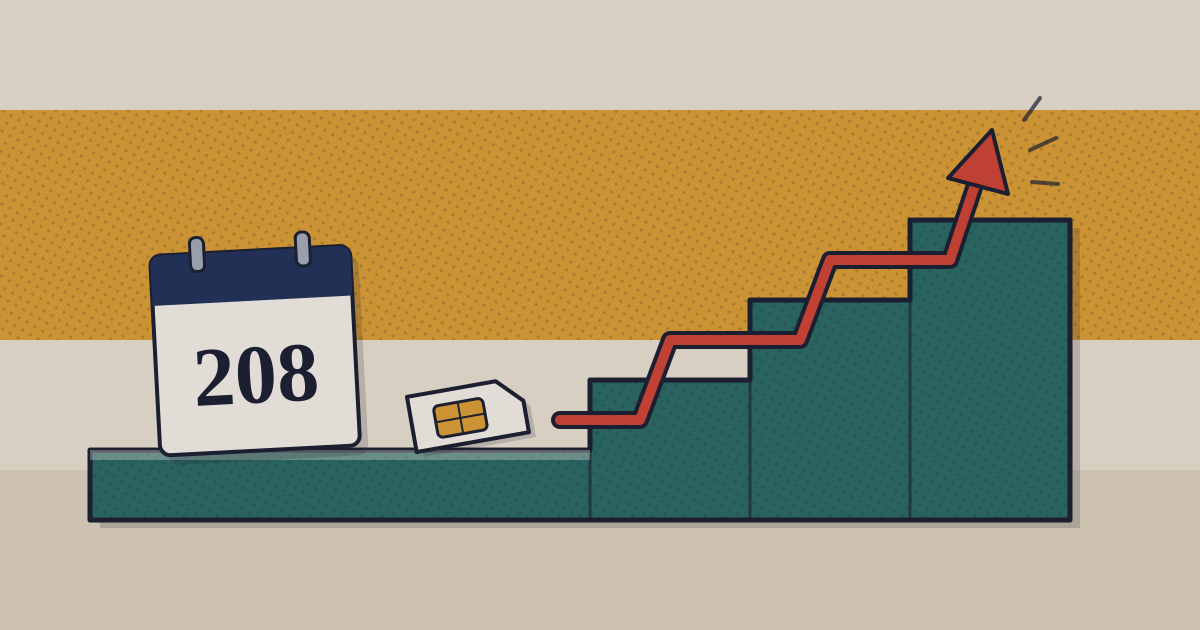
Jio launched its 4G service commercially on 5 September 2016 with free data and voice, first until 31 December 2016 and then, after an extension, until 31 March 2017.1 That is 208 days of a zero price, counted inclusively. The share it bought arrived fast: 1.6 crore subscribers in the first month, 5 crore in 83 days, and 10 crore on 22 February 2017, all while the service cost nothing.1
Jio reached 10 crore subscribers in 170 days, while the service was free
Jio subscribers, crore, at four reported dates from launch (5 September 2016) to June 2026
Subscribers, crore
Table view
| Subscribers (crore) | |
|---|---|
| Oct 2016 | 1.6 |
| Nov 2016 | 5 |
| Feb 2017 | 10 |
| Jun 2026 | 52.4 |
Source: Wikipedia, Jio article, citing Indian Express (9 Oct 2016, 29 Nov 2016) and Times of India (22 Feb 2017); infobox figure for June 2026 · as of 30 September 2026 · dates are uneven; read the bars as milestones, not a time series
By June 2026 the count stood at 52.4 crore.1 That is what penetration pricing is for. A low entry price is not generosity; it is a customer-acquisition budget spent through the price list instead of through advertising, and it only pays if the customers stay once the price rises.
02The bill for the free months arrived in three rounds
The free offer ended on 31 March 2017, and Jio has since raised prices three times. In December 2019, after Airtel and Vodafone Idea had moved, its new plans, effective 6 December, cost up to 40% more.211 A second round followed in December 2021, the last before a two-and-a-half-year pause.34 On 3 July 2024 tariffs rose again, by 12% to 27% depending on the plan; the ₹999 unlimited plan went to ₹1,199 and the ₹719 plan to ₹859.3 Kotak Institutional Equities put the blended increase at about 20%.4 Laid out on a calendar, the long gaps between the rounds say as much about the plan as the rises themselves.
Free for seven months, then three rises spaced years apart: the penetration sequence, end to end
Jio's pricing steps from commercial launch, September 2016 to July 2024, spaced by real time
Table view
| Date | Event | Detail |
|---|---|---|
| Sept 2016 | Free launch | Free data and voice for 208 days |
| Feb 2017 | 10 crore subscribers | Still free |
| Mar 2017 | Free offer ends | |
| Dec 2019 | Up to 40% dearer | Days after Airtel and Vodafone Idea raised theirs |
| Dec 2021 | Second round | Then no rise for about two and a half years |
| Jul 2024 | 12% to 27% by plan | About 20% blended, by Kotak's estimate |
Source: Wikipedia (Jio); Outlook India and The Week (December 2019); Upstox (28 June 2024); Kotak Institutional Equities (28 June 2024) · as of 30 September 2026 · the December 2021 round is placed at the month; its day is not in our sources
That order is the legal frame for every launch price in India. Below-cost pricing is an abuse only when a dominant firm does it. A challenger with a small share can price at zero for as long as its investors will pay, and nothing obliges it to warn you about the exit price.
03In software it is a first-year discount, printed in small type
Software vendors rarely go to zero for everyone, because a seat has a support cost. The common form is a discount that applies to the first year only. IDrive is unusually honest about it. RemotePC’s pricing page shows “Save 25%” on every plan, with the footnote that the discount “is applicable only for the first year. For subsequent years, normal charges are applicable.”6 TechBag’s IDrive pages record the same rule for IDrive 360 endpoint backup, and none for Cloud-to-Cloud Backup, whose price holds.7
Year two costs a third more than year one on every discounted IDrive plan
Annual list price in US$, first year against renewal, three IDrive plans, September 2026
- Year one
- Year two onwards
Table view
| Year one | Year two onwards | Change | |
|---|---|---|---|
| IDrive 360, 5 devices | 112.12 | 149.5 | 33% |
| RemotePC Team, 50 computers | 224.62 | 299.5 | 33% |
| RemotePC Enterprise, 100 computers | 449.62 | 599.5 | 33% |
Source: RemotePC pricing page (undated); TechBag IDrive hub and IDrive 360 page, September 2026 version · as of 30 September 2026 · year-one figures are 75% of the renewal price, rounded down to the cent as IDrive shows them
A 25% discount sounds modest, but undoing it is a 33% rise: the renewal is the year-one price divided by 0.75. TechBag’s IDrive pages carry a reviewer’s line that captures the usual failure exactly: the second-year invoice came in a third higher, and finance had budgeted the promotional figure.7 Our endpoint protection guide records the same pattern at Bitdefender, whose published GravityZone prices are first-year promotional figures that renew at standard rates.8
How do you recognise penetration pricing on a quote? Look for three phrases: “introductory”, “first year” and “limited-time”. Each one tells you a second, higher price exists. Then look for what is missing: a renewal figure, an end date for the offer, or the price of a seat added in month seven. A quote that shows only one number for a multi-year relationship is not a quote for the relationship. It is a quote for the first invoice.
04How to plan it, from either side of the table
For a seller, the lesson from Jio is that the exit price must be planned before launch, not discovered after it. Jio raised prices in steps, years apart, and in two of the three rounds only after a rival had moved first.411 A SaaS founder planning a launch discount should decide the year-two price, the date it applies and how customers will be told, and print all three, as IDrive does. A surprise at renewal is what turns a price rise into churn.
The arithmetic a seller should run first is simple. A 25% first-year discount gives away a quarter of one year’s revenue per customer. It is recovered only from customers who stay after the step-up, and only from the margin they earn. Suppose one customer in four leaves at the first renewal. The vendor has then spent the discount on four customers to keep three, and the three who stay must repay all four discounts out of the margin they earn at full price. If the product does not hold customers at the real price, the launch discount has only bought a cohort of leavers.
For a buyer, the same facts turn into a short list of things to put in writing before the purchase order is raised.
The seller plans the step-up; the buyer's defence is to write it into the order
What a penetration-priced quote leaves open, and the clause that closes it
What the launch price leaves open
- The renewal price, often in a footnote or not printed at all
- When the discount ends: first term, first year, or first invoice
- Whether added seats get the launch price or the list price
- What a free or entry tier will lose when the plan is redrawn
- Notice period before any rise
What the buyer writes into the order
- The year-two and year-three price, in the quote, in writing
- A renewal cap: a fixed percentage or the published list, whichever is lower
- Mid-term additions priced at the contracted rate
- A named feature list that survives a plan change
- Ninety days' written notice of any change at renewal
Source: TechBag analysis of the Jio sequence and IDrive's published terms · as of 30 September 2026
Sources
- Wikipedia, Jio (launch, free offer and subscriber milestones, citing Indian Express and Times of India) — cited reports 9 October 2016 to 22 February 2017; infobox June 2026
- Outlook India, Jio to hike mobile calling, data charges by up to 40% from December 6 — December 2019
- Upstox, Reliance Jio announces prepaid and postpaid tariff hike from July 3 — 28 June 2024
- Kotak Institutional Equities, R-Jio takes the lead with 20% tariff hike (via Investment Guru India) — 28 June 2024
- The News Minute (IANS), No anti-competitive practices by RIL and Reliance Jio: CCI rejects Airtel's complaint — 10 June 2017
- RemotePC by IDrive, pricing page (first-year discount footnote) — vendor pricing page, undated
- TechBag, IDrive vendor hub and IDrive 360 intel page (renewal prices, first-year discount, reviewer quote) — version of 30 September 2026
- TechBag, Endpoint protection guide (Bitdefender first-year promotional pricing) — version of 30 September 2026
- India Briefing, Digital services in India: OIDAR, GST applicability and reverse charge — updated 29 September 2023
- IndiaCorpLaw, Non-dominant enterprises' offers and schemes: predatory pricing or not? — 7 December 2018
- The Week, After Airtel and Vodafone hike rates, Jio follows with up to 40% higher tariffs — 1 December 2019
Related on TechBag: the IDrive hub lists every plan at its renewal price; the remote access guide compares RemotePC with the tools that do not discount year one.
Disclosure. TechBag is a software reseller: it earns a margin when a reader buys through it, including from vendors named here. The analysis is TechBag’s own; no vendor paid for or saw this piece before publication. Facts are labelled reported, TechBag count or our view.
Keep reading