Fractal’s first US$100m quarter: revenue up 20%, half of that growth from currency
Fractal Analytics’ results for July to September: what the AI company sells, why currency explains half its 20% growth, and how small its own products still are.

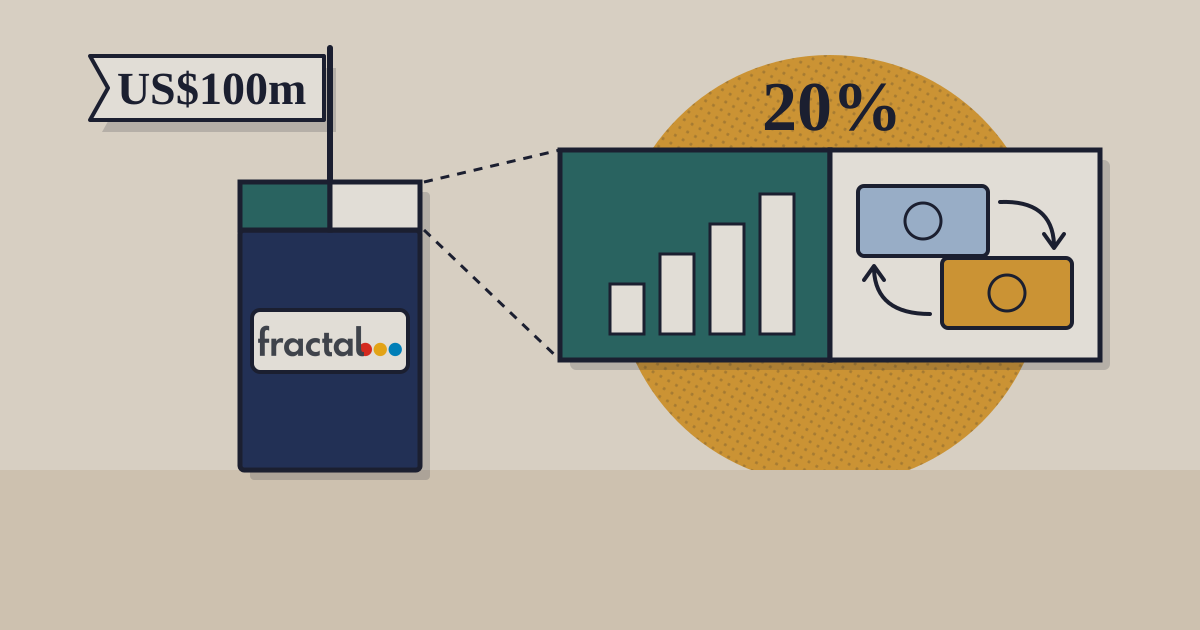
Fractal Analytics’ revenue passed US$100m in a quarter for the first time: ₹956.5 crore in July–September, up 20% on a year earlier. In constant currency, which strips out exchange-rate moves, growth was 10%.1 So about half of the growth came from currency, by our arithmetic. Net income rose 139% to ₹79.2 crore.1 The Mumbai company, which listed on the NSE and BSE on 16 February at ₹900 a share,2 calls itself “an enterprise AI company that builds its own AI models, platforms and products for Fortune 500 organizations”.1
+20%
revenue growth in rupees, July–September
Fractal
+10%
the same growth in constant currency
Fractal
4%
of revenue from Fractal's own products
Fractal, on the call
−18%
revenue from technology, media and telecom clients
Fractal
01What Fractal sells
Mostly people. On the call on 4 November the chief financial officer, Shilpa Kedia, said 58% of revenue came from input-based engagements, billed for the people and time put in, and 42% from output- and outcome-based ones, “including 4% from products”. Products earned ₹38 crore in the quarter, and the portfolio runs at more than ₹150 crore a year, up 39%, the chief executive, Srikanth Velamakanni, said; contracted product revenue not yet recognised is over ₹200 crore.4 The products are built on Cogentiq, its agentic AI platform, which clients also use directly (Cogentiq Invoice to Cash and Cogentiq CX are two).4 A separate unit, Fractal Alpha (Asper.ai, revenue-management software for consumer-goods companies, and the edtech platform Analytics Vidhya),1 earned ₹34 crore, up 40%, with an adjusted segment loss of ₹10 crore.4
The target is far off. Asked about a goal of products reaching 20% of revenue, Velamakanni said “we aim to do roughly a $100 million run rate by the time, in about 12 quarters from now” and called it “a tall order”.4
02Why half the growth is currency
Fractal bills 67.3% of its revenue in the Americas and 21.5% in Europe,3 and reports in rupees. When the rupee weakens, the same dollar and euro invoices turn into more rupees. The weaker rupee also flattered margins: gross margin fell 225 basis points to 44%, after hiring AI engineers cost 279 points and annual pay rises 216, while “the weaker rupee provided a benefit of 270 basis points,” Kedia said.4 Adjusted EBITDA margin rose 123 basis points to 16.2%.4
03Which clients grew
Healthcare added about ₹106 crore of quarterly revenue in a year; technology and media clients cut about ₹38 crore
Fractal revenue by client industry, ₹ crore, July–September 2025 and July–September 2026
- Jul–Sep 2025
- Jul–Sep 2026
Show tableHide table
| Jul–Sep 2025 | Jul–Sep 2026 | Change | |
|---|---|---|---|
| Consumer goods and retail | 299 | 332 | 11% |
| Healthcare and life sciences | 134 | 240 | 79% |
| Technology, media and telecom | 209 | 171 | -18% |
| Banking, financial services, insurance | 100 | 130 | 30% |
| Others (energy, travel, industrials) | 57 | 83 | 46% |
Source: Fractal Analytics, Q2 FY27 investor presentation (slide 7) · as of 3 November 2026 · TechBag arithmetic from Fractal's shares of revenue and year-on-year growth by industry, so approximate. In rupees, including the currency effect.
Healthcare and life sciences grew 79% and banking and insurance 30%. Consumer goods and retail, the largest industry at 34.7% of revenue, grew 11%, and revenue from technology, media and telecom clients fell 18%.3 Velamakanni put the consumer slowdown down to “inflation and consolidation in this sector” and said technology, media and telecom “has bottomed out”, growing 6% on the previous quarter.4
Existing clients spent more: in the main Fractal.ai business, net revenue retention was 115%, from 112% a year earlier, and 58 clients paid over US$1m a year, from 52. The ten largest clients’ share of revenue fell to 51.7% from 53.2%.4 Excluding its share of losses at Qure.ai, the healthcare AI company it incubated and spun out, net income was ₹102.4 crore.13
Sources
- Fractal Analytics, press release: Fractal delivers its first ever $100 million revenue quarter (Q2 FY27) — 3 November 2026
- Fractal Analytics, outcome of board meeting: unaudited consolidated results for the quarter to 30 September 2026, filed with NSE and BSE — 3 November 2026
- Fractal Analytics, Q2 FY27 investor presentation, filed with NSE and BSE — 4 November 2026
- Fractal Analytics, transcript of the Q2 FY27 earnings call (call of 4 November) — 6 November 2026
Disclosure. TechBag is a software reseller: it earns a margin when a reader buys through it, including from vendors named here. The analysis is TechBag’s own; no vendor paid for or saw this piece before publication. Facts are labelled reported, TechBag count or our view.
Keep reading