Intuit sells Mailchimp for US$3.68bn, 31% of the US$12bn it paid
Intuit’s filings of 19 November: the price, why a sale at a third of the 2021 price still books a gain, Mailchimp’s flat revenue, and Bending Spoons’ three deals since July.
Mailchimp is the email marketing tool used by “millions of businesses”, in its buyer’s words.10 In 2021 Intuit bought it as the marketing half of a platform built around QuickBooks; five years on it is selling it for about a third of the price, to a company whose stated method is to buy software businesses and reorganise them. Three questions follow. What does the price say about a mature small-business software product, how can a seller getting back less than a third of its price still book a gain, and what should Mailchimp’s customers expect from the new owner? We read both companies’ filings of 19 November and the documents behind the 2021 purchase.
01The price: US$3.68bn, with US$368m coming back as shares
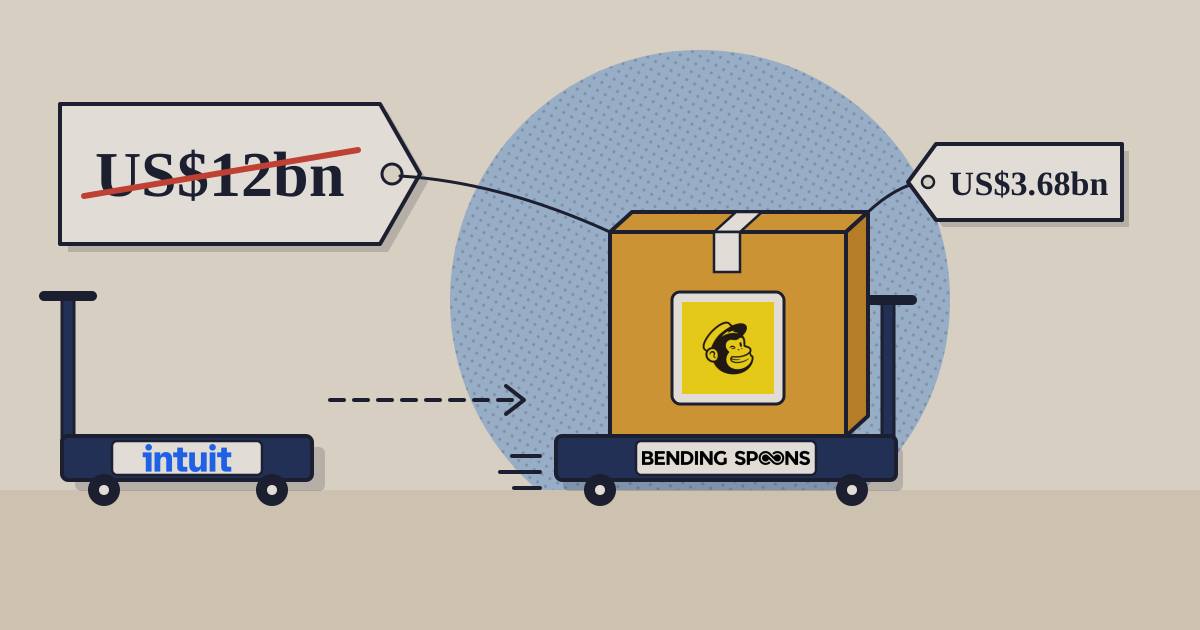
Intuit signed an Equity and Asset Purchase Agreement on 19 November with Bending Spoons US Inc., a Delaware subsidiary of Bending Spoons S.p.A. of Milan. The buyer takes The Rocket Science Group LLC, the Georgia company that is Mailchimp, plus the Mailchimp assets held elsewhere in Intuit, for an “all-cash base purchase price of $3.68 billion”, adjusted for cash, debt, working capital and expenses. Under a separate investment agreement Intuit puts about US$368m of that back into 8,818,595 new Bending Spoons ordinary shares at closing.1 Intuit’s release states the split as US$3.31bn in cash and US$368m in stock.2
Bending Spoons pays US$3.68bn for Mailchimp, 31% of what Intuit paid in 2021
Terms of the sale agreed on 19 November 2026, and the measures they compare with
US$3.68bn
price: US$3.31bn cash and US$368m in Bending Spoons shares
31%
of the US$12.0bn Intuit paid when the purchase closed on 1 November 2021
2.9×
Mailchimp revenue of US$1.272bn in the year to July 2026
−1%
Mailchimp revenue in the quarter to 31 October, to US$313m
Source: Intuit 8-K, release and 10-Q, 19 November 2026; Intuit FY22 10-K; recast FY26 statements · as of 20 November 2026 · 31% and 2.9× are TechBag arithmetic
The TechBag Journal
The share count was fixed at signing from a weighted-average price set in the agreement, so the shares’ value at closing may differ from US$368m, and Intuit may not sell them for six months.3 The count implies about US$41.73 a share. The deal needs the US antitrust waiting period under the Hart-Scott-Rodino Act to expire and “certain other specified regulatory approvals”; it carries no financing condition and needs no vote of Intuit’s shareholders. Either side may walk away if it has not closed by 19 August 2027, extendable by three months for regulatory approvals. Both companies expect closing in early 2027. Intuit agrees not to run a competing business for two years after.1 It says it will use the cash to buy back its own shares within its fiscal year to July 2027, once the sale closes.2
02Why selling at 31% still books a gain
The US$12.0bn is what Intuit’s fiscal 2022 annual report records as the fair value of what it paid: US$5.7bn in cash and 10.1 million Intuit shares valued at US$625.99 each, the closing price on 29 October 2021. Intuit booked US$4.34bn of intangible assets (customer lists, technology and trade names) and US$8.1bn of goodwill, the part of the price not tied to any identifiable asset.7 In 2021 Intuit had announced the deal as “approximately $12 billion in cash and stock”.6
Since then Intuit has recorded no goodwill impairment, on Mailchimp or anything else: its annual filings show zero for every fiscal year from 2016 to 2026, and its only accumulated goodwill write-down, US$114m, dates from fiscal 2015 and sits in the Consumer segment.38 What changed the number is the segment move. From 1 August 2026 Intuit has run Mailchimp as its own segment, outside Global Business Solutions, the QuickBooks segment. Goodwill was then “reassigned” to the new Mailchimp reporting unit “on a relative fair value basis”: US$641m moved over, and US$9.18bn stayed with Global Business Solutions.4
Intuit paid US$12.0bn for Mailchimp; only US$641m of goodwill now sits on Mailchimp's books
US$ billions: 2021 purchase, goodwill booked in 2021, 2026 sale price, Mailchimp segment goodwill at 31 October 2026
Paid in 2021, cash and sharesUS$12
Goodwill booked for Mailchimp, 2021US$8.1
Sale price, 2026US$3.68
Goodwill on Mailchimp's books nowUS$0.64
Show tableHide table
Value (US$)
Paid in 2021, cash and shares
12
Goodwill booked for Mailchimp, 2021
8.1
Sale price, 2026
3.68
Goodwill on Mailchimp's books now
0.64
Source: Intuit FY22 10-K (Note 7); Intuit 10-Q, Q1 FY27 (Note 5); Intuit 8-K, 19 November 2026 · as of 20 November 2026 · 2021 goodwill is the preliminary allocation in the FY22 10-K
The TechBag Journal
A gain or loss on a sale is the price less the book value of what is sold. With only US$641m of goodwill attached, Mailchimp’s book value is mostly what is left of the 2021 intangibles after five years of amortisation, plus working capital. Intuit gives no figure, but says that on completion “we expect to recognize a pre-tax gain”, whose size depends on Mailchimp’s net carrying value at closing, adjustments, selling costs and the closing-date value of the Bending Spoons shares. The board approved the sale in November, so Mailchimp was not shown as held for sale at 31 October.3
03What Bending Spoons is buying: flat revenue, rising profit
Recast for the new segment, Mailchimp’s revenue was US$1,267m in the year to July 2024, US$1,287m in 2025 and US$1,272m in 2026. Its segment operating income rose from US$516m to US$604m over the same years.4 In the quarter to 31 October revenue fell 1% to US$313m, “due to a decrease in paying customers and mix shift, partially offset by higher effective prices”. Segment operating income rose 45% to US$202m, 65% of revenue, as Intuit cut staffing costs by US$31m, marketing by US$19m and outside services by US$8m against a year earlier.3 Intuit’s guidance for the year to July 2027 has Mailchimp at US$1,256m to US$1,266m, down 1% to flat.2
Mailchimp's revenue has not grown in three years; its segment profit rose 17%
Mailchimp segment revenue and segment operating income, US$ millions, fiscal years to 31 July
Revenue
Segment operating income
Show tableHide table
Revenue
Segment operating income
FY2024
1,267
516
FY2025
1,287
548
FY2026
1,272
604
Source: Intuit 8-K, recast FY26 financial statements (Note 14), 19 November 2026 · as of 20 November 2026 · Segment operating income excludes share-based pay, amortisation and other corporate costs
The TechBag Journal
The segment measure flatters every Intuit unit equally. Intuit leaves share-based pay, amortisation of acquired intangibles and “other corporate expenses” out of all segment profits; those unallocated items came to US$2.3bn across the company in the quarter.3 The 65% is not a net margin a buyer inherits; the trend is costs falling while revenue holds. Bending Spoons says its model is to transform what it buys “to sustainably expand earnings”.10 Dropbox, with nine quarters of revenue within 1.5% of a year earlier, took the other path this month and bought Tigris for about US$350m. In 2021 Intuit described Mailchimp as having 800,000 paid customers and 13 million users; it has given no customer count since.6
04The rest of the release: Credit Karma's guidance cut
Intuit reported the sale with its first-quarter results, after the US market closed on 19 November. Revenue rose 12% to US$4.35bn and GAAP operating income 63% to US$868m. Global Business Solutions grew 15% to US$3.1bn.2 But Intuit cut its revenue guidance for the year, “reflecting a change to Credit Karma”. Credit Karma, the consumer credit and loan marketplace Intuit bought in 2020, is now expected to grow 3% to 7%, against 11% to 13% in August. Total revenue guidance went from 9–10% to 8–9%; operating income and earnings per share guidance was kept.257
Credit Karma's growth guidance was cut from about 12% to 5%; the rest of Intuit held
Revenue growth guidance for the year to July 2027, midpoint of each range, %: 25 August vs 19 November 2026
25 August
19 November
Show tableHide table
25 August
19 November
Change
Global Business Solutions
13.5
13.5
0 pts
Credit Karma
12
5
-7 pts
Total revenue
9.5
8.5
-1 pts
Consumer
5
3
-2 pts
Source: Intuit Q4 FY26 release, 25 August 2026; Intuit Q1 FY27 release, 19 November 2026 · as of 20 November 2026 · Midpoints are TechBag arithmetic; guidance excludes the Mailchimp sale
The TechBag Journal
Intuit’s 10-Q says Credit Karma’s quarter gained US$52m from personal loans and US$21m from insurance and lost US$16m on credit cards, and was “impacted by higher interest rates and a shift in consumer behavior”.3 Intuit’s shares opened on 20 November at US$284.06, 8.4% below the 19 November close of US$310.02, and were at US$298.03, down 3.9%, at 9:53am in New York (8:23pm IST). The quotes are from Yahoo Finance, not an exchange filing.19
05The buyer: three deals since July, paid for with debt and new shares
Bending Spoons listed on Nasdaq on 1 July at US$29 a share.1612 It describes itself as a company that “acquires digital businesses, implements deep transformations” and reinvests in more acquisitions, and says it “has never sold a material business”. The transformation, in its own words, is “typically deep” and “entails reorganizing teams, overhauling technology, redesigning user interfaces”, and changing marketing and pricing.9 Its third-quarter results name what that meant last quarter: “separation packages offered to team members in connection with the reorganizations of Airtable, AOL, Tractive, and Vimeo”, and US$25m of reorganisation-related expense. For Mailchimp, its chief executive Luca Ferrari said that after closing “we’ll invest substantially in the business”.109
Bending Spoons agreed three software deals worth US$6.3bn between 4 August and 19 November
Bending Spoons' listing, acquisitions and financing, 1 July to 19 November 2026
Show tableHide table
Date
Event
Detail
Jul 2026
Nasdaq listing
US$29 a share
Aug 2026
Airtable agreed
Enterprise value US$1.285bn
Sept 2026
Airtable closes
Sept 2026
Miro agreed
Enterprise value US$1.355bn
Oct 2026
Berkshire Hathaway buys more
10m shares at US$33
Oct 2026
Miro closes
Oct 2026
Notes priced
US$1.25bn at 9.625%, €500m at 8.625%, due 2032
Nov 2026
Mailchimp agreed
US$3.68bn; US$1.30bn of shares sold at US$40
Show tableHide table
Business
Agreed
Enterprise value
Revenue measure in the filings
Multiple
Airtable
4 Aug 2026
US$1.285bn
ARR about US$480m (June 2026)
2.7×
Miro
10 Sep 2026
US$1.355bn
ARR around US$600m
2.3×
Mailchimp
19 Nov 2026
US$3.68bn
Revenue US$1.272bn (year to July 2026)
2.9×
Source: Bending Spoons 424B4 and Forms 6-K, July to November 2026 · as of 20 November 2026 · Enterprise value ÷ revenue measure is TechBag arithmetic; the measures differ by company
The TechBag Journal
Bending Spoons’ third-quarter revenue rose 125% to US$780m, almost all of the growth from businesses it bought: organic growth was 3%. Operating income rose 34% to US$172m, interest expense rose to US$107m, and at 30 September net debt was US$4.00bn, 2.1 times an adjusted EBITDA that counts acquired businesses for a full twelve months and includes “certain expected cost savings”.10 The deals themselves were priced at 2.3 to 2.9 times the revenue or recurring-revenue figure each filing gave.1213 Since 30 September it has drawn US$1.25bn and €395m of term-loan add-ons and issued US$1.25bn and €500m of notes due 2032, at 9.625% and 8.625%, whose proceeds are “intended to fund future acquisitions”.1015 On the equity side, Berkshire Hathaway bought 10 million shares at US$33 in October, taking its stake to 4%, and on 19 November investors agreed to buy 32.5 million shares for US$1.30bn, or US$40 each.1411 Intuit’s new shares work out at about US$41.73 each. Bending Spoons’ shares closed at US$41.70 on 19 November and were at US$42.59, up 2.1%, at 9:53am New York time on 20 November.19 Bending Spoons has not said how it will fund the US$3.31bn of cash; its fourth-quarter guidance includes nothing from Mailchimp.10
Disclosure. TechBag is a software reseller: it earns when companies buy through it, including from vendors named here. The analysis is TechBag’s own; no vendor paid for or saw this piece before publication. Facts are labelled reported, TechBag count or our view.