Markets & the AI economyAnalysis
33 of 56 listed vendors fell 30% or more; what changes at renewal and what does not
How far the listed companies behind TechBag's vendor hubs fell from 31 December 2025 to 19 October 2026, what their filings say, and the clauses that protect a renewal.

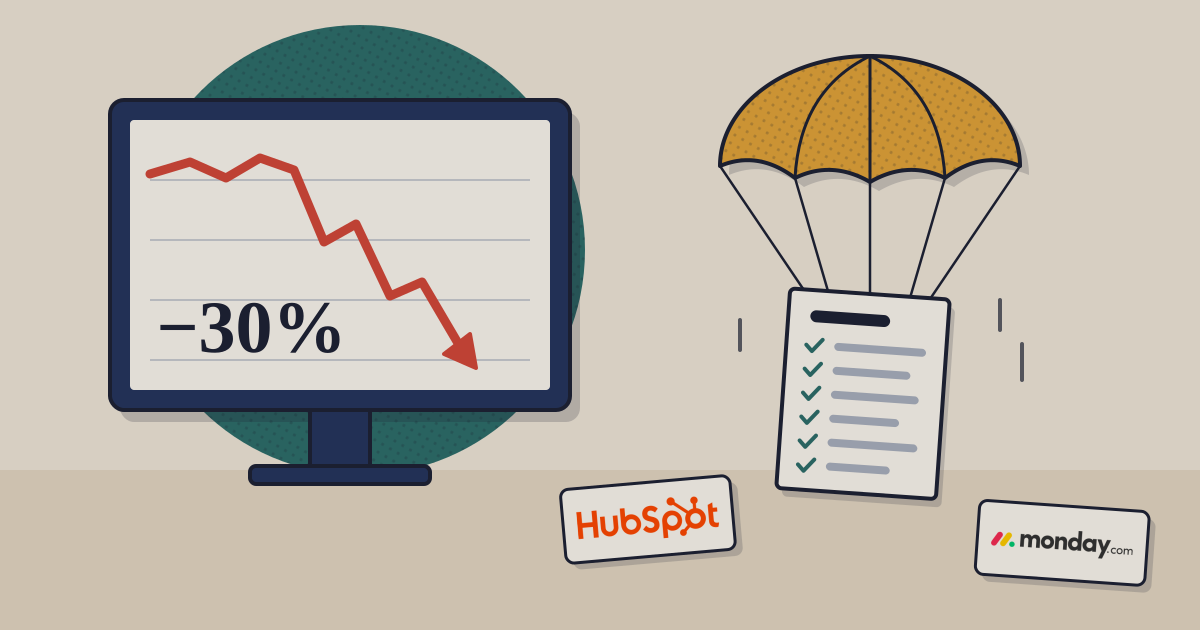
A vendor you are about to renew has lost a third of its market value. The finance team asks whether the company will still be there in three years; the account manager offers a discount for a longer term. The decision is whether the share price should change what you sign, and if so, which clauses carry the risk.
01Thirty-three of 56 fell 30%; four were still that far down on 19 October
We took the daily closing price of every listed company behind a TechBag vendor hub, from 31 December 2025 to 19 October 2026: 56 companies on Nasdaq, the NYSE, the NSE, Frankfurt, Paris and Tokyo. Thirty-three of them closed at least 30% below their year-end price on some day this year. Most of those lows came in two windows: the software sell-off after 28 January, when the S&P 500 software and services index shed about US$1 trillion in seven sessions by Reuters’ count, and the week to 10 April.12
A 30% fall was common this year, and most vendors came back; four did not
Share price at its 2026 low and on 19 October 2026, indexed to the closing price on 31 December 2025 = 100, twelve of the 33 companies that fell 30% or more
- 2026 low
- 19 Oct 2026
Table view
| 2026 low | 19 Oct 2026 | Change | |
|---|---|---|---|
| Quick Heal | 47.2 | 57 | 21% |
| HubSpot | 42.4 | 58.5 | 38% |
| N-able | 40.1 | 60.8 | 52% |
| monday.com | 39.9 | 63.3 | 59% |
| Adobe | 55.3 | 70.6 | 28% |
| Rapid7 | 33.2 | 87 | 162% |
| Salesforce | 56.7 | 91.5 | 61% |
| Zscaler | 52.5 | 94.5 | 80% |
| ServiceNow | 54.2 | 94.9 | 75% |
| Freshworks | 56.2 | 115.3 | 105% |
| Atlassian | 35.2 | 132.4 | 276% |
| Snowflake | 55.2 | 143.8 | 161% |
Source: Yahoo Finance daily closing prices (split-adjusted); TechBag calculation · as of 19 October 2026 · lows are the lowest close between 1 January and 19 October 2026; dates of the lows differ by company
Atlassian closed 64.8% below its year-end price on 10 April and was 32.4% above it on 19 October. Rapid7 fell 66.8% by 9 April and had recovered to 13% down. The four still 30% or more down were Quick Heal (43.0%), HubSpot (41.5%), N-able (39.2%) and monday.com (36.7%); Adobe was just short at 29.4%. Over the same period the S&P 500 rose 12.4% and the iShares software ETF was flat.1
03What a fall feeds into: pricing, people, roadmaps and owners
A falling share price raises the pressure to show investors margin and growth, and the filings this year show four ways it reaches customers. The first is pricing. ServiceNow moved every product to three tiers on 9 April, combining seats with other meters and a pool of AI tokens, and did not publish the prices.12 We covered the move from seats to credits, and what to ask for when a vendor proposes it, in our 1 July analysis of the software sell-off.
The second and third are people and roadmaps. On 6 October HubSpot told staff it would cut about 7% of its workforce, nearly 660 people, at a cost of US$65 million to US$75 million. Its chief executive, Yamini Rangan, wrote that the company had “shifted our strategy from building software that helps customers grow to delivering outcomes for them with AI”, that the shift “is transforming product, pricing and how we serve our customers”, and that product teams would be organised “around these outcomes instead of hubs”. She also wrote: “This is not driven by AI-related efficiencies.”4 N-able approved a 6% reduction on 20 July to “align investments with highest priority opportunities”.7 Freshworks announced about 500 roles, 11% of staff, on 5 May.11 The filings do not tie these decisions to the share price, and neither do we; they are what a buyer of these products lived through in the same year.
In ten months, the vendors behind TechBag's hubs repriced, cut staff and changed owners
Selected pricing, workforce and ownership events at vendors with TechBag hubs, January to October 2026
Table view
| Date | Event | Detail |
|---|---|---|
| 2 Feb 2026 | Jamf is private | Francisco Partners' US$13.05-a-share take-private reported closed; the stock leaves Nasdaq |
| 5 Feb 2026 | Software sell-off | About US$1 trillion off US software and services stocks since 28 January (Reuters) |
| 12 Feb 2026 | CyberArk sold | Palo Alto Networks reported to have completed its US$25 billion acquisition |
| 9 Apr 2026 | ServiceNow tiers | Seats plus meters plus a pool of AI tokens; no prices published |
| 5 May 2026 | Freshworks cuts 11% | About 500 roles in a restructuring |
| 12 May 2026 | CyberArk becomes Idira | Quotes and contracts carry the Palo Alto brand |
| 20 Jul 2026 | N-able cuts 6% | Reorganisation approved; disclosed on 10 August |
| 6 Oct 2026 | HubSpot cuts 7% | Nearly 660 people; product teams reorganised around outcomes |
Source: Company filings and releases; Reuters; TechTarget; MacTech; ITPro; TechBag CyberArk (Idira) hub · as of 19 October 2026
The fourth is ownership. Jamf, the Apple device-management vendor, left Nasdaq when Francisco Partners’ take-private at US$13.05 a share, about US$2.2 billion including debt, was reported closed on 2 February.13 Palo Alto Networks completed its US$25 billion purchase of CyberArk in February14, and on 12 May relaunched the portfolio as Idira, so CyberArk customers now see a new name on quotes and contracts.15 A lower share price makes a vendor cheaper to buy; what a buyer needs to know is what the contract says when that happens.
Sources
- Yahoo Finance chart data: daily closes for the 56 listed companies behind TechBag's vendor hubs, the iShares Expanded Tech-Software ETF (IGV), the SPDR S&P 500 ETF (SPY) and USD/INR, 31 December 2025 to 19 October 2026 — closes to 19 October 2026
- Reuters (Medha Singh, Saqib Iqbal Ahmed), via Yahoo Finance: US software stocks slammed on mounting fears over AI disruption, lose $1 trillion in week — 5 February 2026
- HubSpot, Inc., Form 10-Q for the quarter ended 30 June 2026 (revenue, cash and investments, revolving credit facility, cash flows, share repurchases) — 5 August 2026
- HubSpot, Inc., Form 8-K (Item 2.05) and Exhibit 99.1, update to employees from Yamini Rangan — 6 October 2026
- monday.com Ltd., Form 6-K, Exhibit 99.1: monday.com Announces Second Quarter 2026 Results — 10 August 2026
- N-able, Inc., Form 10-Q for the quarter ended 30 June 2026 (revenue, cash, term loan and maturity) — 10 August 2026
- N-able, Inc., Form 8-K (Item 2.05): reorganisation reducing employees by about 6% — 10 August 2026
- N-able, Inc., Form 8-K (Item 1.01): third amendment to credit agreement, US$75 million delayed-draw term loan — 17 June 2026
- Quick Heal Technologies Limited, outcome of board meeting, Q1 FY27 results press release and earnings presentation (filed with BSE and NSE) — 30 July 2026
- Quick Heal Technologies Limited, Integrated Annual Report 2025-26 (debt-free balance sheet) — 26 August 2026
- Freshworks Inc., Form 8-K (Item 2.05 restructuring) and first-quarter 2026 results — 5 May 2026
- TechTarget (Beth Pariseau): ServiceNow AI pricing change takes on enterprise ROI struggles — 10 April 2026
- MacTech: Francisco Partners completes acquisition of Jamf — 2 February 2026
- ITPro: Palo Alto Networks CEO hails 'the end of identity silos' as firm closes CyberArk acquisition — 12 February 2026
- TechBag: CyberArk (Idira) vendor hub (Palo Alto ownership; Idira relaunch on 12 May 2026) — version of 16 October 2026
- Akamai Technologies, Inc., Form 8-K (Item 1.01): Anthropic master services agreement and project plans; Lenovo and Jabil agreements — 24 September 2026
- Reserve Bank of India: Master Direction on Outsourcing of Information Technology Services (paragraphs 16, 19 and 22) — 10 April 2023
- India Briefing: Digital services in India: OIDAR, GST applicability and reverse charge — updated 29 September 2023
Related on TechBag: the HubSpot hub, the Seqrite hub, and the catalogue for alternatives to compare before you renew.
Disclosure. TechBag is a software reseller: it earns a margin when a reader buys through it, including from vendors named here. The analysis is TechBag’s own; no vendor paid for or saw this piece before publication. Facts are labelled reported, TechBag count or our view.
Keep reading