Markets & the AI economyAnalysis
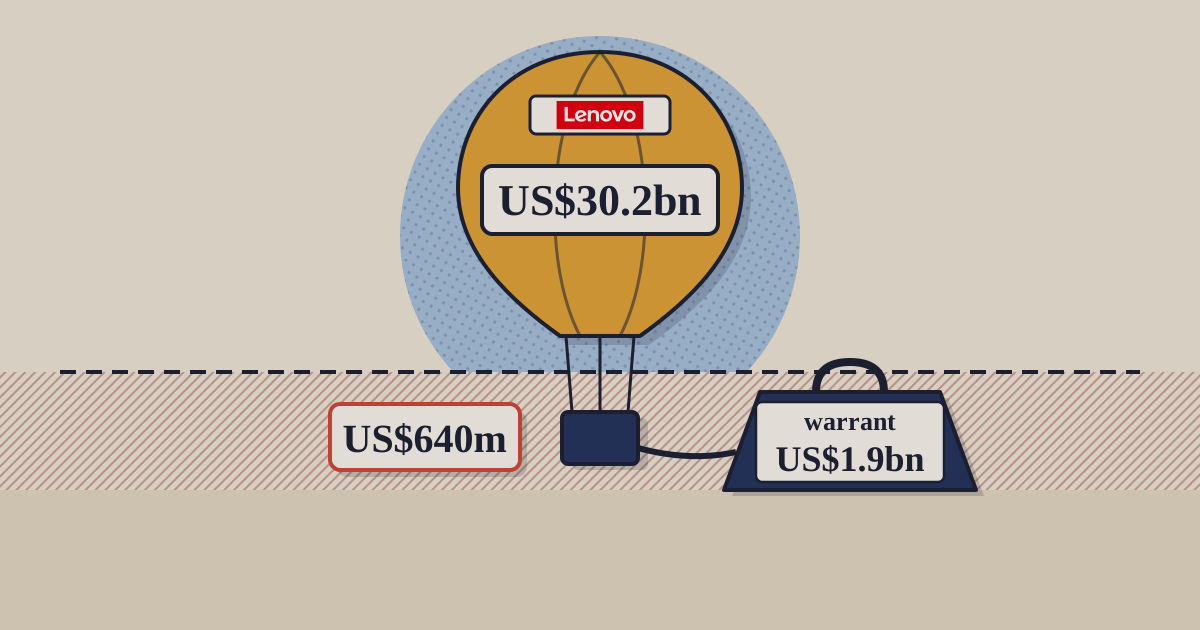
Lenovo’s record US$30.2bn quarter ended in a US$640m loss, from a US$1.9bn warrant charge
Lenovo’s results for July to September: revenue up 48% to a record, servers up 178%, adjusted profit up 166%, and the 2025 warrants whose revaluation turned the quarter to a loss.

Lenovo is the world’s largest PC maker by IDC’s count, yet servers, storage and services now earn 61% of its business groups’ operating profit.313 Its second fiscal quarter produced two headline numbers that point in opposite directions: record revenue and profit on the measure Lenovo prefers, and a loss on the one the accounting rules require. A reader needs to know which number describes the business, what the warrant charge is and who holds the warrants, whether it costs Lenovo any cash, and why it can swing back. We read Lenovo’s results filing, its 2024 warrant documents and its last four quarterly reports to find out.
01A record quarter that reports a loss
Lenovo filed its results with the Hong Kong exchange at 12:01pm on 19 November. Revenue for July to September was US$30,238m, up 48% from US$20,452m, the first quarter above US$30bn. Gross margin rose 0.6 points to 16.0%. Below that line, “other operating income/(expenses)” went from a US$158m charge to a US$2,168m charge, and the main item in it was a US$1,906m “fair value loss on derivative financial liabilities relating to warrants”. The quarter ended with an operating loss of US$117m and a loss attributable to shareholders of US$640m, against a US$340m profit a year earlier.1
Lenovo's revenue and adjusted profit set records; the warrant charge turned the reported result into a loss
Lenovo Group, quarter to 30 September 2026, US$, with year-on-year change
US$30.2bn
revenue, a record, up 48%
HKEX filing
US$1.36bn
adjusted profit to shareholders, up 166%
Lenovo's non-HKFRS measure
US$1.91bn
fair-value loss on warrants, non-cash
HKEX filing
−US$640m
reported loss to shareholders, from a US$340m profit
HKEX filing
Source: Lenovo FY2026/27 interim results announcement, HKEX · as of 20 November 2026
The same pattern runs through the half year. Revenue for April to September rose 46% to US$57.2bn and adjusted profit 170% to US$2.44bn, while the warrant loss for the six months reached US$3,596m and the reported loss US$1,248m. In the first quarter the warrant loss was US$1,690m and the reported loss US$609m.14 The board raised the interim dividend to HK9.0 cents a share from HK8.5 cents. Cash moved the other way from the reported result: operating cash flow was US$1.6bn in the quarter and free cash flow US$1.2bn.1 Lenovo’s shares closed at HK$16.25 on 19 November, down 5.5% from HK$17.20 the day before, and at HK$16.35 on 20 November.12
02Where the US$30.2bn came from
Lenovo reports three business groups. The Intelligent Devices Group, which sells PCs, tablets and Motorola phones, is still the largest at US$17.4bn, up 15%. The Infrastructure Solutions Group, servers and storage, almost trebled to US$11.3bn. The Solutions and Services Group grew 20% to US$3.1bn. The three add up to US$31.8bn before US$1.5bn of sales between the groups is eliminated.1
Servers and storage grew 178% and now bring in two-thirds as much as Lenovo's PC and phone business
Revenue by business group, quarter to 30 September 2026, US$bn, with year-on-year change; before inter-group eliminations
Source: Lenovo FY2026/27 interim results announcement, segment note · as of 20 November 2026 · Eliminations of US$1.5bn bring the total to US$30.2bn
The devices business grew on price rather than volume. Lenovo says an “improved product mix and higher average selling prices helped offset volume pressures”, that premium PCs were 63% of its PC shipments, up 13.5 points, and that its operating margin held at 7.1% on operating profit of US$1,226m.1 IDC’s preliminary count for the same three months has Lenovo shipping 14.9m PCs against 19.3m a year earlier, down 22.6%, in a market that fell 20.1%; IDC put Lenovo’s share at 23.8%.13 Lenovo’s press release names the cost behind the prices: it balanced growth against “industry-wide higher component costs”, and in August it warned that “component supply-demand imbalances may continue to create near-term headwinds”.24 Our trend piece on PC shipments and memory prices charts the DRAM side.
Lenovo puts 36% of the quarter’s revenue, US$10.8bn, up 79%, in an “AI-related” bucket. Its definition counts all PCs and phones “equipped with NPU”, GPU servers, and services that help customers build and run AI.2 By region, revenue grew 74% in the Americas, 51% in mainland China, 30% in Europe, the Middle East and Africa and 24% in the rest of Asia-Pacific.3
03Servers went from a loss to US$1.1bn of profit in a year
A year ago Lenovo’s server business was losing money. In the July–September quarter of 2025 the Infrastructure Solutions Group had revenue of US$4.1bn and an operating loss of US$32m; it lost money in each of the three quarters to December 2025, and in February Lenovo announced a restructuring aimed at “over US$200 million” of annual savings. It turned a profit of US$202m in January to March, then US$777m and now US$1,091m, a margin of 9.6%.1456
Lenovo's server revenue nearly trebled in a year, and its margin went from a loss to 9.6%
Infrastructure Solutions Group revenue (US$bn) and operating margin (%), quarters ending June 2025 to September 2026
- ISG revenue (US$bn)
- ISG operating margin (%)
Show tableHide table
| ISG revenue (US$bn) | ISG operating margin (%) | |
|---|---|---|
| Jun 2025 | 4.3 | -2 |
| Sep 2025 | 4.1 | -0.8 |
| Dec 2025 | 5.2 | -0.2 |
| Mar 2026 | 5.6 | 3.6 |
| Jun 2026 | 8.5 | 9.1 |
| Sep 2026 | 11.3 | 9.6 |
Source: Lenovo results announcements: Q1 and Q2 FY2026/27, FY2025/26 annual, Q3 FY2025/26 (segment notes) · as of 20 November 2026 · Margins are operating profit or loss divided by revenue, our arithmetic from Lenovo's segment figures
Lenovo gives three drivers. Revenue from cloud service providers grew 168% and from enterprise and small-business customers 200%; revenue from GPU, or AI, servers grew “more than 300 percent”. It says it now ships the most x86 servers in the world, with 16% of units once servers built directly by contract manufacturers are left out.13 The order book it reports, an “AI server pipeline”, was US$15.5bn at the end of December, US$21bn at the end of March, US$54.0bn at the end of June and US$80bn now.456 One named customer shows the shape of these deals: on 23 September Akamai signed a master agreement and a seven-year statement of work under which Lenovo supplies hardware, software and services, which Akamai may end for convenience on payment of specified termination costs.14 Our analysis of Akamai’s cloud contracts covers the buyer’s side.
04From a US$1.36bn profit to a US$640m loss
Lenovo’s adjusted profit is its own measure. It strips out eight kinds of item, including fair-value changes on investments, amortisation and impairments from acquisitions, the warrant revaluation and “notional interest on convertible bonds, which is non-cash in nature”. Lenovo says these items are not “reflective of ongoing operating results”, and adds that the measure “should not be considered in isolation from, or as a substitute for” the reported results. Its reconciliation for the quarter has four steps.1
The warrants account for US$1.9bn of the US$2bn gap between Lenovo's adjusted profit and its reported loss
Profit attributable to Lenovo's shareholders, quarter to 30 September 2026, US$m
- 01
Reported: −US$640m
Loss attributable to shareholders under Hong Kong financial reporting standards (HKFRS).
- 02
Add US$1,906m
Fair-value loss on the warrants, booked in other operating expenses. No cash is paid.
- 03
Add US$95m
Notional interest on convertible bonds (US$43m) and other non-cash items, mainly investment losses and acquisition amortisation (US$52m).
- 04
Adjusted: US$1,361m
Lenovo’s non-HKFRS profit, up 166% from US$512m.
Source: Lenovo FY2026/27 interim results announcement (non-HKFRS reconciliation); investor presentation · as of 20 November 2026 · Other non-cash items are shown net of tax and of the share belonging to minority holders
The cash flow statement confirms that the charge is an accounting entry. In reconciling the half-year’s pre-tax loss to the cash its operations generated, Lenovo adds back the full US$3,596m of warrant losses.1 The charge does reach the balance sheet. The warrant liability stood at US$3,692m on 30 September, and equity attributable to shareholders fell from US$7,635m at the end of March to US$6,392m. Lenovo’s borrowings are counted separately; it reported net cash of US$530m.1
Sources
- Lenovo Group: FY2026/27 interim results announcement (HKEX 992) — 19 November 2026, 12:01 HKT
- Lenovo Group: Q2 financial results 2026/27, press release — 19 November 2026
- Lenovo Group: 2Q FY26/27 earnings announcement, investor presentation — 19 November 2026
- Lenovo Group: FY2026/27 first quarter results announcement — 13 August 2026
- Lenovo Group: FY2025/26 annual results announcement — 22 May 2026
- Lenovo Group: FY2025/26 third quarter results announcement — 12 February 2026
- Lenovo Group: Proposed issuance of warrants under specific mandate — 29 May 2024
- Lenovo Group: Circular on the issuance of convertible bonds and warrants under specific mandates — 19 August 2024
- Lenovo Group: Completion announcement, issuance of convertible bonds and warrants — 8 January 2025
- Lenovo Group: Adjustment of conversion price and of warrant exercise price (HK$12.31 to HK$11.92) — 17 July 2025
- Lenovo Group: Adjustment of conversion price of the 2028 bonds and of warrant exercise price (HK$11.92 to HK$11.51) — 23 July 2026
- Yahoo Finance: Lenovo Group (0992.HK) daily closing prices (quote source, not primary) — closes from 2 January 2025 to 20 November 2026, read after the 20 November close
- IDC: PC Market Woes Continue: Shipments Fall 20.1% in Q3 2026 — 8 October 2026
- Akamai Technologies: Form 8-K (Lenovo Agreement) — 24 September 2026
Disclosure. TechBag is a software reseller: it earns when companies buy through it, including from vendors named here. The analysis is TechBag’s own; no vendor paid for or saw this piece before publication. Facts are labelled reported, TechBag count or our view.
Keep reading