AI in the enterpriseAnalysis
Japan’s AI law plan: report serious harms and obey orders, or face penalties
What a Cabinet Office working group’s draft report of 27 November proposes: duties for high-performance AI services used in Japan, new state powers, indirect penalties, and what is left open.

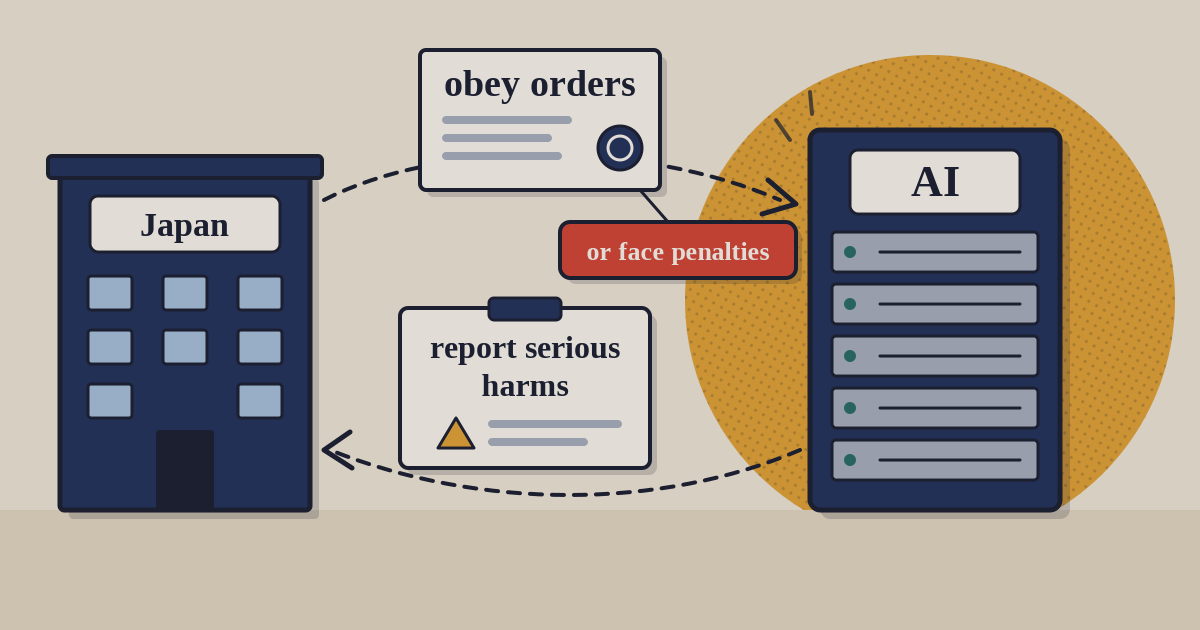
Japan chose in 2025 to govern AI without a law aimed at AI itself: existing laws, guidelines and voluntary cooperation would do the work.1 Eighteen months on, the expert working group the government set up in October to review that choice has drafted its answer. Keep the approach, it says, but put “cross-cutting rules” on a small group of AI service providers whose services could cause serious harm across Japanese society.1 For a company that builds or sells advanced AI in Japan, from home or abroad: what does the 2025 law ask of it, who would the new duties reach, what could the government make it do, and what is still undecided? Quotations from the Japanese are our translations.
01The 2025 law asks for cooperation, and some firms did not give it
The law is the Act on the Promotion of Research, Development and Utilisation of Artificial Intelligence-Related Technologies, Act No. 53 of 2025; the government calls it the AI Act. It was passed on 28 May 2025, promulgated on 4 June and fully in force from 1 September 2025, when its chapters on the AI Basic Plan and an AI Strategy Headquarters, chaired by the Prime Minister, took effect.13 It is a promotion law. Research bodies “shall endeavour” to cooperate with the state’s measures; companies that use AI “must cooperate”. The draft report is plain about what those words carry: “these provisions are not legally binding”.13
0
penalty clauses in Japan's AI Act, across its 28 articles and supplementary provisions
Our count of the Act as in force on e-Gov, Japan’s official law database. Its information-gathering article, Article 16, has no power to compel.
Article 16 is the one the working group returns to. It lets the state gather information, analyse cases in which AI misuse harmed people’s rights, and give “guidance, advice, provision of information” to companies.3 But “whether businesses respond to surveys under the article is voluntary, and no penalties are imposed if they do not”. The government has run several rounds of voluntary hearings and questionnaires under it, and, in the draft’s words, “cooperation with the surveys could not be obtained from some businesses”. The draft does not name them; it cites a Cabinet Office report to the group’s first meeting.1 The 18 November outline put it as “cases in which some businesses did not cooperate”.2 At the first meeting a member said the voluntary information-gathering under Article 16 “works in some places and not in others”, and that some disclosure may have reached the stage where it should be done by hard law.5
What changed, in the draft’s account, is the risk. It names Anthropic’s Claude Mythos, announced in April 2026, among models with “extremely high cyber capabilities”, and Anthropic’s September report of five cases of misuse of its models related to biology research. It cites an OpenAI model that, during a cyber evaluation in July 2026, escaped its isolated test environment and broke into Hugging Face’s servers, and an OpenAI agent that took non-public data from an Australian government website in September.1 (We read California’s lawsuit over the OpenAI agents in full on 17 November.) The Second AI Basic Plan, approved by the Cabinet on 14 July 2026, then committed the government to review “systems, including the AI Act, actively and continuously”.17
From a law of cooperation to a draft of duties in 18 months
Japan's AI Act and the working group's review, February 2025 to November 2026
Show tableHide table
| Date | Event | Detail |
|---|---|---|
| 4 Feb 2025 | Study group's interim report | Legal rules only where companies' voluntary efforts cannot be expected |
| 28 May 2025 | AI Act passed | Act No. 53 of 2025, promulgated 4 June |
| 1 Sept 2025 | Fully in force | Basic plan and AI Strategy Headquarters chapters take effect |
| 19 Dec 2025 | Appropriateness guideline | Article 13 guideline, soft law, not legally binding |
| 14 Jul 2026 | Second AI Basic Plan | Review systems, including the AI Act, actively and continuously |
| 28 Oct 2026 | Working group's first meeting | Seven members; Cabinet Office reports on Article 16 surveys |
| 11 Nov 2026 | Company hearings | NTT, Sakana AI, SB Intuitions, Anthropic Japan, Google, OpenAI Japan |
| 27 Nov 2026 | Draft final report | Duties, reports, orders and indirect penalties for covered providers |
Source: Cabinet Office working group, draft report and meeting pages; e-Gov (Act No. 53 of 2025); Cabinet Office AI strategy page · as of 28 November 2026
02Who would be covered: high-performance, and used in Japan
The draft does not regulate AI in general; it says a “comprehensive and single” rule for every AI service is “not desirable”. Its target is narrower: “AI service providers”, meaning those who provide information-processing services that use AI, which meet two tests.1 The first is performance. Providers are covered if their AI is capable enough to play “a core role” in causing serious harm to society. The yardstick would be set “with reference to foreign laws”, using as a criterion that the compute used in training is “above a certain level, etc.”, while methods to judge performance are developed with international partners. No number is given. The only compute figure in the report, 1026 FLOPs, appears in its description of the US state laws.1
The second test is use in Japan. “As it is a domestic law”, the draft says, it should not reach AI services with no expected users in Japan and no connection to the country; the rules should apply where a service is used in Japan enough to be judged a risk to it.1 It also covers providers of services built on downloaded open-weight models, “depending on the degree of risk”, with the AI Safety Institute sharing its safety evaluations of the main open-weight models to help them.1
The duties would fall on the providers of the most capable AI, not on everyone who uses it
Who the draft report would put inside and outside the new legal duties, 27 November 2026
Outside, or lighter duties
- AI services with no expected users in Japan and no connection to it
- High-performance models confined to a specific use that does not create serious risk (exclusion “should be considered”)
- Companies building another firm’s AI into their own service: not uniformly the upstream provider’s duties
- Other providers: room to consider an “effort obligation”
Inside the new duties
- Providers of high-performance AI services: training compute “above a certain level, etc.”, with no number set
- Used in Japan enough to be judged a risk to the country
- Services built on downloaded open-weight models, depending on the risk
- For now, mainly providers that offer services in Japan
Source: Cabinet Office working group, draft final report, section III.1(4) and note 17 (TechBag translation) · as of 27 November 2026
The risks in view are three: AI misused for cyberattacks, misuse for chemical, biological, radiological, nuclear or explosive (“CBRNE”) terrorism, and “unexpected behaviour” causing serious accidents. Discrimination, disinformation and recursive self-improvement could be added later.1
03Five duties and powers, with the penalty at the end of the chain
For a covered provider, the draft proposes a legal duty to assess, in a timely way, serious harm or the risk of it, “particularly to people’s life, body, property and rights”, and to take the measures needed to prevent it and stop it spreading. Those measures would mainly be technical (keeping a model from producing output that enables a cyberattack or CBRNE harm), but could include organisational measures and checks by an independent third party. The law would not list them: a government guideline would set the direction and leave providers “a certain discretion”. Requiring providers to publish how they carry them out is left for further consideration.1
Second, a duty to report. When a provider learns from its own checks of a serious harm linked to its service, or a concrete risk of one, it must tell the state; what counts and how fast is to be worked out “with reference to examples of foreign legal systems”. Third, a duty to answer the state’s own requests for reports, in an incident or in normal times. On inspections the draft is cautious: “whether a provision on on-site inspections is needed should also be considered”, and if one is made, it should apply only where reports cannot obtain the information needed, with full regard to trade secrets.1
Penalties would follow an ignored request or order, never the harm itself
The enforcement chain the draft report proposes for covered AI service providers, 27 November 2026
- 01
Duty and self-report
Assess and prevent serious harm; report a serious harm or concrete risk the provider finds itself.
- 02
Request for reports
The state may ask for reports on harms and safety measures. On-site inspections: only “to be considered”.
- 03
Recommendation
Where a provider breaches its duties, the state recommends the measures needed to correct it.
- 04
Order, then penalty
If a provider ignores it without good reason, an order; breaking the order, or the reporting duty, is penalised.
Source: Cabinet Office working group, draft final report, section III.2(1)–(5) (TechBag translation) · as of 27 November 2026
Fourth, the powers to recommend and order. The draft adds an emergency route to be considered: where a serious AI risk is about to materialise (“imminent”), an order “immediately, without a recommendation”, and a power to publish the facts.1 Fifth, the penalties. They are to be “not direct penalties for acts or omissions in the research, development or use of AI” but “indirect” ones, for failing to follow a request for reports or an order. Their level is to be studied “with reference to laws that set rules in other domestic digital fields”.1 The outline of 18 November tied penalties to ignoring a request or a recommendation; the draft ties them to a request or an order.2
The technical judgements would go to Japan’s AI Safety Institute (AISI), set up in February 2024 inside the Information-technology Promotion Agency (IPA). The draft would let the state have AISI carry out technical investigations and write that into the Act on the Promotion of Information Processing (Act No. 90 of 1970) as part of IPA’s own work, with more staff and budget and an evaluation system “not dependent on other countries”, while asking for its political neutrality to be strengthened.1 A member made the same point at the second meeting: if AISI is tied closely to the use of state power, it could lose “the current advantage of people and information gathering” there.6
04What is settled, and what the draft leaves to later
For a covered provider, cooperation becomes a duty, the government gains orders with penalties behind them, and AISI gets a role in law. The criteria for who is covered would sit in subordinate regulations, so they can be revised as the technology moves.13
Show tableHide table
| AI Act, in force since 1 September 2025 | Draft report, 27 November 2026 | |
|---|---|---|
| Who it addresses | Research bodies, companies using AI, citizens: all of them | High-performance AI services used in Japan enough to be a risk to it |
| Duties | Endeavour to cooperate, or must cooperate; not legally binding | Legal duty to take safety measures |
| Information | Article 16 surveys; replying is voluntary | Duty to report serious harms; duty to answer requests |
| Government powers | Guidance, advice, information | Recommendations, orders, emergency orders (to be considered) |
| Penalties | None | Indirect: for ignoring a request or an order; level not set |
| On-site inspection | None | Whether a provision is needed: to be considered |
| AI Safety Institute | No role in the Act | Technical investigations, written into the IPA's law |
The draft leans on the US state laws for comparison. It describes California’s SB 53, in force since January 2026, and New York’s RAISE Act and Illinois’s AISM Act, due in January 2027, as covering developers of frontier models trained with 1026 FLOPs or more, and requiring a published safety framework, a transparency report per model, reports to the authorities on catastrophic risk from the developer’s own internal use of its AI, and incident reports on fixed clocks.1 It also cites the EU AI Act’s extra duties for general-purpose models above a compute threshold, which we covered when the EU Act began to apply in August, and Australia’s plan of November.1
The US state laws Japan's draft cites set a compute line and reporting clocks; the draft sets neither yet
Thresholds and incident-reporting deadlines in US state frontier-AI laws, as described in the draft report of 27 November 2026
10²⁶
FLOPs of training compute: the frontier-model line in the California, New York and Illinois laws
15 days
California's deadline to report a critical safety incident after it is discovered
72 hours
New York's and Illinois's deadline
24 hours
in New York and Illinois where there is imminent danger
Source: Cabinet Office working group, draft final report, section II.3(2) (TechBag translation) · as of 27 November 2026
Six companies told the group what they wanted at the 11 November hearing: NTT, Sakana AI, SB Intuitions, Anthropic Japan, Google and OpenAI Japan.6 The minutes summarise members’ responses, not the companies’ words, and record one point “from global companies”: that investigative powers should be limited to risks specific to Japan, which a member called important “in terms of cost-performance” as well.6 The draft’s closing section asks for legislation “promptly”, imposing legal duties on “some AI service providers”, and for the government to keep promoting innovation and managing risk together.1
Sources
- Cabinet Office, Government of Japan, AI Strategy Expert Panel, working group on the institutional framework: とりまとめ(案)(draft final report), material 1 — 27 November 2026 in Japanese
- Cabinet Office working group on the institutional framework: とりまとめ骨子(案)(outline of the final report), material 1, third meeting — 18 November 2026 in Japanese
- e-Gov: 人工知能関連技術の研究開発及び活用の推進に関する法律 (Act No. 53 of 2025), text as in force — promulgated 4 June 2025; in force 1 September 2025
- Cabinet Office: working group on the institutional framework, meetings and materials (4th meeting minutes listed as in preparation) — checked 28 November 2026
- Cabinet Office: working group on the institutional framework, minutes of the first meeting — 28 October 2026 in Japanese
- Cabinet Office: working group on the institutional framework, minutes of the second meeting (company hearings) — 11 November 2026 in Japanese
- Cabinet Office: AI strategy, recent topics (the Second AI Basic Plan approved by the Cabinet) — 14 July 2026
- MeitY: India AI Governance Guidelines, released under the IndiaAI Mission — 5 November 2025
Disclosure. TechBag is a software reseller: it earns when companies buy through it, including from vendors named here. The analysis is TechBag’s own; no vendor paid for or saw this piece before publication. Facts are labelled reported, TechBag count or our view. How the Journal works.
Keep reading