AI in the enterpriseAnalysis
Riemann Hypothesis: a 17-million-line Lean proof, made with Claude, is certified correct
The Lean maintainers’ statement of 21 November, the author’s note and MIT’s verification log: what was proved, how a 61.57 GB proof is checked, and what the US$1m prize still requires.

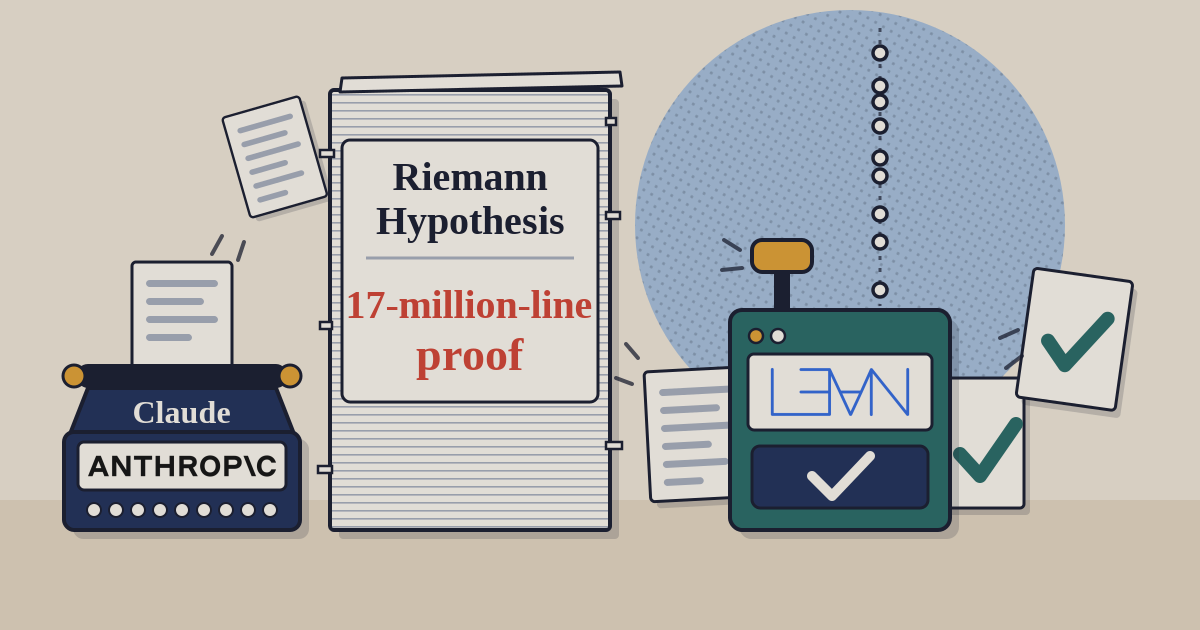
A proof of the Riemann Hypothesis, the 167-year-old conjecture about how the prime numbers are spread, has been certified correct by the organisations that maintain the Lean proof language and its mathematics library.1 It is 17 million lines of Lean code, released on 20 November by Levent Alpöge, a number theorist at Anthropic, the company that makes the Claude AI models.11013 No journal has published it, and by the author’s own account he does not yet command the whole argument. What exists is code that proof-checking programs accept. This piece sets out what was proved, how a proof of this kind is checked, what the check cannot tell anyone, and what the US$1m prize attached to the problem requires.
The proof is 17 million lines of code that export to a 61.57 GB file
Size of the Lean library released on 20 November 2026, and of the exported proof the checkers read
17 million
lines of Lean code in the library
Lean FRO and Mathlib Initiative
175,187
modules, all compiled with zero errors
MIT log
61.57 GB
the exported proof, the file every checker reads
MIT log
3
axioms the five theorems rest on, all standard
MIT log
Source: Lean FRO and Mathlib Initiative, joint statement; Andrew Sutherland, verification log, MIT · as of 24 November 2026, 7:45pm IST
01What was released, and what the certificate says
Alpöge posted a four-page note and a source archive in 14 parts, 239 MB in all.23 “I believe I have, working with Claude, discovered a proof of the Riemann Hypothesis,” the note says. “In fact, the method easily extends much further, resolving the so-called Generalized Riemann Hypothesis.” There is no written proof alongside it: “I decided to only present Lean.”2
The next day the Lean Focused Research Organization (Lean FRO) and the Mathlib Initiative published a joint statement: “We have full confidence that Alpöge’s proof of the Riemann Hypothesis is correct.” They give four grounds. The statement being proved is the one already in Mathlib, “carefully vetted by experts in Lean and number theory”. The library compiles, and “dozens of people” reproduced the same export file. Two independent tools confirm that the theorem proved is exactly Mathlib’s statement. And several proof checkers accept the exported proof.1
On Claude’s part, the note says the two worked together in “recent months” and that “Claude far outpaced me near the finish line”; Alpöge writes that he “guided us to the right situation”, after which “Claude began to leave me in awe”. Its “rough timeline Claude provided after a thorough search” lists 20 steps dated from 6 October to 16 November, the last reading simply “GRH”. The note names no Claude model or version and gives no figure for the computing used.2 Anthropic’s news and research pages carried no statement on the proof when we read them.
From the first dated step to a certificate of correctness took 46 days
Dated events in the proof’s making and checking, 6 October to 24 November 2026
Show tableHide table
| Date | Event | Detail |
|---|---|---|
| 6 Oct 2026 | First dated step | “Stepanov determinant”, the first entry in the note’s timeline |
| 16 Nov 2026 | “GRH” | The last entry in the note’s timeline |
| 20 Nov 2026 | Library released | 17 million lines; the first independent kernel accepts the export the same day |
| 21 Nov 2026 | Certified | Joint statement; a sandboxed rebuild reproduces the export byte for byte |
| 22 Nov 2026 | Lean’s kernel accepts | After 48 hours 3 minutes on one thread |
| 23 Nov 2026 | Clay page: “Active” | The page’s metadata records a change that day |
| 24 Nov 2026 | One run outstanding | The last stage of lake comparator, as of 05:25 UTC |
Source: Alpöge’s note; Lean FRO and Mathlib Initiative; Sutherland’s log, MIT; Clay Mathematics Institute page metadata · as of 24 November 2026, 7:45pm IST
The library proves five theorems. What they cover and what they leave out, as the MIT log sets it out:
Show tableHide table
| Statement | Status | What it says |
|---|---|---|
| The Riemann Hypothesis, in Mathlib’s own definition | Proved, kernel-checked | Every zero of the zeta function other than the trivial zeros −2, −4, −6, … has real part 1/2 |
| The same statement in the library’s own wording | Proved, kernel-checked | Lean accepts the two as equal by definition |
| Dirichlet L-functions: no zeros right of the line | Proved, kernel-checked | For every modulus and every character, primitive or not, no zero has real part above 1/2 |
| Dirichlet L-functions: zeros in the critical strip | Proved, kernel-checked | Any zero with real part between 0 and 1 has real part exactly 1/2 |
| The same for primitive characters | Proved, kernel-checked | The form in which the Generalized Riemann Hypothesis for Dirichlet L-functions is usually stated |
| Dedekind zeta, Hecke and automorphic L-functions in general | Not among the statements checked | The log says so in terms |
| The “Extended Riemann Hypothesis” | Not released | The author expects it “with more time” |
02What the hypothesis says, and why primes depend on it
The zeta function is an infinite sum, 1 + 1/2s + 1/3s + 1/4s and so on, studied for complex values of s. In a memoir published in 1859, Bernhard Riemann showed that the number of primes below any limit can be written in terms of the points where that function equals zero.7 Some zeros are easy, the “trivial” ones at −2, −4, −6 and onwards. The hypothesis is that every other zero has a real part of exactly one half, so that plotted on the complex plane they all sit on one vertical line. Riemann wrote only that this was “very likely”.7
167 years
since Riemann’s memoir of 1859 stated the hypothesis
David Hilbert put it on his list of 23 problems in 1900. The Clay Mathematics Institute attached US$1m to it in 2000. Source: Clay Mathematics Institute.
Primes care because the zeros control the error. The Clay institute puts it this way: “The prime number theorem determines the average distribution of the primes. The Riemann hypothesis tells us about the deviation from the average.”4 The count of primes up to x follows a smooth curve that Gauss proposed; the hypothesis is equivalent to saying the count never strays from that curve by more than a constant multiple of the square root of x times its logarithm.7 Another equivalent form mentions no zeros at all: for every whole number n above 5,040, the sum of n’s divisors is less than a fixed constant times n times the logarithm of the logarithm of n. The MIT log shows that inequality, too, passing the kernels as a consequence of the proof.3
Until this month the evidence was numerical and partial. Computers had confirmed the first 10 trillion zeros.4 Proofs covered only a share of them: in August Anthropic said an unreleased research version of Claude had raised the proven share from 41.6% to 67.2%, a result Alpöge and a colleague examined, and added, “We don’t expect that the techniques Claude used will lead to proving the Riemann hypothesis.”10
In August, proofs covered 67.2% of the zeta function’s zeros; November’s covers all of them
Share of the Riemann zeta function’s zeros proved to lie on the critical line, by result
41.6%
Before August 2026
The longstanding bound, as Anthropic gives it
67.2%
August 2026
An unreleased research version of Claude, Anthropic says
100%
November 2026
The Lean proof, as certified
Source: Anthropic, research post of 10 August 2026; Lean FRO and Mathlib Initiative, 21 November 2026 · as of 24 November 2026, 7:45pm IST
Dirichlet L-functions are relatives of the zeta function that track primes in arithmetic progressions, such as the primes that leave a remainder of 1 when divided by 4.7 The generalised hypothesis says their zeros lie on the same line, and it is the version with consequences for computing. “We know there are some algorithms that we run where they’re very quick, but we don’t actually know for sure if they work,” Kevin Buzzard, professor of pure mathematics at Imperial College London, told Al Jazeera. “They seem to work, and we know that if the generalised Riemann hypothesis is true, then they do work.”9
03How a 61.57 GB proof is checked
Lean is a programming language in which definitions, theorems and proofs are all code. At its centre is a kernel, a small program that checks each step against the rules of logic. Everything else, whether a person typed it or an AI model generated it, is untrusted: it counts only if the kernel accepts what it produces. Buzzard set out the questions to ask of such code on his Xena project blog on 12 November, eight days before the release: does the Lean statement match the mathematical one, does the code compile, does it prove the theorem as stated rather than a quietly redefined one, and does it exploit a bug in the kernel?8 The last is not hypothetical. A soundness bug was found in Lean’s kernel and, he writes, fixed four hours later, which is why a proof is now put through several kernels written by different people.8 The joint statement says the four criteria “are all satisfied”.1
Four checks stand between 17 million lines of code and a certified theorem
How the Lean proof of the Riemann Hypothesis was verified, 20 to 24 November 2026
- 01
The statement
The hypothesis exactly as Mathlib already defined it, set down in a file that imports nothing but Mathlib.
- 02
The build
All 175,187 modules compile with zero errors. A sandboxed rebuild on a separate machine reproduces the export byte for byte.
- 03
The export
The proof is written out as an inert 61.57 GB file, out of reach of any code in the library.
- 04
The kernels
Lean’s kernel and independently written checkers re-check the export. Comparison tools match the theorem and the axioms.
Source: Lean FRO and Mathlib Initiative; Kevin Buzzard, Xena project; Andrew Sutherland, verification log, MIT · as of 24 November 2026, 7:45pm IST
Andrew Sutherland of MIT keeps the fullest record, with every log file and hash; his page says the checks were “run with Claude Code”.3 The five theorems depend on three axioms only, printed in Lean as propext, Classical.choice and Quot.sound: that statements which imply each other are equal, the axiom of choice, and a rule for treating equivalent objects as one. Lean’s own kernel accepted the export after 48 hours 3 minutes on a single thread, using 82.6 GiB of memory at its peak. Others were far quicker:3
Show tableHide table
| Checker | Result | Time |
|---|---|---|
| Lean’s default kernel (v4.36.0) | Accepts | 48 h 3 min on one thread; 82.6 GiB peak |
| Lean’s “paranoid” kernel | Accepts | 72 h 20 min on one thread; 98.8 GiB peak |
| nanoda, an independent kernel written in Rust | Accepts | 27 min 42 s on 80 threads |
| con-leche, an independently written kernel | Accepts 1,468,418 declarations | 3 min 15 s on 64 threads |
| lean4lean | 175,187 of 175,187 modules pass | Module by module |
| Comparator v4.33.0 | “Your solution is okay!” | 64 h 8 min |
| lake comparator (v4.36.0) | Two of three stages accepted | Last stage still running at 05:25 UTC, 24 November |
The statement adds that con-leche and its Rust port con-ron “come with a formal proof, relative to set theory, that they cannot accept a false proof”.1 The run still outstanding is the newest end-to-end tool; its final stage is the single-threaded kernel that took 48 hours on its own.3
That is a different assurance from peer review. A referee reads an argument, judges whether it is right and whether it is new, and can miss a gap. A kernel misses no step and judges nothing. Trust moves from a reader’s understanding to a few small programs and the definitions they are handed.
04What the check does not give: an explanation
The author is plain about this. “I am presenting the world with a complete argument before having mastered a massive neighbourhood around its mathematics,” Alpöge writes. At the decisive stage he was, “so to speak, out of my element”, having “little mastery of automorphic forms on higher rank groups”. He did generate a prose version and held it back: “It being obviously inappropriate to attempt to post some massive unreadable travesty of ‘slop’, I decided to only present Lean.” A footnote gives its length: “I of course amused myself, and hit 250,000+ pages.” He expects the argument to be “massively simplified” and says he intends “to write it properly”.2
At the minute, we don’t even know why the theorem is true.
Buzzard said the code “might correspond to tens of thousands of pages of mathematics” and that nobody yet knows how much of it is new; with people already translating it back into English, he expects “a much better understanding” within a week or two. Abhishek Saha, professor of mathematics at Queen Mary University of London, told the same outlet the credit belongs to the person: “Much of the press is referring to this as a proof by Claude. I think they should instead credit the person involved.”9 The Register reported on 24 November that Stanford’s Ravi Vakil has since released a draft proof of nearly 1,000 pages by Alessandro Maria Masullo; we have not read that draft.11
The note also addresses its own timing. Alpöge writes that the result came “late Sunday night”, that he “messaged Dario” about announcing it (Anthropic’s chief executive is Dario Amodei) and that “there was a constraint to respect”, which he does not name. “There is an obvious cynical view, to do with the timing, but it is false.”2 Anthropic’s shares began trading on Nasdaq on 19 November, the day before the release. Anthropic is not the only laboratory with such a claim. OpenAI said in September that an unreleased model had solved the Navier–Stokes problem, Al Jazeera notes, and Clay lists that problem beside this one.95
05The US$1m prize: “Active”, not solved
When we read it on 24 November, Clay’s page for the Riemann Hypothesis carried the label “Active”. Internet Archive copies of 20 and 21 November show “Unsolved”, and the page’s metadata records a change on 23 November.412 The institute’s index now sorts its seven problems into two “Active problems” (Navier–Stokes and Riemann), four “Unsolved problems” and one solved, the Poincaré conjecture.5 Neither page defines “Active” or mentions the Lean proof.
The prize rules, adopted on 26 September 2018, say Clay may award a prize “if and only if” the proposed solution has been published by a “Qualifying Outlet”, “at least two (2) years have elapsed since publication”, it “has achieved general acceptance in the global mathematics community”, and it answers the official problem description, the last two “in the sole discretion of CMI”. A qualifying outlet is “a refereed mathematics publication of worldwide repute” or one the board approves under relaxed conditions. Clay accepts no direct submissions. After two years it may convene a committee of at least three, and it “will pay special attention to the question of whether a Prize solution depends crucially on insights published prior”. The rules do not mention machine-checked proofs or software.6
Sources
- Lean FRO and Mathlib Initiative: Lean verification of the Riemann Hypothesis, joint statement (Lean community blog) — 21 November 2026
- Levent Alpöge: note announcing the proof, four pages — undated; released 20 November 2026
- Andrew Sutherland, MIT: Verification files for the Lean proof of the Riemann Hypothesis — page last updated 24 November 2026, 05:25 UTC
- Clay Mathematics Institute: Riemann Hypothesis (Millennium Prize problem page) — page metadata last modified 23 November 2026
- Clay Mathematics Institute: The Millennium Prize Problems (index) — page metadata last modified 11 September 2026
- Clay Mathematics Institute: Millennium Prize Description and Rules — 26 September 2018
- E. Bombieri: Problems of the Millennium: the Riemann Hypothesis (Clay’s official problem description) — undated
- Kevin Buzzard, Xena project: “…and the proof is checked in Lean” — 12 November 2026
- Al Jazeera: Riemann hypothesis: Has the world’s most famous maths problem been cracked? — 21 November 2026
- Anthropic: Claude has improved on a longstanding lower bound for the fraction of zeros of the Riemann zeta function that satisfy the Riemann hypothesis — 10 August 2026, updated 13 August 2026
- The Register: Anthropic says Claude solved an age-old math problem, but the written proof is 250,000 pages of slop — 24 November 2026
- Internet Archive: captures of Clay’s Riemann Hypothesis page, 20, 21 and 23 November 2026 — 21 November 2026
- Levent Alpöge: homepage — undated
Disclosure. TechBag is a software reseller: it earns when companies buy through it, including from vendors named here. The analysis is TechBag’s own; no vendor paid for or saw this piece before publication. Facts are labelled reported, TechBag count or our view. How the Journal works.
Keep reading