Kuaishou’s revenue fell 11.1% and Kling’s costs rose: an operating loss of RMB635m
Kuaishou’s results for July to September: ads down 11.1%, live streaming down 19.0%, R&D up 41.9% for Kling, and US$2.9bn raised for Kling with buy-back rights attached.

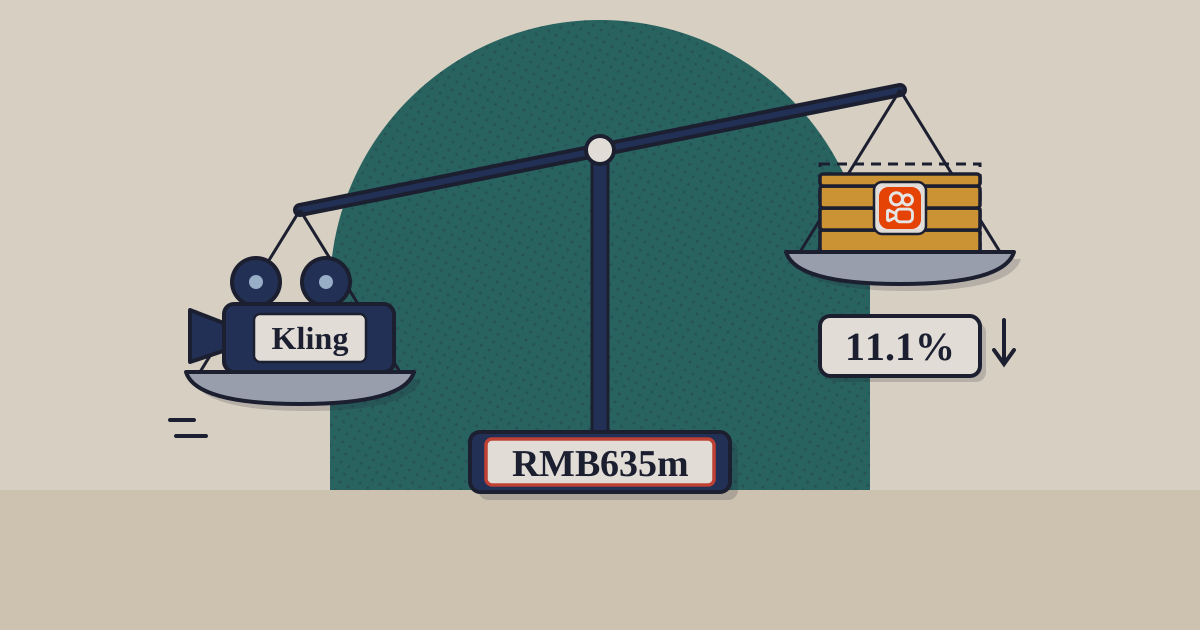
Kuaishou, the Beijing company behind China’s Kuaishou short-video app and the Kling AI video generator, made an operating loss of RMB635m in July–September, against an operating profit of RMB5.3bn a year earlier, as revenue fell 11.1% to RMB31.6bn.1 The loss for the quarter was RMB959m, against a RMB4.5bn profit, and adjusted net profit, Kuaishou’s own measure, fell 84.2% to RMB790m. Kuaishou attributes the fall in its domestic operating profit to lower domestic revenue and “increased investments in Kling AI”.1
−11.1%
revenue, to RMB31.6bn; also down 11.1% from April–June
HKEX filing
RMB635m
operating loss, from a RMB5.3bn operating profit a year earlier
HKEX filing
+41.9%
R&D spending, to RMB5.2bn, mainly for Kling AI and its training
HKEX filing
RMB42.8
ad revenue per daily user, from RMB48.3 a year earlier
HKEX filing
01Where the revenue went
Online marketing, Kuaishou’s advertising, fell 11.1% to RMB17.9bn, which it attributes to lower e-commerce marketing spending amid “intensifying competition across the e-commerce sector”. Advertising from other sectors did better: marketing spending by content businesses, led by short dramas, many of them AI-generated, more than doubled. Live streaming fell 19.0% to RMB7.8bn. Other services rose 1.5% to RMB6.0bn on games and Kling AI revenue, partly offset by lower e-commerce revenue.1 Daily users rose 0.3% to 417.3m, and Kuaishou says the time each spent on the app fell year on year “due to market competition”. Advertising revenue per daily user dropped to RMB42.8 from RMB48.3.1
02What turned the profit into a loss
Revenue-sharing costs rose 3.8% to RMB11.4bn even as revenue fell, mainly on advertising revenue shared over short dramas, and gross margin fell to 48.2% from 54.7%. Research and development rose 41.9% to RMB5.2bn, “primarily attributable to the increased investment in Kling AI, including the related training expenditures”. Administrative costs rose 127.6% to RMB1.6bn, mainly on RMB0.7bn of share-based pay under share participation schemes adopted for Beijing Kling, the subsidiary that runs Kling.1 The domestic segment’s operating profit fell to RMB420m from RMB5.4bn. Kling 4.0, announced in September, makes videos of up to 30 seconds; Kuaishou does not give Kling’s own revenue in the announcement.1
Lower gross profit and RMB2.4bn more R&D and admin cost erased a RMB5.3bn operating profit
Kuaishou: how much each line reduced operating profit, July–September 2026 against July–September 2025, RMB m
Source: Kuaishou Technology, results announcement, HKEX, 19 November 2026 · as of 19 November 2026 · Offsets: selling and marketing cost RMB937m less, other income RMB58m more; operating profit fell RMB5,934m in all
03Outside money for Kling, with a buy-back promise
Investors subscribed about RMB19.8bn (US$2.9bn) for new equity in Beijing Kling under an agreement of 2 July, completed on 30 October; RMB17.9bn arrived in the quarter. Each investor can require Beijing Kling to buy its stake back if certain events occur, so Kuaishou books a RMB15.4bn liability and puts the most it could owe at the investment plus 8% a year in simple interest; that interest, RMB48m this quarter, is left out of adjusted profit.1 Borrowings stood at RMB27.3bn, against RMB13.1bn in December, after US$1.5bn and RMB3.5bn of bonds in January. Kuaishou still bought back HK$1.4bn of its shares in the quarter.1
It expects that “revenue and profitability may continue to be under pressure” in October–December, citing softer traffic and continued spending on Kling.1 On 20 November, the first session after the results, the Hong Kong shares closed at HK$20.42, 11.4% below the previous day.2 Among its peers, Baidu reported AI cloud revenue up 94% as its ads fell, and Tencent’s capex rose 527%.
Sources
Disclosure. TechBag is a software reseller: it earns when companies buy through it, including from vendors named here. The analysis is TechBag’s own; no vendor paid for or saw this piece before publication. Facts are labelled reported, TechBag count or our view.
Keep reading