AI in the enterpriseAnalysis
Mercor raised US$750m at US$20bn selling expert judgment to AI labs
Mercor’s Series D of 10 November, read with its own posts since 2024: how a hiring start-up became a US$20bn supplier of expert-made AI training data, who pays, and what its breach showed.

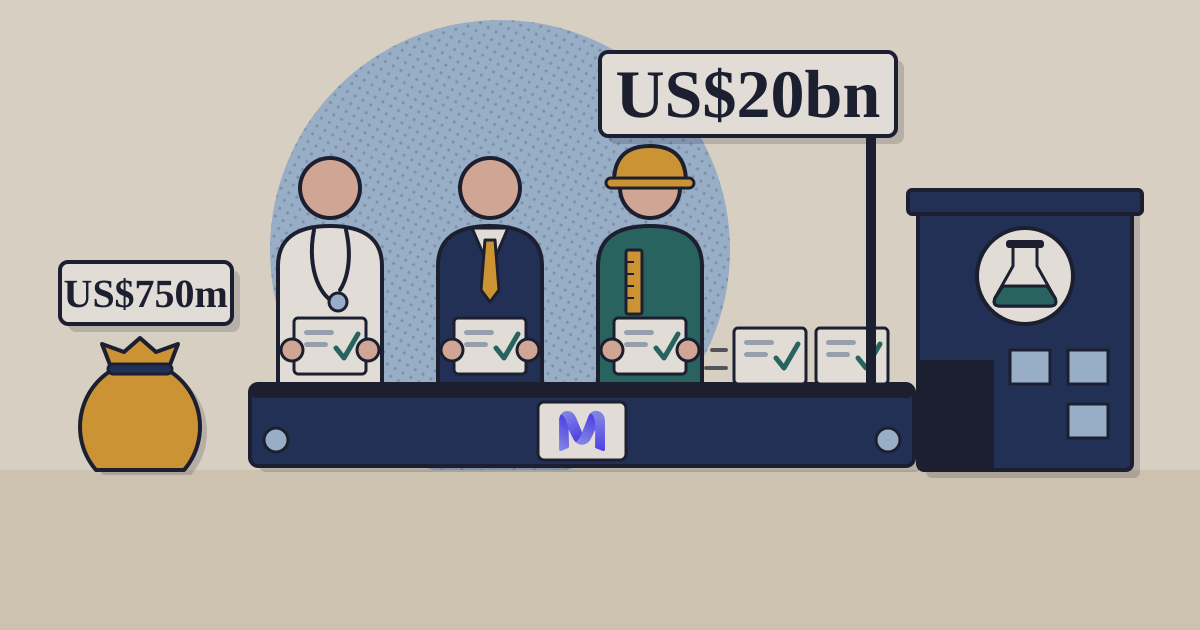
Mercor is one of a handful of companies that AI labs pay to make training data by hand, and since 10 November it is valued at US$20bn. This piece reads Mercor’s own posts since 2024, and the fully readable reporting around them, for four things: what the work is and who pays for it, how a hiring start-up became a data supplier, what a US$2bn run rate does and does not mean, and what a breach in March showed about depending on a few buyers.
01What Mercor sells: expert hours, turned into training data
A model learns language from text gathered at scale. To do a lawyer’s or an analyst’s job, it needs examples and grades written by people who do that job. Mercor’s own guide lists the stages: supervised fine-tuning on pairs of prompts and expert answers; reinforcement learning from human feedback, in which people rank a model’s answers; and evals, sets of tasks with known good answers that test whether training worked. It says a lab will likely need human experts, not synthetic data, to push past what current models can do.21 The newest layer is the “environment”: recreated software where an agent practises a workflow, with tasks and “verifiers” that score it. Mercor says its experts write the tasks and verifiers.12
For the expert, the job description is short: review model outputs in your field, create examples that “teach models how experts think”, and grade quality against set standards. Most projects require at least undergraduate-level expertise, many need years of experience or an advanced degree, and applicants first sit an AI interview that adapts its questions to their field. Projects run for weeks to months and “can be extended, shortened, or concluded early” depending on the customer.4
A lab pays for the expert's hours plus Mercor's percentage, and gets data back
How a Mercor project moves, as Mercor describes it on its expert, docs and company pages
- 01
A buyer scopes the work
A lab or company asks for a dataset, an eval or an environment, and agrees an hourly rate for each kind of expert.
- 02
Mercor finds the experts
Applicants take an AI interview; matched ones join a project. Over 5m people are in the network.
- 03
Experts make and grade
They write prompts, answers, rubrics and tasks, and rank model outputs, often on the customer’s own platform.
- 04
Money flows back
The buyer is billed; experts are paid weekly as contractors; Mercor keeps a fixed percentage.
Source: Mercor experts page and Incentive Structure guide; Mercor security-incident update; Deeptune post · as of 10 November 2026
The pricing is cost-plus. In Mercor’s words, “the vendor and client together decide what the right level of compensation is for the talent, and the vendor takes a fixed percentage of that.” It recommends paying by the hour rather than by the task, saying per-task pay pushes people to rush and skip hard tasks, and that many of the top labs it works with have adopted hourly pay. It recommends hiring annotators as contractors, who, it notes, do not get employees’ benefits.5 Its expert page gives an average contracted rate of US$90 an hour and 734,000 roles created.4 The network and the workforce are different sizes: over five million people are in the network, while in May Mercor counted more than 30,000 weekly active contractors.110
02From a hiring app to a data supplier in two years
Mercor was founded in 2023.2 Its founders, chief executive Brendan Foody, chief technology officer Adarsh Hiremath and chief operating officer Surya Midha, were three 21-year-old Thiel Fellows when it raised its Series B; its mission page now signs Foody and Hiremath as co-CEOs.153 It started as a hiring company that judged candidates from interview transcripts, résumés and portfolio sites, then, in CNBC’s account, found it had built a network of specialists and turned to hiring them to train AI models.16 When it raised its Series A in September 2024, Reuters still called it an AI hiring platform, with more than 300,000 people in its candidate pool.14 At its Series B in February 2025 it said its “current focus is on contracting experts to help advance the frontier of AI”, and that it was growing more than 51% a month.7
Foody set out the logic in March 2025. Mercor began 2024 “in our apartment with no US employees, under $1M in annual revenue, and only seed companies as customers”, and grew 6,400% that year. Labs were the wedge: they report how a contractor performed within days, against about three months at a typical employer, which trains Mercor’s hiring models faster, and they make “unreasonable asks” such as 300 people in two days, which force automation. The plan he published had four steps: hire people to train AI models, use those contracts to learn to predict job performance, expand to short contract roles, then “hire people for all jobs”.6
Four priced rounds in 26 months, with a breach and a paused customer in between
Mercor's funding rounds and the events of 2026, September 2024 to November 2026
Show tableHide table
| Date | Event | Detail |
|---|---|---|
| 19 Sept 2024 | Series A | US$30m at US$250m, led by Benchmark (Reuters; TechCrunch gives US$32m) |
| 20 Feb 2025 | Series B | US$100m at US$2bn, led by Felicis |
| 27 Oct 2025 | Series C | US$350m at US$10bn, led by Felicis |
| 31 Mar 2026 | Breach confirmed | via a compromised release of the open-source LiteLLM tool |
| 3 Apr 2026 | Meta pauses work | indefinitely, two sources told Wired |
| 6 Jul 2026 | US$2bn run rate | Foody: crossed in June, four months after US$1bn |
| 9 Jul 2026 | Deeptune deal | Mercor to buy the environment builder; US$20bn talks reported |
| 10 Nov 2026 | Series D | US$750m at US$20bn |
Source: Mercor blog posts; Reuters; TechCrunch; Wired; Brendan Foody on X · as of 10 November 2026
A competitor’s deal opened the market wider. In June 2025 Meta paid US$14.3bn for 49% of Scale AI, and some large labs, including Google and OpenAI, reportedly cut ties with Scale. “It just doesn’t happen too often in startups where your biggest competitor gets torpedoed overnight,” Hiremath told Forbes.16 Four months later Mercor’s Series C valued it at five times its Series B.8 The field is still crowded: Wired lists Surge, Handshake, Turing, Labelbox and Scale AI as rivals.17
03US$20bn, and what a US$2bn run rate means
The valuation rose eight-fold, then five-fold, then two-fold. General Catalyst led a US$3.6m seed in 2023; Benchmark led the Series A at US$250m; Felicis led the Series B at US$2bn and the Series C at US$10bn; the Series D is at US$20bn.141581 That is 80 times the Series A valuation in 26 months. The US$20bn was on the table by July, when Bloomberg reported that Mercor had told investors it held a term sheet at that price.19
Mercor's valuation rose 80-fold in 26 months, to US$20bn
Valuation at each priced round as announced, US$ billion, September 2024 to November 2026
US$
Show tableHide table
| Valuation, US$bn | |
|---|---|
| Series A, Sep 2024 | 0.25 |
| Series B, Feb 2025 | 2 |
| Series C, Oct 2025 | 10 |
| Series D, Nov 2026 | 20 |
Source: Reuters (Series A); TechCrunch and CNBC (Series B); Mercor Series C and Series D posts · as of 10 November 2026 · Series B valuation also follows from Mercor's statement that the Series C was 5x it
The revenue claim behind it is a run rate. A run rate takes a recent period’s revenue and scales it to a year; TechCrunch described Mercor’s as the latest month times 12.15 Foody wrote on 6 July that Mercor “crossed $2B in ARR in June, just 4 months after hitting $1B”.13 In May its engineers put the path at US$0 to a US$500m run rate in 17 months.10 A run rate is a month’s pace, not a year’s revenue already earned, and Mercor’s projects can be shortened or ended early by the customer.4
It is also gross. Mercor bills the buyer for the expert’s hours plus its percentage and counts the whole bill. The Information, which first reported the figure as “gross annualized revenue”, reported that contractors receive 60% to 70% of billings, as The Next Web relayed; on that range, Mercor keeps about US$600m to US$800m a year of the US$2bn.20 Mercor called itself “a profitable Series C company” in May; it publishes no accounts.10
04Who pays, and what the breach showed
Mercor names no customers on its own pages. It says it spent two years building for “the frontier labs”, and that big tech, open-model developers, application companies and the Fortune 500 are now adopting the same work.1 In May it described itself as “trusted by 6 of 7 Mag 7 companies”, the seven largest US technology stocks.10 In February 2025, most of a US$75m run rate came from AI labs, and Mercor said it worked with the five largest, OpenAI among them.15 Wired named OpenAI and Anthropic among the labs that rely on it.17
In late March 2026 a malicious release of LiteLLM, an open-source tool for routing requests to AI models, harvested credentials from systems that installed it, and Mercor was one of them. It confirmed the incident on 31 March.1118 A group claimed to hold 4TB of its data; Mercor did not comment on that claim, and five contractors sued over their personal data, Business Insider reported.18
Mercor’s account, published on 25 June after a forensic investigation with Google’s Mandiant, is that “only a very limited subset” of nearly five million experts had sensitive information affected, that the impact on customers was limited because many work on their own platforms, and that “all frontier labs have increased their work with us”. It added round-the-clock managed detection, dependency audits and regular credential rotation.11 Neither company has said publicly whether Meta resumed.
Mercor's daily payouts to experts rose from US$1.5m to US$4m in about a year
Paid to experts per day, US$ million, as stated by Mercor, October 2025 to November 2026
US$
Show tableHide table
| Paid to experts per day, US$m | |
|---|---|
| Oct 2025 | 1.5 |
| Mar 2026 | 2 |
| May 2026 | 2 |
| Nov 2026 | 4 |
Source: Mercor Series C post; Mercor company posts of 3 March and 8 May 2026; Mercor newsroom · as of 10 November 2026 · Each value is a floor: Mercor writes 'over' or '+'
The chart shows the mechanism of concentration. Payouts track hours, hours track projects, and projects come from a few buyers who can end them early. When one large buyer stops, its experts stop billing on the same day. Payouts doubled between May and November, after the pause; Mercor has not said which buyers account for the rise.417
05What the US$750m is for
Mercor says the money goes into infrastructure and research for evals and post-training, and into more environments where agents learn complex workflows. It wants enterprises to buy what labs buy: evals built from a company’s own workflows, and the training that follows.1 It launched an enterprise platform in March that maps how staff work, through screen capture, internal wikis and AI-led interviews.24
Deeptune is the environment half. Announced on 9 July, it had recreated “hundreds of enterprise applications”, from spreadsheets to Salesforce, for labs to train agents in; Andreessen Horowitz led its US$43m Series A earlier in the year; Mercor was already a customer, and Foody an early investor. No price was disclosed.12 Foody told Fortune that a purchase was “in a lot of ways the main motivation” for his investment, The Next Web reported.20
Research is the third. Mercor says it raised the score of the open Qwen3.5-397B model on its APEX-Agents benchmark from 16% to 27% of tasks fully passed, and in October it post-trained NVIDIA’s Nemotron 3.5 Super for legal, software and accounting work, with Harvey, Cognition and Ramp as partners.2223 NVIDIA is now also an investor. Mercor has opened offices in New York and London, has more than 400 staff, and says it spends three times as much on AI inference as on employee salaries.12
The Series D in four numbers
Round size and valuation, 10 November 2026; network and staff as stated on Mercor's site
US$750m
Series D, including an employee tender
Mercor
US$20bn
Valuation, twice the Series C's US$10bn
Mercor
5m+
Experts in the network; 30,000+ active weekly in May
Mercor
400+
Employees, in San Francisco, New York and London
Mercor
Source: Mercor Series D post and newsroom · as of 10 November 2026
Sources
- Mercor: Organizing human intelligence for the entire economy (Series D) — 10 November 2026
- Mercor: Newsroom (company facts: founding, payouts, staff, network) — page as of 9 November 2026
- Mercor: Mission (founders' note, offices) — page as of 9 November 2026
- Mercor: Experts page and FAQ (rates, qualifications, AI interview, project length) — page as of 9 November 2026
- Mercor docs: Incentive Structure (cost-plus, hourly pay, contractors) — page as of 9 November 2026
- Mercor: The Secret Mercor Master Plan — 3 March 2025
- Mercor: Announcing Mercor's Series B — 20 February 2025
- Mercor: Unlocking human potential in the AI economy (Series C) — 27 October 2025
- Mercor: Organizing human intelligence to power the AI economy — 3 March 2026
- Mercor: When you go from $2 million a month to $2 million a day — 8 May 2026
- Mercor: Update on Mercor security incident — 25 June 2026
- Mercor: Mercor to acquire Deeptune — 9 July 2026
- Brendan Foody (Mercor CEO) on X: run rate — 6 July 2026
- Reuters via ThePrint: AI hiring platform Mercor backed by Dorsey, Peter Thiel in $30 million fundraise — 19 September 2024
- TechCrunch: Mercor, an AI recruiting startup founded by 21-year-olds, raises $100M at $2B valuation — 20 February 2025
- CNBC: AI startup Mercor now valued at $10 billion with new $350 million funding round — 27 October 2025
- Wired: Meta pauses work with Mercor after data breach puts AI industry secrets at risk — 3 April 2026
- TechCrunch: After data breach, $10B-valued startup Mercor is having a month — 9 April 2026
- TechCrunch: Mercor is in talks for a $20B valuation (citing Bloomberg) — 9 July 2026
- The Next Web: A 23-year-old's AI startup wants a $20bn valuation, months after a breach cost it Meta (citing The Information and Fortune) — 10 July 2026
- Mercor docs: Types of Data (fine-tuning, RLHF, evals) — page as of 9 November 2026
- Mercor: Why Mercor is building a research team — 8 October 2026
- Mercor: Specializing NVIDIA Nemotron 3.5 Super for legal, software and accounting work — 15 October 2026
- Mercor: Introducing Mercor Enterprise AI — 26 March 2026
- Mercor: Supported Countries and Regions — page as of 9 November 2026
Disclosure. TechBag is a software reseller: it earns a margin when a reader buys through it, including from vendors named here. The analysis is TechBag’s own; no vendor paid for or saw this piece before publication. Facts are labelled reported, TechBag count or our view.
Keep reading