Cloud & DevOpsAnalysis
Nebius drops ARR after a US$325m one-off; plans US$40–45bn of capex
What Nebius’s July–September results and filings show: how US$325m of point-in-time revenue lifted a US$980.8m quarter, why it stopped guiding on ARR, and who pays for US$40–45bn of 2027 capex.

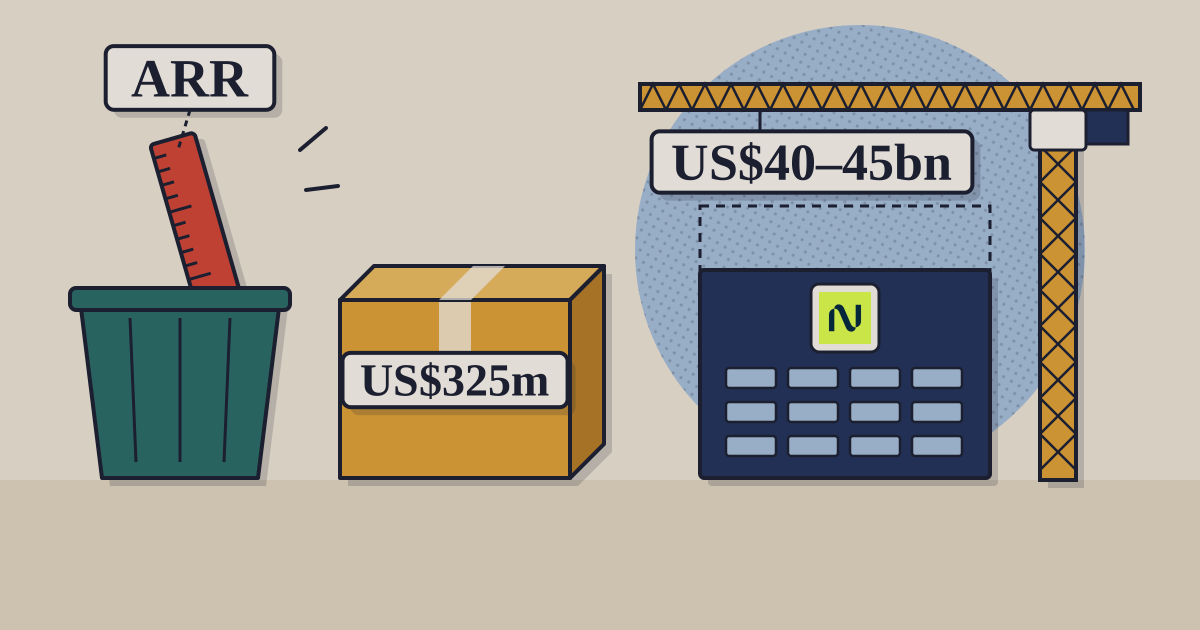
Nebius, based in Amsterdam and listed on Nasdaq, builds and runs GPU data centres and sells the cloud software and managed AI services on top, to AI labs and AI start-ups and, for the first time this quarter, to enterprise data and AI platforms such as Databricks and Snowflake. It reported its third quarter on 12 November, before the US open. We read the shareholder letter, the release and the 6-K filed with the SEC that day, with the three quarters before them, to answer three questions: what the US$325m was, what ARR measured and why Nebius stopped guiding on it, and how customers’ money pays for a US$40–45bn build.123
01A third of the quarter was booked once
Group revenue was US$980.8m, against US$146.1m a year earlier and US$582.3m in April–June: up 571% on the year and 68% on the quarter. The AI cloud business made US$973.8m of it.136 The letter says that “approximately $325 million of non-recurring revenue” came from what Nebius calls its asset-light model; the 6-K gives the exact figure, US$325.1m, under “revenue from strategic partnerships”.14
Nebius set out the model in its August letter. A partner pays for its own data centre, power and hardware; Nebius supplies the cloud software, the system design and the customers. It earns, in its words, “both when we enable our architecture and platform on a partner’s capacity, and as that capacity comes online.”51 The accounting follows: this revenue is recognised “at a point in time”, when Nebius’s right to the payment is established, not month by month like a cloud contract. The 6-K adds that such revenues “are by their nature non-recurring” and their timing “cannot be predicted”.34
One dollar in three of Nebius's July–September revenue came from partnership deals booked at a point in time
Revenue from strategic partnerships as a share of group revenue, July to September and January to September 2026
33.1%
of July–September revenue
US$325.1m of US$980.8m
20.9%
of January–September revenue
US$409.1m of US$1,962.1m
Source: Nebius Form 6-K, Exhibits 99.1 and 99.2 (12 Nov 2026) · as of 12 November 2026
The nine-month figure, US$409.1m, means US$84.0m of partnership revenue was booked in January–June; the first- and second-quarter reports did not show it separately.49 Without the US$325.1m, July–September revenue was about US$655.7m, 13% above April–June. Operating income was US$50.4m, against a loss of US$130.2m a year earlier; it was helped by a longer life for servers, five years instead of four from January, which cut the quarter’s depreciation by US$43.1m. After US$112.5m of interest the quarter ended in a net loss of US$37.5m.34
02What ARR measured, and why Nebius dropped it
Nebius defined ARR as AI cloud revenue from the last month of the quarter, multiplied by 12.7 It is a common yardstick for subscription software, where a month’s billing repeats. It was also the number Nebius steered by: US$551m at the end of September 2025, US$1.25bn at the end of December, US$1.9bn in March, US$3.0bn in June and US$6.4bn in September, up 113% in a quarter.158
We no longer see ARR as the right measure of our business.
The letter gives three reasons: ARR rests on one month of the quarter; partnership revenue “can add choppiness to ARR until such revenue ramps”; and the business is moving to a phase judged on revenue and profit. From 2027 Nebius will guide on revenue, pre-tax earnings and capacity. Its last ARR target stands, moved two months: above US$7bn for the month of February, instead of US$7–9bn by December.1
ARR, one month times 12, ran US$2.5bn ahead of the quarter's AI cloud revenue times four in September
ARR at quarter end and AI cloud revenue for the quarter times four, US$bn, September 2025 to September 2026
- ARR
- Quarter × 4
US$bn
Show tableHide table
| ARR | Quarter × 4 | |
|---|---|---|
| Sep 25 | 0.55 | 0.52 |
| Dec 25 | 1.25 | 0.86 |
| Mar 26 | 1.9 | 1.56 |
| Jun 26 | 3 | 2.3 |
| Sep 26 | 6.4 | 3.9 |
Source: Nebius shareholder letters and 6-Ks, Q3 2025 to Q3 2026 · as of 12 November 2026 · Revenue times four is TechBag arithmetic; ARR is Nebius's figure
03Why a GPU cloud's revenue may not recur
A GPU cloud sells capacity in very different wrappers. Nebius now offers spot capacity that can be taken back, on-demand use, three- to six-month clusters priced at more than twice its reserved rate, reserve auctions, one- to three-year contracts (“our core”) and, this quarter, five-year deals. Each renews, ends or expands on its own clock.1 Contracted revenue not yet earned, its remaining performance obligations, was US$38.7bn at 30 September, up 3% from June; 40% is expected within 24 months and 40% in months 25 to 48. That figure leaves out contracts of a year or less.14
Three customers paid 70% of Nebius's revenue in July–September, against two paying 49% a year earlier
Share of revenue by customer, % (customers with 10% or more shown separately), July to September 2025 and 2026, and January to September 2026
- Largest customer
- Second
- Third
- All other customers
Show tableHide table
| Largest customer | Second | Third | All other customers | |
|---|---|---|---|---|
| Jul–Sep 2025 | 29 | 20 | 0 | 51 |
| Jan–Sep 2026 | 21 | 21 | 20 | 38 |
| Jul–Sep 2026 | 33 | 22 | 15 | 30 |
Source: Nebius Form 6-K, Exhibit 99.2, note on significant customers (12 Nov 2026) · as of 12 November 2026 · Customers are not named in the filing
The filing labels customers by letter only; the largest in July–September took 33% of revenue, and one customer accounted for 75% of the US$4.04bn owed to Nebius at 30 September.4 Delivery dates are the other moving part. Capacity at several colocation sites run by others moved into the first half of 2027. In New Jersey, Nebius now expects to have delivered more than half of the capacity contracted with Microsoft by the end of the year, with the remaining tranches in April–June 2027. Late in July–September, DataOne began retiring some of the site’s temporary generation ahead of permanent power, which reset the schedule; Nebius is moving the site onto Bloom Energy fuel cells. It says Microsoft has been part of the planning and that the contracts behind the delayed capacity remain in place.1
Prices moved the other way. Nebius says prices on deals signed in July–September were more than 20% higher per GPU-hour than in April–June, annual contract value per megawatt passed US$25m from more than US$20m, and its reserve auctions cleared more than 15% above the reserve price.1
04How customers' money pays for the GPUs
The second half of the story is cash. More than 90% of the contract value Nebius signed in July–September carried a prepayment, and on those deals the prepayments covered more than 100% of the related capital spending, including construction and networking, against 50–60% on April–June deals.1 On the balance sheet the money sits as deferred revenue: US$9,409.2m at 30 September, from US$1,577.5m at the end of 2025. Nebius expects it to become revenue over one to five years.24
A prepayment is booked as deferred revenue, spent on GPUs, and earned as the capacity runs
How a prepaid contract moves through Nebius's accounts, as its 6-K and letter describe it, 2026
- 01
Sign
A one- to five-year contract with a prepayment; the weighted prepayment share rose about 20 points in the quarter.
- 02
Bill and collect
The advance enters deferred revenue. Until the customer pays, it also sits in receivables.
- 03
Build
GPUs and data-centre work: US$7.3bn of capital spending in July–September.
- 04
Earn
Deferred revenue becomes revenue as capacity is delivered. Accounting rules charge interest on the advance meanwhile.
Source: Nebius Form 6-K, Exhibits 99.1 and 99.2; Q3 2026 shareholder letter (12 Nov 2026) · as of 12 November 2026
The steps do not land in the same quarter. Deferred revenue rose by US$3,434.0m in July–September, but receivables rose by US$3,761.8m, so operating cash flow was negative US$273.0m in a quarter when the January–June figure was a positive US$4,504.1m.249 Advances also carry a cost. Of the US$112.5m interest expense, US$58.7m was interest on customer advances that contain a “significant financing component” and on equipment suppliers delivered ahead of payment; the 6-K does not split the two.34
05The bill for 2027
3.4×
capital spending planned for 2027 as a multiple of revenue guided for 2027, at the midpoints
US$42.5bn against US$12.5bn. For 2026: about US$27bn of capex, against revenue at the low end of US$3.0–3.4bn.
Nebius raised its 2026 capital spending to about US$27bn, above its US$20–25bn range, to build capacity for 2027 at its own sites. With US$15.43bn spent in the first nine months, that leaves about US$11.6bn for October–December. Revenue at the low end of the range leaves about US$1.04bn for the same quarter. The adjusted EBITDA margin guide of about 40% is unchanged.12 For 2027 it expects revenue of US$12–13bn, “approximately four times” 2026, and a pre-tax profit at breakeven by October–December 2027, after financing costs and with compute written off over five years.1
Capital spending reached US$7.3bn a quarter, and operating cash flow turned negative again in July–September
Purchases of property, equipment and intangibles, and operating cash flow (continuing operations), US$bn, July to September 2025 to July to September 2026
- Capex
- Operating cash flow
US$bn
Show tableHide table
| Capex | Operating cash flow | |
|---|---|---|
| Q3 25 | 0.96 | -0.08 |
| Q4 25 | 2.06 | 0.83 |
| Q1 26 | 2.47 | 2.26 |
| Q2 26 | 5.66 | 2.25 |
| Q3 26 | 7.3 | -0.27 |
Source: Nebius results releases and 6-Ks, Q3 2025 to Q3 2026 · as of 12 November 2026
Nebius expects prepayments and financing against its existing contracts with investment-grade customers to cover 75–85% of 2027 capex: US$10bn of committed prepayments in 2026 and US$17–20bn in 2027, plus loans secured on contracts, of which the first, US$775m at the SOFR benchmark plus 2.50 percentage points, closed in July. It says its agreements with Microsoft and Meta can be financed the same way. That leaves 15–25% of US$40–45bn, about US$6–11bn, for other sources.13 This year those included US$5.75bn of convertible notes in August, about US$1.0bn from selling shares on the market in July–September, and a 364-day US$3.5bn facility from Citi on 22 October at SOFR plus 2.75 points, rising to as much as 3.50. Debt stood at about US$14.2bn on 30 September, and cash at US$7.4bn.124
CoreWeave, which reported two days earlier, answered the same question differently: it paid for most of its quarter’s GPUs with borrowed money, as we set out in our reading of its results; Nebius leans on its customers’ advances first.
Sources
- Nebius Group: Letter to shareholders, Q3 2026 — 12 November 2026
- Nebius Group: Nebius reports third quarter 2026 financial results — 12 November 2026
- Nebius Group: Form 6-K, Exhibit 99.1, Operating and Financial Review, three and nine months to 30 September 2026 — 12 November 2026
- Nebius Group: Form 6-K, Exhibit 99.2, unaudited condensed consolidated financial statements to 30 September 2026 — 12 November 2026
- Nebius Group: Letter to shareholders, Q2 2026 (Form 6-K, Exhibit 99.2) — 12 August 2026
- Nebius Group: Second quarter 2026 financial results (Form 6-K, Exhibit 99.1) — 12 August 2026
- Nebius Group: Letter to shareholders and first quarter 2026 results (Form 6-K, Exhibits 99.1 and 99.2) — 13 May 2026
- Nebius Group: Letter to shareholders and fourth quarter 2025 results (Form 6-K, Exhibits 99.1 and 99.2) — 12 February 2026
- Nebius Group: Form 6-K, Exhibit 99.1, Operating and Financial Review, three and six months to 30 June 2026 — 12 August 2026
- CNBC: Nebius falls 16% as company expects increased 2026 capex spend, issues weak outlook — 12 November 2026
- StockAnalysis: Nebius Group (NBIS) price history — 13 November 2026 Close for 12 November; premarket quote at 9:07am ET, 13 November.
Disclosure. TechBag is a software reseller: it earns when companies buy through it, including from vendors named here. The analysis is TechBag’s own; no vendor paid for or saw this piece before publication. Facts are labelled reported, TechBag count or our view.
Keep reading