OpenAI’s GPT-6.2 Astra costs 20% less than GPT-6 Astra; cached input 60% less
OpenAI’s price page and changelog of 17 November: GPT-6.2 Astra’s per-token rates, cheaper cached input, new background windows, and one month’s bill against Claude and Gemini.

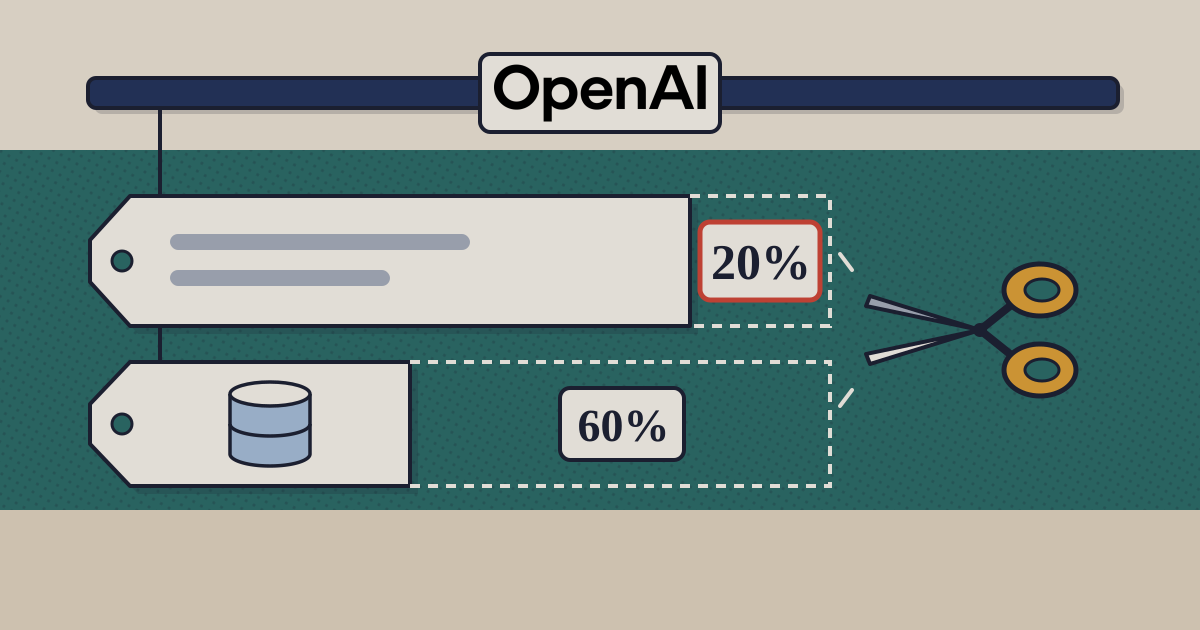
OpenAI released GPT-6.2 Astra on 17 November at US$8 per million input tokens and US$40 per million output tokens. GPT-6 Astra, still on the price list, costs US$10 and US$50: the new model is 20% cheaper on both.12 Cached input, the rate for a prompt prefix the API has already seen, falls further, to US$0.40 from US$1.00, or 60% less.1 The same day OpenAI added background completion windows to its Responses API, in public beta: token rates 30% below Standard for a request that can wait up to two hours, and 40% below for eight hours.2 GPT-6.2 Sol, released alongside, lists at US$2 and US$10, the same as GPT-6.1 Sol.1
−20%
GPT-6.2 Astra input and output against GPT-6 Astra: US$8 and US$40 per million tokens
OpenAI
−60%
cached input: US$0.40 per million tokens, from US$1.00
OpenAI
−30%
token rates for a request with a two-hour completion window
OpenAI
−40%
token rates for an eight-hour completion window
OpenAI
01What else the price page says
The rates hold for prompts of up to 272,000 input tokens. Above that, input and cache rates double and output costs 1.5 times as much, for the whole request; the model accepts up to 922,000 input tokens and returns up to 128,000.3 Writing a prompt into the cache costs US$10 per million tokens for 30 minutes (US$12.50 on GPT-6 Astra) and US$20 for 12 hours.13 Batch jobs cost half the Standard rate, and Fast mode twice. Ultrafast, a tier that shortens the gap between output tokens, costs three times Standard until 28 February 2027 and six times from 1 March.3
The background windows sit between Standard and Batch. Batch suits independent requests submitted together up front; a background request suits an agent run, where the application reads one answer, runs a tool and sends a follow-up. The API aims to finish within the chosen window, and the discount applies to every eligible request in the run, follow-ups included.4 It covers GPT-6.2 Astra, GPT-6.2 Sol, GPT-6.1 Terra and GPT-6 Luna.1
02One month’s bill
On the same tokens, GPT-6.2 Astra costs US$400 a month less than GPT-6 Astra, and as much as Claude Fable 5.2
Monthly list-price bill for 100 million input and 20 million output tokens, US$, prompts up to 272,000 tokens, as listed on 18 November 2026
Source: OpenAI API pricing; Anthropic, Claude Platform pricing; Google, Gemini Developer API pricing · as of 18 November 2026 · TechBag arithmetic on list prices; no caching, tools or taxes
GPT-6.2 Astra now lists at the same per-token rates as Anthropic’s Claude Fable 5.2, US$8 and US$40, and both list Batch at US$4 and US$20. Fable 5.2’s cached input is US$0.20, half of Astra’s.5 Gemini 4 Carbon costs US$2 and US$10 until 30 November and US$4 and US$20 from 1 December.6 Our Note of 14 November priced the same workload on those models.
A bill counts tokens, and the same job does not produce the same tokens on every model: each company splits text with its own tokenizer, and models spend different amounts on reasoning. Two changes in GPT-6.2 also move the count. The Responses API now drops earlier reasoning when an application edits the start of a conversation, and OpenAI says the model “may use more tokens to repeat earlier work”; and top-level instructions are now placed after the input, so reusable instructions only qualify for the cached rate if they go in a developer message at the start.7 Keeping that prefix unchanged is what earns the US$0.40 rate.
What to watch: 1 December, when Gemini 4 Carbon doubles, and 1 March 2027, when Ultrafast doubles to six times Standard. For an Indian buyer, OpenAI adds 10% to any regional-processing endpoint for models released since 5 March 2026; when we read its terms on 12 November, processing inside India covered only GPT-6 Luna.1
Sources
- OpenAI: API pricing (Standard, Batch, Fast and Ultrafast tables; background-window and regional-processing notes) — undated page, as read 18 November 2026
- OpenAI: API changelog (GPT-6.2 Astra and GPT-6.2 Sol; background completion windows) — entries of 17 November 2026
- OpenAI: GPT-6.2 Astra model page (context window, long-context, Batch, Fast and Ultrafast rates) — undated page, as read 18 November 2026
- OpenAI: Background mode guide (choose a completion window) — undated page, as read 18 November 2026
- Anthropic: Claude Platform pricing (Claude Fable 5.2 and 5.1) — undated page, as read 18 November 2026
- Google: Gemini Developer API pricing (Gemini 4 Carbon) — rates through 30 November and from 1 December 2026, as read 18 November 2026
- OpenAI: Using GPT-6.2 (what’s new: prefix edits, instructions field) — undated page, as read 18 November 2026
Disclosure. TechBag is a software reseller: it earns when companies buy through it, including from vendors named here. The analysis is TechBag’s own; no vendor paid for or saw this piece before publication. Facts are labelled reported, TechBag count or our view.
Keep reading