RBI’s mule-account rules: 7 days to explain a debit hold; police get 30 days
The RBI’s directions of 27 November for six types of bank, in force from 1 July 2027: when a bank may hold an account’s debits, the clocks that run, and what changed since the draft.

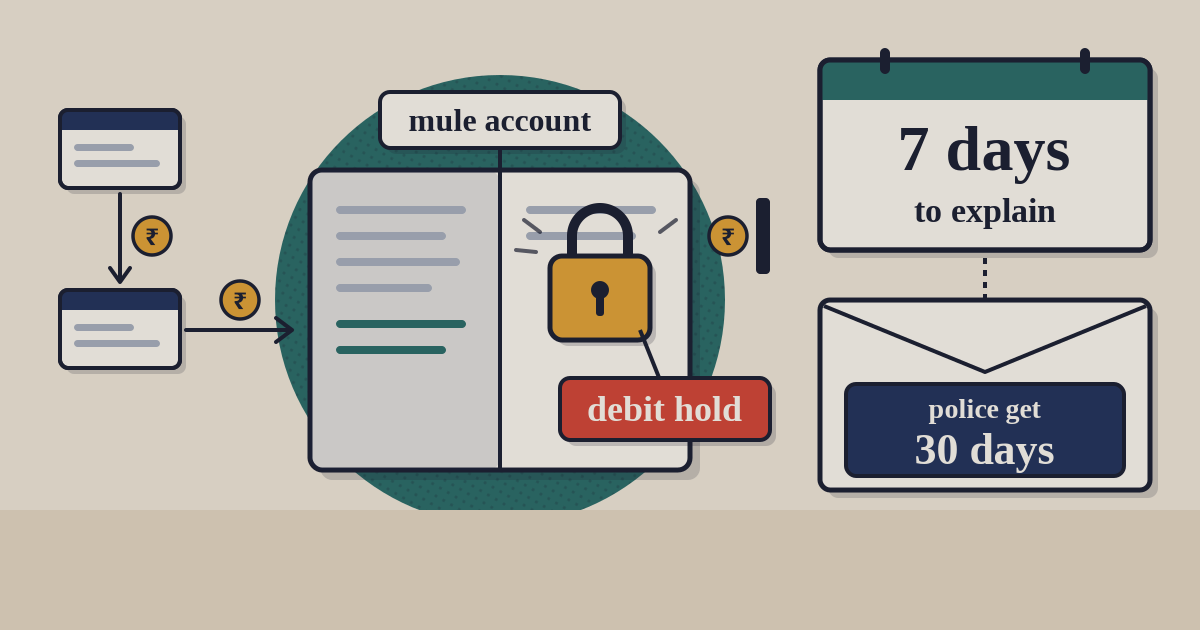
Indian banks may place a debit hold, blocking every payment out, on an account they believe is a money mule account, one used to receive and pass on the proceeds of fraud, on their own assessment, under a procedure the Reserve Bank of India (RBI) issued on 27 November.1 The holder has seven calendar days to explain. If the bank is not satisfied, or hears nothing, it reports to the police; if no direction to keep the hold arrives within 30 days, the bank lifts it on the 31st day, provided its enhanced due diligence is satisfied. Records are kept for five years.2 The rules cover commercial, small finance, payments, local area, regional rural and urban co-operative banks, from 1 July 2027 or earlier if a bank chooses.1 7
7 days
to explain, against 20 in the September draft
RBI
30 days
for the police after the bank’s report
RBI
₹1,000
the draft’s minimum amount, now dropped
RBI
5 years
records of each hold kept
RBI
01What a mule account is, and what the hold stops
The RBI defines a mule account as one “used on behalf of another person, knowingly or unknowingly, to receive, layer or transfer” the proceeds of fraud, money laundering or terrorist financing; accounts used so on the holder’s own behalf are covered too.2 A victim’s money lands in one account and is moved through others before it is withdrawn; that chain is what the rules aim to break, in frauds such as the one Spandana Sphoorty reported. Respondents told the RBI that a fixed threshold “may encourage fraudsters to structure transactions below the prescribed limit”, so it dropped one.3
A hold means “not allowing any debit”, on one amount or the whole account, through every channel: the RBI refused to let cheques clear or to exempt ECS debits and statutory dues. The directions say nothing about money coming in.2 3 An account-level hold needs “a high degree of suspicion” and senior approval, and “mechanical application” is to be avoided. Holds ordered by the police or through the national cybercrime portal follow those orders instead.2 3
02The clock, if you are flagged by mistake
The bank must tell you promptly by SMS or email, or by the end of the next working day, with the reason, how to get the hold lifted and the handling officer’s contact details, then decide within seven days of your explanation. Nodal officers for complaints must be listed on its website and in branches; complaints are resolved within 30 days, and an unresolved one can go to the RBI Ombudsman.2 3 A complaint does not pause the hold. Asked to add compensation for wrongful holds, the RBI pointed to the Ombudsman.3
Without a police or court direction, a bank’s own hold ends on the 31st day after its report
Steps and time limits for a debit hold a bank places itself, RBI directions of 27 November 2026, in force from 1 July 2027
- 01
Hold and notice
The bank blocks debits and tells the holder why, with senior approval for a whole account.
- 02
Seven days
The holder explains within seven calendar days; the bank decides within seven more.
- 03
Police report
Not satisfied, or no reply: the hold stays, the bank reports with reasons and runs enhanced due diligence.
- 04
Day 31
No direction within 30 days of the report: the hold is lifted, if the due diligence is satisfied.
Source: RBI, Commercial Banks KYC Second Amendment Directions, 2026, paragraph 68 (the same for all six bank types) · as of 29 November 2026, 12:30pm IST
03What changed, and what banks must build
The RBI drafted the rules on 11 September after a Supreme Court order of 4 August.4 Its feedback statement records the changes: 7 days to explain instead of 20, 7 to decide instead of 10, no minimum amount. It refused to let banks keep a hold without police instruction, “akin to placing a permanent restriction on the account, the cost of which is borne by the customer”, or to give the police 90 days.3 The start moved from 1 April to 1 July 2027.5 The court’s 29 October order recorded these Directions as due in force by 31 December and said RBI rules must make institutions that failed in due diligence compensate victims.6 The final text has no compensation clause; who pays is in the RBI’s draft of 23 November.
Banks’ fraud and operations teams must build detection on “objective parameters” in their own policy (the RBI declined to set them), approvals, notices with the required content, tracking for the 7, 7 and 30-day clocks, police reporting, a five-year record of every hold and letter, and a complaints log; existing holds may be reviewed.2 3 NBFCs and payment aggregators are not among the six bank types.1
Sources
- RBI, press release: Amendment Directions on suspected money mule accounts (2026-2027/1584) — 27 November 2026
- RBI (Commercial Banks – Know Your Customer) Second Amendment Directions, 2026 — 27 November 2026
- RBI, statement on the feedback received on the draft (press release Annex) — 27 November 2026
- RBI, press release: comments invited on the draft KYC Amendment Directions — 11 September 2026
- RBI, Draft (Know Your Customer) Amendment Directions, 2026 — 11 September 2026
- Supreme Court of India, record of proceedings, SMW(Crl) No. 3/2025 (copy hosted by MediaNama) — 29 October 2026
- RBI (Small Finance Banks – Know Your Customer) Second Amendment Directions, 2026; the other four at Id=13765 to 13768 — 27 November 2026
Disclosure. TechBag is a software reseller: it earns when companies buy through it, including from vendors named here. The analysis is TechBag’s own; no vendor paid for or saw this piece before publication. Facts are labelled reported, TechBag count or our view. How the Journal works.
Keep reading