Sarvam’s upgraded 105B: ₹10 in, ₹25 out per million tokens, and open weights at 65 GB
Sarvam’s posts of 22 and 23 November and its price pages: what the upgraded 105B costs, what its own benchmarks claim, the GPU it runs on, and Dictate at ₹0.50 a minute.

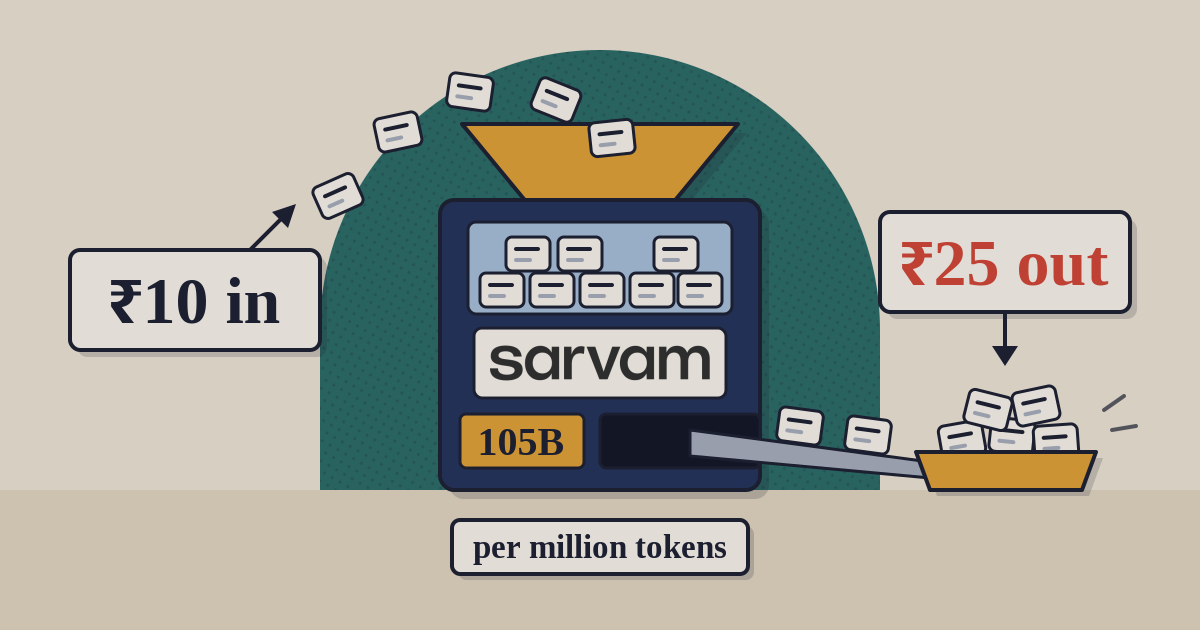
Sarvam’s upgraded 105B model lists at ₹10 per million input tokens and ₹25 per million output tokens on its Token Factory service, with input reused from a cached prompt at ₹0.25 per million. All three prices exclude GST.3 The Bengaluru company released the new version, Sarvam-105B-1711, on 22 November and says its blended price has fallen by two-thirds, from US$0.44 to US$0.15 per million tokens.1 Its API documentation calls the price introductory and says it applies “through the end of 2026”.4
₹10 / ₹25
per million input / output tokens, introductory, excluding GST
Sarvam
73.9
average on eight benchmarks Sarvam ran itself, from 42.6 for the earlier release
Sarvam
65 GB
the open-weight 4-bit version, which fits one 96 GB workstation GPU
Sarvam
₹0.50
per minute of audio for Dictate, its new dictation API
Sarvam
01What the model costs now
With 18% GST the rates come to ₹11.80 and ₹29.50. A workload of 100 million input tokens and 20 million output tokens a month costs ₹1,500 before GST and ₹1,770 with it. Sarvam’s US$0.15 is a blend of three input tokens to one output token at ₹90 to the dollar, and the US$0.44 it compares with is its figure for the first release, which it calls its February release.1 The list moved in steps. At the start of November Sarvam’s documentation priced the same model at ₹15 in and ₹60 out, as we recorded then; against that list, input is a third cheaper and output 58% cheaper.
Show tableHide table
| Model on Sarvam’s list | Input | Cached input | Output | Context |
|---|---|---|---|---|
| Sarvam 105B, from 22 November (introductory) | ₹10 | ₹0.25 | ₹25 | 128K |
| Sarvam 105B, as listed in early November | ₹15 | not recorded | ₹60 | not recorded |
| Sarvam Prism (returns scores, not text) | ₹4 | none | ₹0 | 32K |
| DeepSeek V4.1 Flash, Standard (introductory) | ₹14 | ₹0.25 | ₹55 | 1M |
| Gemma 4 31B | ₹35 | ₹10 | ₹90 | 256K |
Prices are ₹ per million tokens, excluding GST. Sarvam now prices its own model below the DeepSeek model it serves from Indian GPUs.3 One detail differs between its pages: the launch post says training extended the context to 160K tokens, while the model page lists a 128K window.15
02What Sarvam claims, and what runs it
Sarvam places the model in what it calls the Flash-Lite class, built for customer support, voice agents and agentic tasks. On eight benchmarks of instruction following, chat quality, tool calling and Indian languages, run on its own setup, it reports an average of 73.9, against 74.0 for Google’s Gemini 3.5 Flash-Lite at a blended US$0.85 and 73.0 for Gemma 4 31B at US$0.54.1 Its own table also shows where the model trails: 66.9 against Gemini’s 73.0 on GDPval-S work tasks, 62.4 against Gemma’s 68.8 on BFCL v4 tool calling, and a lower average than Qwen3.8 27B, which scores 74.6 at US$0.96. The post cites no independent test.1
The weights are on Hugging Face in two versions, and the model card carries an Apache 2.0 licence; the launch post names none.16 The 65 GB version stores most of the model in a 4-bit format that needs Nvidia’s Blackwell chips. Sarvam says it fits on a single 96 GB RTX PRO 6000 Blackwell, where one user gets 99 tokens a second on a 10,000-token prompt, so a bank or a government department can run it on its own premises.1
03Dictate, and two sets of accuracy figures
A day later Sarvam released Dictate, an API that turns speech into the text the speaker meant to type, in English and 22 Indian languages. It pairs the company’s speech model, Saaras v4, with a version of 105B, and costs ₹0.50 per minute of audio on the pay-as-you-go plan, with both steps included.24 On 2,691 English dictations, Sarvam says 4.2% of characters needed editing, against 7.0% for Gemini 3.5 Transcribe and 5.3% for AssemblyAI Dictation.2 The model post of a day earlier, and the product page, give 5.0%, 8.1% and 10.6% on 2,959 dictations.17 We use the later post. For a buyer the practical points are the same in both: the benchmarks are the vendor’s, the 105B price holds to 31 December, and Sarvam has not published the rate that follows.
Sources
- Sarvam, Introducing Sarvam-105B-1711 — 22 November 2026
- Sarvam, Introducing Sarvam Dictate — 23 November 2026
- Sarvam Token Factory, Pricing (INR per million tokens, excluding GST) — undated page, as read 24 November 2026
- Sarvam API docs, Pricing, Credits & Rate Limits — undated page, as read 24 November 2026
- Sarvam Token Factory, Sarvam 105B model page — undated page, as read 24 November 2026
- Hugging Face, sarvamai/sarvam-105b-1711 model card — 23 November 2026
- Sarvam, Dictate product page — undated page, as read 24 November 2026
- Sarvam, Open-Sourcing Sarvam 30B and 105B — 6 March 2026
Disclosure. TechBag is a software reseller: it earns when companies buy through it, including from vendors named here. The analysis is TechBag’s own; no vendor paid for or saw this piece before publication. Facts are labelled reported, TechBag count or our view. How the Journal works.
Keep reading