Data & privacyNote
Spirit Airlines cleared to sell Google its emails, chats and code for US$10m
The sale terms filed in the US bankruptcy court on 17 November: what Google gets for US$10m, the 97.5m passenger profiles and 20 kinds of staff records left out, and how the rest is scrubbed.

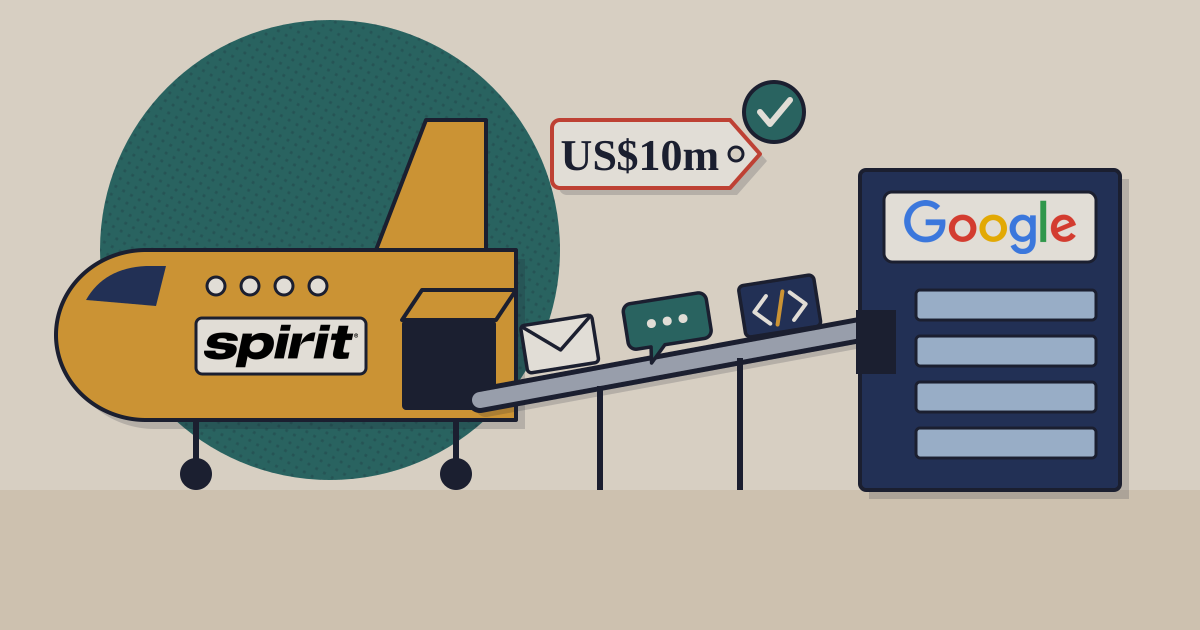
A US bankruptcy judge, Sean Lane, approved on 17 November the sale of the defunct Spirit Airlines’ internal data to Google for US$10m. Google has said it intends to use the data to train AI models.1 Google does not receive the raw files. Under the sale agreement filed that morning, an outside firm, Tonic AI, first removes whole categories of records and transforms the rest so that it cannot reasonably be linked to a passenger or an employee; Google pays for that work on top of the price, and pays the US$10m only when the data is delivered.2
US$10m
price for the data, paid on delivery after de-identification
Sale agreement
1.99bn
emails, from 90,967 accounts, on the asset schedule as “Included”
Sale agreement
97.5m
passenger profiles on the same schedule, marked “Not Included”
Sale agreement
0.1
average identifiability, the ISO/IEC 27559 threshold the scrubbed data must meet
Proposed sale order
01What Google is buying, and what it is not
The asset schedule attached to the sale agreement lists, as included, Spirit’s Microsoft 365 data: 1,986,737,423 emails across 90,967 email accounts, 663,530,348 Teams items and 90,847,707 SharePoint and OneDrive items. It also includes 516 source-code repositories (about 30m lines of code, 372,585 commits and 43,170 pull requests), 667,563 IT tickets, finance files from invoices to board presentations and deal documents, flight, maintenance and fuel records, and pricing data: 3.53bn fare-basis observations and 7.25bn observations of competitors’ fares.2 The 121 lawmakers who wrote to both companies on 8 October put the volume at about 100 million emails and 500 million Teams messages, citing court findings; the schedule does not say what each count measures.3
Marked not included: 97.5m passenger profiles, 50.2m loyalty members, 30.9m recorded calls, chat sessions, booking records, payroll records, tax forms and time cards. The agreement still lets Spirit sell its customer list, with each traveller’s spend aggregated by year, to companies in travel, hospitality and leisure.2
02What is taken out, and how the rest is checked
Exhibit A excludes 20 kinds of employee records, among them medical and disability data, drug and alcohol tests, disciplinary and grievance files, payroll, passports and licences, biometric data, recordings of flight attendants and safety reports. Records in the first 16 kinds that cannot be removed are de-identified instead; the last four are never sold. Confidential data of 19 named suppliers and partners, Airbus, GE Aerospace, Pratt & Whitney, Sabre, Amadeus, Mastercard and Expedia among them, is also out. The unions and those companies get 15 days after the order to propose search terms; if their exclusions cut the data by more than 8%, Google may walk away without paying.2
Tonic must apply the California Consumer Privacy Act’s de-identification standard (HIPAA’s for health data) and then measure the risk of re-identification under ISO/IEC 27559:2022, holding groups of records that share indirect identifiers to an average identifiability of 0.1, the standard’s benchmark for data not released publicly. A verification agent independent of Google and the unions, picked by Spirit after consulting them, checks that assessment on samples before Tonic can certify the data. Google may not try to re-identify anyone, must keep the data confidential and in a secure environment, and binds anyone it passes it to.2
Mercor, the AI training-data start-up, is the alternate bidder if the Google sale does not close.2 How another company sets the terms for its own AI training data is in our Note on Gemini’s retention change.
Sources
- The Record, Judge signs off on sale of Spirit Airlines’ data to Google — 18 November 2026
- Spirit Aviation Holdings, Notice of filing of further revised proposed sale order and further revised sale agreement for the Deidentified Data (Doc 1827, case 25-11897, US Bankruptcy Court SDNY) — 17 November 2026
- Rep. Steven Horsford, Spirit Airlines to sell employee data to train Google AI (release and letter) — 8 October 2026
- Association of Flight Attendants-CWA, AFA wins data privacy protections for former Spirit flight attendants — 10 November 2026
- Epiq, Spirit Aviation Holdings docket: AFA-CWA notice of withdrawal of objection (Doc 1829) — 17 November 2026
- The Record, Lawmakers warn Google could expose Spirit Airlines data in $10 million AI training deal — 9 October 2026
Disclosure. TechBag is a software reseller: it earns when companies buy through it, including from vendors named here. The analysis is TechBag’s own; no vendor paid for or saw this piece before publication. Facts are labelled reported, TechBag count or our view.
Keep reading