Data & privacyNote
California fines Hertz US$1.55m over ignored opt-out signals
CalPrivacy’s orders of 6 November against Hertz, FedEx and Filson: what a browser’s opt-out signal is, how the sites missed it, and the quarterly tests Hertz must now run.

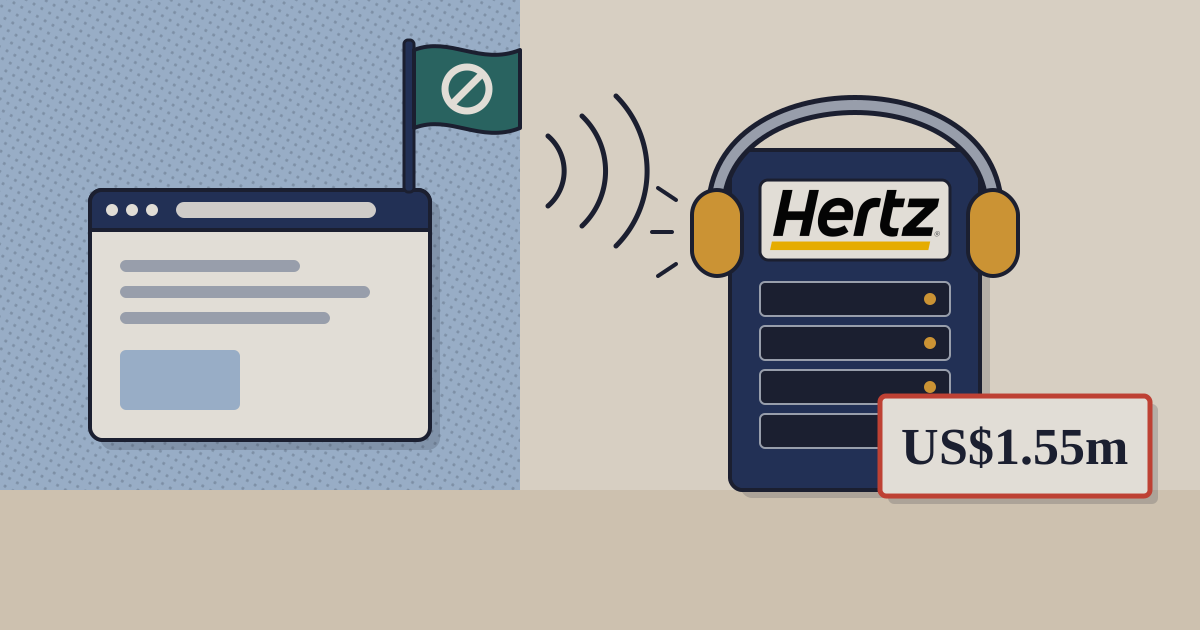
California’s privacy regulator has fined Hertz US$1.55m, a week after it announced a US$2.975m fine on FedEx, and both orders cite the same failure: their websites did not honour the “do not sell or share” signal a browser can send to every site a person visits.12 The California Privacy Protection Agency (CalPrivacy) adopted both orders and a third, against the clothing maker CC Filson, on 6 November, and published Hertz’s and Filson’s on 17 November.3 By our count of the Board’s decisions, FedEx’s and Hertz’s are the two largest of the nine fines it has ordered under the California Consumer Privacy Act (CCPA). Neither is the largest privacy penalty in the state: General Motors agreed to a US$12.75m civil penalty with the Attorney General and district attorneys, working with CalPrivacy.1
US$1.55m
Hertz, also covering its Dollar and Thrifty brands, due within 60 days
CalPrivacy
US$2.975m
FedEx, which told visitors it did not sell or share their data
CalPrivacy
US$217,987
Filson, set after it showed it could not pay a multi-million fine
CalPrivacy
Since 2020
the year California began requiring sites to honour the signal
Hertz order
01The signal the sites ignored
An opt-out preference signal, such as Global Privacy Control (GPC), is a browser-based standard that tells every website a person visits that they are opting out of the sale or sharing of their data. In the order’s words, it does this “by sending a standardized HTTP header and setting a JavaScript property that websites can detect”, so a site can stop its trackers from running. California has required businesses to honour such signals since 2020.4
Hertz’s sites carried trackers from Meta, Google, Pinterest, LinkedIn, Microsoft, TikTok, the Trade Desk, LiveRamp, Adobe, Amazon, Sojern, Criteo and Wunderkind, which passed identifiers and rental search details to advertising firms. For part of the period from July 2023 to August 2026, the order finds, Hertz did not configure its sites to detect the signal and kept selling and sharing that data; its privacy policy did not say how signals were handled; and on Dollar.com and Thrifty.com, a cookie window that showed every toggle off reverted to allowing advertising cookies if the visitor closed it without pressing “Save Changes”.4 Hertz admits the order’s opening facts, including that it sold and shared data for cross-context advertising, neither admits nor denies the rest, and admits no violation.4
FedEx’s privacy policy said it did not sell or share personal information, while trackers from Meta, LinkedIn, Google and Adobe on fedex.com did; it had no “Do Not Sell or Share” link, and switching off its tracking cookies did not stop all of it.5 “The CCPA protects Californians from online surveillance, even in a business-to-business (B2B) setting,” said Tom Kemp of CalPrivacy.2
Hertz and FedEx drew the two largest fines California’s privacy board has ordered
Fines in the CalPrivacy Board’s decisions under the CCPA, US$ thousand, largest first, with the month each was ordered, March 2025 to November 2026
Source: CalPrivacy, Board enforcement decisions and press releases · as of 18 November 2026 · LocateSmarter’s decision was under the CCPA and the Delete Act
02What Hertz must now test, every quarter
For three years, Hertz must scan its sites and apps at least every quarter for trackers that sell or share data, check for the signal before any such tracker loads, and test, in staging and in production, that opt-outs take full effect: on every site, for every tag-management container, on different browsers and mobile platforms, for server-side as well as browser-side trackers, and for visitors it knows and does not. It must test its request forms quarterly, check its consent-management vendor twice a year rather than rely on the vendor’s word, and, when it publishes its yearly request figures, count separately the opt-outs that arrived as signals.4
Filson must stop device-based sales and sharing with advertising firms within 30 days unless an officer certifies, under penalty of perjury, that it meets the order’s audits, tests and training. The order counts at least five prohibited disclosures every time a visitor with the signal on loaded its site.6
Another US rule on how sellers use personal data: New York City’s council has voted 44–5 to ban surveillance pricing.
Sources
- CalPrivacy, Vehicle Rental Services Company Hertz to Pay $1.55 Million CCPA Fine, Adjust Privacy Practices — 17 November 2026
- CalPrivacy, Federal Express to Change Practices and Pay Close to $3 Million Fine Over CCPA Privacy Violations — 10 November 2026
- CalPrivacy, Board enforcement decisions (list, with the earlier releases for each fine) — as listed on 18 November 2026
- CalPrivacy Board, In the Matter of The Hertz Corporation, Order of Decision and Stipulated Final Order, case ENF25-001-V-HE — 6 November 2026
- CalPrivacy Board, In the Matter of Federal Express Corporation, Order of Decision and Stipulated Final Order, case ENF25-073-TS-FE — 6 November 2026
- CalPrivacy Board, In the Matter of CC Filson Co., Order of Decision and Stipulated Final Order, case ENF25-074-R-FI — 6 November 2026
- CalPrivacy, Tractor Supply to pay $1.35M over CCPA violations — 30 September 2025
- CalPrivacy, PlayOn Sports to pay $1.10 million fine — 3 March 2026
- CalPrivacy, Honda settles with CPPA over privacy violations ($632,500) — 12 March 2025
- CalPrivacy, Ford to change practices, pay fine ($375,703) — 5 March 2026
- CalPrivacy, Todd Snyder to pay six-figure fine ($345,178) — 6 May 2025
- CalPrivacy, first action against a data broker under both the CCPA and the Delete Act: LocateSmarter ($116,490) — 11 August 2026
Disclosure. TechBag is a software reseller: it earns when companies buy through it, including from vendors named here. The analysis is TechBag’s own; no vendor paid for or saw this piece before publication. Facts are labelled reported, TechBag count or our view.
Keep reading