TRAI caps IP interconnection ports at ₹5.6 lakh a year, first change in 14 years
TRAI’s amendment of 9 November: what an interconnection port is, who pays for it, how the ₹5.6 lakh and ₹42.3 lakh ceilings were built, and the E1 charges they sit beside.

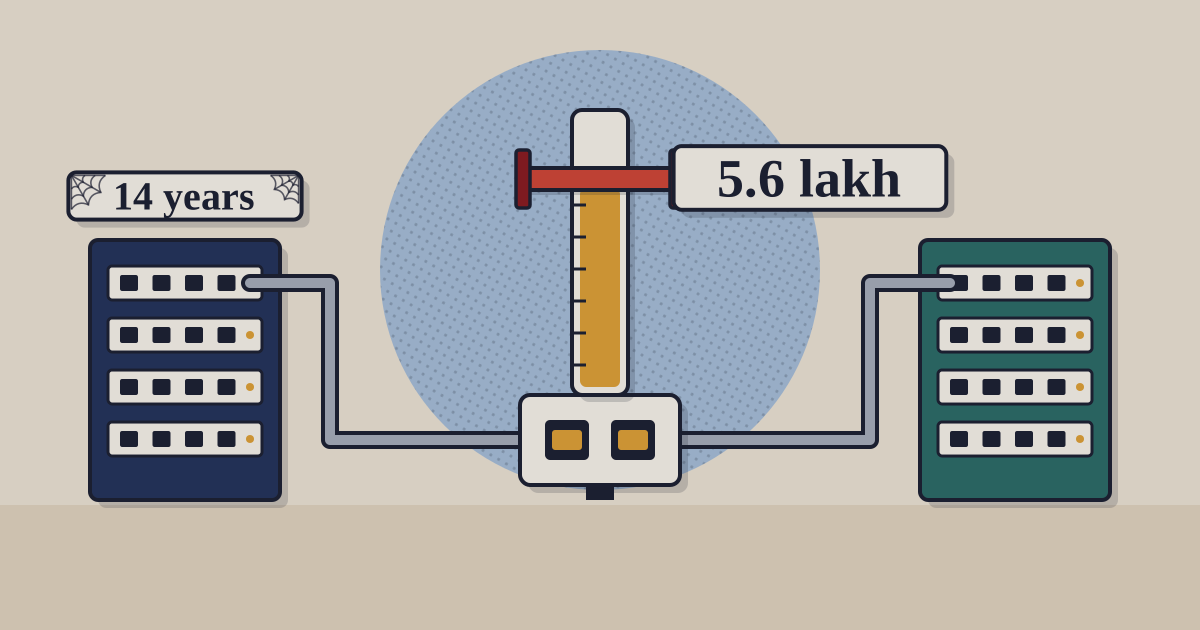
From 1 January 2027, an Indian telecom operator that hands calls to another over an IP link can be charged at most ₹5.6 lakh a year for a 1 Gbps port and ₹42.3 lakh for a 10 Gbps port, under rules the Telecom Regulatory Authority of India notified on 9 November.12 It is the first change to India’s port charges in 14 years. The last, in September 2012, priced only E1 ports, the 2 Mbps circuits of the old switched telephone network: ₹4,000 a year at a mobile switch and ₹10,000 at a tandem or long-distance switch.3 Those E1 charges stay, for E1 ports only.2
01What a port is, and who pays for it
When a customer of one operator calls a customer of another, the call crosses from one network to the other at a point of interconnection. The port is the termination point on the equipment there, where the traffic enters and leaves. The operator asking to connect, the interconnection seeker, pays the operator it connects to for terminating its links.12 These are charges between licensed operators, not a line on a customer’s bill.
Operators have moved their own networks to IP for 4G, 5G and voice over LTE, but calls between them still largely cross on E1 ports. Operators told TRAI the mix causes transcoding delays and poorer call quality between networks, and that the switched equipment is at the end of its life, hard to buy and hard to support. TRAI calls the move to IP interconnection “necessary and unavoidable”, though the amendment sets no date for it.2 The new ceilings apply alike to fixed, mobile, national and international long-distance calls; operators may agree lower charges, or other port sizes priced by the same method.1
02How TRAI built the ceiling
TRAI costed a port as two routers and two session border controllers, the equipment that admits and polices calls, doubled for redundancy, using figures from two operators it does not name. That puts the capital cost at ₹27,87,983 for a 1 Gbps port and ₹2,10,79,413 for 10 Gbps. It then spread the cost over ten years, added a 15% return on the value not yet written off and 10% for overheads, and averaged the result: ₹5,59,688 and ₹42,31,692 a year.2 Those are the same life, return and overhead it used for E1 ports in 2012.3
A megabit of IP port costs ₹560 a year at the new ceiling; over E1 it cost ₹1,953 to ₹4,883
Ceiling on annual port charges per Mbps of port capacity, ₹, E1 ports (from October 2012) and IP ports (from January 2027)
Source: TRAI, Port Charges (Second Amendment) Regulations, 18 September 2012; Port Charges (Third Amendment) Regulations, 9 November 2026 · as of 14 November 2026 · Per-Mbps figures are TechBag arithmetic from TRAI’s per-port ceilings.
Counted by calls rather than megabits, TRAI reckons a 1 Gbps link carries 10,486 calls at once with the AMR voice codec, and a 10 Gbps link 1,04,858.2 At the ceiling, that is about ₹53 a year for each call a 1 Gbps port can hold. The only penalty in the amendment is for late reports under its regulation 3: ₹25,000 a day for the first 15 days, ₹50,000 a day after, up to ₹15 lakh per service area for each instance.2 The review began with a pre-consultation paper in April 2025; 17 parties commented on the consultation paper of November 2025.1 TRAI’s other rules for operators this autumn, on spam calls, are in our Trend on India’s spam complaints. What to watch: how many interconnection points move to IP after 1 January.
Sources
- TRAI, press release 157/2026: TRAI releases the Telecommunication Interconnection (Port Charges) (Third Amendment) Regulations, 2026 — 9 November 2026
- TRAI, Telecommunication Interconnection (Port Charges) (Third Amendment) Regulations, 2026 (11 of 2026), with Explanatory Memorandum and Annexures I–II — 9 November 2026
- TRAI, Telecommunication Interconnection (Port Charges) (Second Amendment) Regulations, 2012, with Explanatory Memorandum — 18 September 2012
Disclosure. TechBag is a software reseller: it earns when companies buy through it, including from vendors named here. The analysis is TechBag’s own; no vendor paid for or saw this piece before publication. Facts are labelled reported, TechBag count or our view.
Keep reading