Data & privacyTrend
India’s spam complaints rose 41% in a quarter; one-year disconnections fell 71%
TRAI’s spam figures for July–September against April–June: 1.53 million complaints, 13,777 numbers cut off for a year, 374 senders blacklisted, and the rules it amended on 18 September.

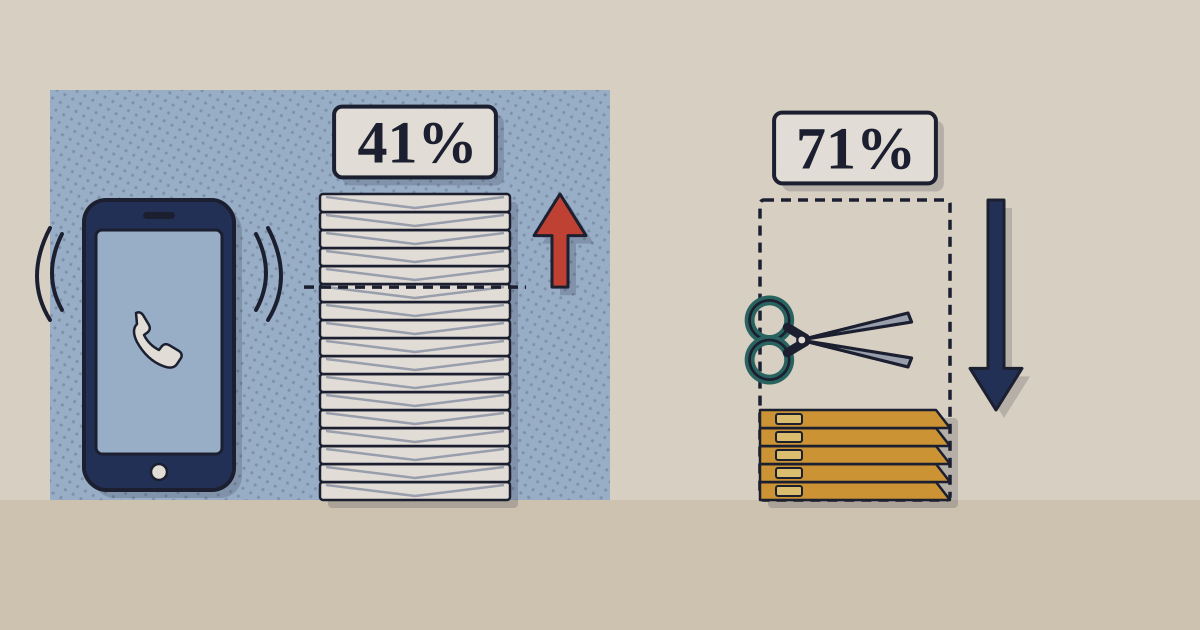
The Telecom Regulatory Authority of India (TRAI) now publishes every quarter what operators did about unsolicited commercial communication: the promotional calls and texts a person did not agree to receive. The latest release, on 13 November, shows complaints rising sharply while one-year disconnections fell. What drives each line, and what changes next?1
01Complaints up 41%, nine in ten through TRAI’s app
Complaints rose even as calls fell: 714.01 billion calls were made in July–September against 730.82 billion in April–June.12 Almost all of the rise came through TRAI’s own DND app, which took 1.421 million complaints, 92.9% of the total, against 0.966 million and 89% a quarter earlier. In 2025 the app carried just over half: 17.06 lakh of 31.09 lakh complaints for the year.4
Spam complaints nearly doubled from 2025’s quarterly pace, almost all through TRAI’s app
Complaints about unsolicited commercial calls and texts, million per quarter: 2025 average, April–June and July–September 2026
- All complaints
- Through the TRAI DND app
million complaints
Show tableHide table
| All complaints | Through the TRAI DND app | |
|---|---|---|
| 2025 avg | 0.777 | 0.427 |
| Apr–Jun | 1.085 | 0.966 |
| Jul–Sep | 1.529 | 1.421 |
Source: TRAI press releases 20/2026, 111/2026 and 158/2026; 2025 average is TechBag arithmetic · as of 13 November 2026 · 2025 is TRAI's annual total divided by four
The app is being pushed hard. Downloads reached 4.236 million on 30 September, from 3.316 million on 30 June and 28.08 lakh at the end of 2025.124 In the quarter TRAI ran campaigns on 132 FM channels, 23 private TV channels and 97 newspapers, and more than 3 billion text messages about the app were sent to customers.1 TRAI says complaints are “the basis for identification of the spammers”, so more complaints are what it is asking for.1
02Fewer numbers cut off, more senders blacklisted
Operators act on “actionable” complaints, the ones that meet the rules’ tests, and the penalty climbs with each violation. A first violation bars the number’s outgoing service for 15 days; a repeat disconnects it for a year. A sender, the business or telemarketer behind the numbers and SMS headers, can be blacklisted for a year, and is then given no new telecom resources by any operator.1
Actionable complaints rose by about 170,000; one-year disconnections fell by 33,000
Actionable complaints, numbers barred for 15 days, and numbers disconnected for one year, April–June against July–September 2026
- Apr–Jun
- Jul–Sep
Show tableHide table
| Apr–Jun | Jul–Sep | |
|---|---|---|
| Actionable | 5,53,000 | 7,23,831 |
| Barred | 1,37,053 | 1,10,325 |
| Disconnected | 46,786 | 13,777 |
Source: TRAI press releases 111/2026 and 158/2026 · as of 13 November 2026
So actionable complaints rose about 31% while barring fell 20% and one-year disconnections 71%. Against each actionable complaint there were about 0.33 actions on numbers in April–June and 0.17 in July–September. The penalties aimed at the sender rose: 374 senders blacklisted against 263, and 3,725 SMS headers blocked against 2,873.12 TRAI’s releases give no reason for the fall in disconnections.
A second route is growing beside complaints. Operators’ AI systems flagged 18.28 billion incoming calls as suspected spam in July–September, 2.6% of all, and sent 4.59 million warnings to suspected senders, against 243,000 in the first week of warnings in June. They re-checked the identity (e-KYC) of 34,025 suspected senders and disconnected 9,977 numbers that failed, a line April–June’s release did not carry.12
03The rules changed on 18 September: what to watch
TRAI’s Third Amendment to its commercial-communication rules, issued on 18 September, ties complaints to the operators’ AI flags. Under it, action against a sender starts at three unique complaints in ten days if the sender’s number is also flagged by the AI system, where five complaints were needed before. Five or more of a sender’s numbers flagged within ten days triggers investigation and graded action, from KYC re-checks to barring and disconnection.3 Businesses that call customers through software must declare those automated calls, and the numbers used, to their operator, or the calls count as spam; an operator receiving them may charge the sending operator up to ₹0.05 a minute.3 Call-blocking apps are barred from blanket-blocking or tagging calls from TRAI’s 140, 1600 and 1601 series, the numbers reserved for registered promotional and service calls.3
What to watch.
- The October–December release: whether the three-complaint trigger lifts disconnections back toward April–June’s 46,786.
- Complaints per million calls, now 2.14: with app downloads still climbing, this line can rise because more people report, not only because more spam is sent.1
- The AI route against the complaint route: 9,977 disconnections after failed KYC already rival the 13,777 made on complaints.1
How TRAI wants operators to answer complaints in general is in our Note on its 2 November amendment.
Sources
- TRAI Press Release 158/2026: Quarterly Highlights of Action Against Unsolicited Commercial Communications, July–September 2026, with Annexures A–C — 13 November 2026
- TRAI Press Release 111/2026: Quarterly Highlights of Action Against Unsolicited Commercial Communications, April–June 2026 — 4 August 2026
- TRAI Press Release 119/2026: TRAI strengthens framework for curbing unsolicited commercial communications (TCCCPR Third Amendment) — 18 September 2026
- TRAI Press Release 20/2026: Over 7 lakh notices, 5.6 lakh restrictions: TRAI tightens grip on spam telemarketers in 2025 — 13 February 2026
Disclosure. TechBag is a software reseller: it earns when companies buy through it, including from vendors named here. The analysis is TechBag’s own; no vendor paid for or saw this piece before publication. Facts are labelled reported, TechBag count or our view.
Keep reading