Buying software in IndiaAnalysis
Copilot's meter goes on by default for reseller buyers: a ₹3,757 cap on a ₹1,745 seat
Microsoft's Partner Center notice of 3 November and its price pages: who gets the default limit of US$40 a user, about ₹3,757 at the 6 November rate, from January to March.

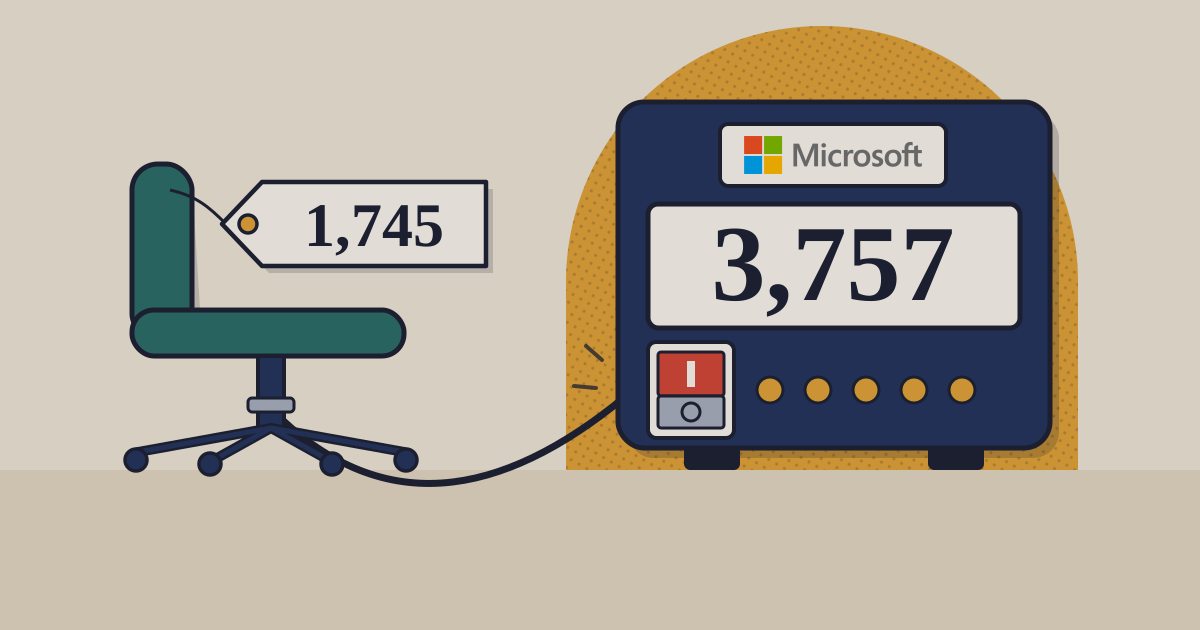
Copilot now has two prices. The seat covers everyday use: chat and Copilot inside Word, Excel, Outlook and Teams. “Advanced AI”, in Microsoft’s words “work you hand off”, runs on a meter.7 Until now a reseller had to connect that meter by hand, and Microsoft says most eligible customers never had it connected.4 The change removes that step. This piece sets out who is affected and when, the largest sum the default allows in rupees, how the charge reaches an invoice, and which settings decide it.
01Who is affected, and from when
The notice of 3 November says usage-based billing “is now enabled by default for new Microsoft 365 Copilot Business subscriptions purchased in Cloud Solution Provider (CSP) during Microsoft’s FY27 Q3 (January-March 2027), instead of December 1, 2026, as previously announced”. Microsoft gives no day. It says a test environment for partners will be available at least 30 days before general availability, and that environment’s own date, 2 November, has been withdrawn with no new one set.1
India was not originally expected to be among the first. The new timelines apply “across all markets, including Australia, Belgium, Brazil, France, Germany, India, Italy, Korea, the Netherlands, Poland, and Spain, where these capabilities were previously not expected to be available initially”.1
Three events switch it on: a new subscription to an eligible offer, seats added through the Partner Center portal, and a trial that converts to paid. One purchase is enough for the whole organisation: it “enable[s] usage-based billing by default for existing Microsoft 365 Copilot Business licenses in the tenant”. Without a purchase event nothing changes, seat changes made through Partner Center’s API do not trigger it, and no default policy is created where one already exists.14
Microsoft pushed the default from 1 December to January–March, and has not named a day
Dates Microsoft has published for Copilot billing, limits and offers, September 2026 to March 2027
Show tableHide table
| Date | Event | Detail |
|---|---|---|
| 25 Sept 2026 | Enterprise rule stated | Metered services stay off until an admin creates a spending policy |
| 2 Nov 2026 | Free Chat limits begin | Fair use limits for tenants of up to 2,000 Microsoft 365 seats |
| 3 Nov 2026 | Default postponed | Moved from 1 December 2026 to January–March 2027 |
| 9 Nov 2026 | Limits reach larger tenants | Fair use limits for tenants above 2,000 seats |
| 1 Dec 2026 | New Copilot offers | No qualifying Microsoft 365 base subscription required; same price |
| 31 Dec 2026 | Seat offer ends | Promotional price for eligible annual purchases |
| 1 Jan 2027 | Default-on quarter opens | Rollout planned to begin during January–March 2027 |
Source: Microsoft Partner Center announcements, October and November 2026; Microsoft Copilot blog · as of 9 November 2026 · The January date marks the start of the quarter; Microsoft says rollout begins during it
02US$40 a user is a ceiling, and more than twice the seat
Microsoft “applies a default spending limit for all eligible services of 4,000 Copilot Credits per user per month for all users in the customer’s organization”. Pay-as-you-go is the default configuration, at US$0.01 a credit, billed in arrears at the end of the month.12 Partner documentation sets the default limit for the whole organisation at 1,200,000 credits, which is 300 users at 4,000 each.4 When a user reaches a limit, access to the metered services stops until credits reset on the first of the month.5
Nothing is charged for a seat that uses only what the seat includes. Microsoft’s India pricing page says everyday AI is included and that the usage-based list today is “Copilot Cowork, Code, Autopilot, and the Work IQ APIs”, adding that more “may be added over time”; the partner notice names Copilot Cowork, Work IQ APIs and GitHub Copilot Harness.31
The default limit per user is more than twice the price of the seat it sits on
Rupees per user per month, before GST: Copilot Business seat prices and metered limits, November 2026
Source: Microsoft India pricing page; Partner Center announcements; Copilot Credits Guide; ECB rate of 6 November · as of 9 November 2026 · Limits are maximums, converted by TechBag at ₹93.92 to US$1; Microsoft's meter is priced in US$
03From checkout to invoice
There is “no separate step to explicitly opt in to usage-based billing at launch”. Partner Center sets up the billing at the moment of purchase “so consumption ‘just works’ without additional manual steps”. Microsoft says roughly three in four Copilot Business customers sold through CSP have no Azure footprint today, so for most the purchase also creates an Azure plan, a subscription and a resource group.4
A seat purchase now also creates the Azure billing and the spending policy behind the meter
What happens when a CSP reseller sells an eligible Copilot Business offer, as Microsoft describes it, November 2026
- 01
The reseller checks out
The same cart as any Copilot subscription. The product tile and cart carry a usage-based billing notice for the partner.
- 02
Azure is set up
A plan, subscription and resource group are created, or an existing plan is reused.
- 03
A default policy applies
4,000 credits per user and 1,200,000 for the organisation, unless a policy already exists.
- 04
Use is billed in arrears
The charge appears with Azure consumption, separate from the seat line on the invoice.
Source: Microsoft Partner Center: Usage-based billing for Microsoft 365 Copilot Business · as of 9 November 2026 · Microsoft says the article describes features not yet released
On the invoice, the charge is “billed separately from - and remain[s] clearly distinguishable from - the Copilot Business seat-based subscription charge”. Because the switch is organisation-wide, Microsoft warns partners that they “might see consumption charges appear for a tenant even when only a subset of seats generated the triggering purchase event”.4
The notices are written to resellers, and they state the commercial reason: “Early usage creates a natural path to expanded consumption, upsell conversations, and the Copilot Cowork activation incentive.” Partners are told: “Help your customers understand their usage-based billing options as they adopt eligible experiences.” In what we could read, the disclosure screens are the partner’s; we found no statement of what the end customer is shown at purchase.14
04Large enterprises get the opposite default
The switch is a small-business and reseller matter. “Microsoft 365 Copilot (Enterprise) isn’t in scope”, and education, nonprofit and government community cloud offers are excluded.4 For enterprise customers, Microsoft wrote on 25 September, usage-based services “stay off until an admin creates a spending policy in the Microsoft 365 admin center, and nothing is billed before that”.7
The same meter starts off for an enterprise and on for a reseller's small-business customer
How Microsoft's usage-based billing is set up by route to market, as stated November 2026
Enterprise: Microsoft 365 Copilot
- Metered services off until an admin creates a spending policy
- The admin picks the billing method and limit when activating
- Limits can be set for the organisation, groups and users
- Outside the CSP default entirely
Reseller route: Copilot Business
- Metered services enabled by the purchase, from January–March 2027
- Pay-as-you-go is the default billing configuration
- Default limit of 4,000 credits per user, 1,200,000 for the organisation
- Offers of up to 300 seats; the reseller invoices seat and usage
Source: Microsoft Copilot blog, 25 September 2026; Partner Center announcements and article, November 2026; Microsoft Learn · as of 9 November 2026
The same page of notices carries a second change, already live. From 2 November for organisations with up to 2,000 Microsoft 365 seats, and from today for larger ones, the free Copilot Chat has fair use limits. “Admins can’t view or adjust them, and Microsoft doesn’t publish specific limits because they’re subject to change”. Partners get a view of which customers’ users are reaching limits, and are told: “This creates a natural opening for you to start the conversation.”1
05The settings that decide the bill
Everything that matters sits in the Microsoft 365 admin center, under Copilot, Cost Management. Global and Billing administrators can create policies and set billing methods; AI and License administrators can edit limits but cannot create policies.6 The separate discovery setting, which Microsoft is replacing, does not control spending: it decides what users can see, while Cost Management “controls access and spending”.9
Six steps for an admin, before the default arrives
Actions in the Microsoft 365 admin center and with the reseller, from Microsoft's documentation, November 2026
Step 1 of 6
Ask the reseller
Ask when your tenant changes, whether a spending policy already exists, and in what currency and at what rate the meter will be invoiced.
Source: Microsoft Learn: managing and setting up usage-based billing; Partner Center article · as of 9 November 2026 · Step 1's questions are ours; Microsoft says policy requirements may evolve
Sources
- Microsoft Partner Center: November 2026 announcements (usage-based billing availability update; Copilot Chat limits) — 3 and 4 November 2026; page updated 6 November 2026
- Microsoft: Copilot Credits Guide — November 2026
- Microsoft India: Microsoft 365 Copilot plans and pricing — offer period 1 July to 31 December 2026
- Microsoft Partner Center: Usage-based billing for Microsoft 365 Copilot Business in Partner Center — last updated 12 October 2026 describes features not yet released
- Microsoft Learn: Managing AI experiences enabled by usage-based billing — last updated 3 November 2026
- Microsoft Learn: Set up usage-based billing for Copilot Credits — updated 4 November 2026
- Microsoft Copilot Blog: Evolution of the Copilot pricing model — 25 September 2026, updated 28 September 2026
- European Central Bank euro reference rates, USD/INR cross rate (via the Frankfurter API) — 6 November 2026
- Microsoft Learn: Discovery setting for AI experiences enabled by usage-based billing — last updated 3 November 2026
- Microsoft Partner Center: October 2026 announcements (new Copilot offers without a base subscription) — October 2026
- India Briefing: Digital services in India: OIDAR, GST applicability and compliance — updated 29 September 2023
Disclosure. TechBag is a software reseller: it earns a margin when a reader buys through it, including from vendors named here. The analysis is TechBag’s own; no vendor paid for or saw this piece before publication. Facts are labelled reported, TechBag count or our view.
Keep reading