WeRide’s robotaxi revenue passed RMB100m in a quarter, more than 90% of it outside China
WeRide’s results for July to September: robotaxi revenue up 204%, revenue up 88% to RMB321.5m, a 43% gross margin, a RMB310m loss, and its Gulf fleet and Spanish permit.

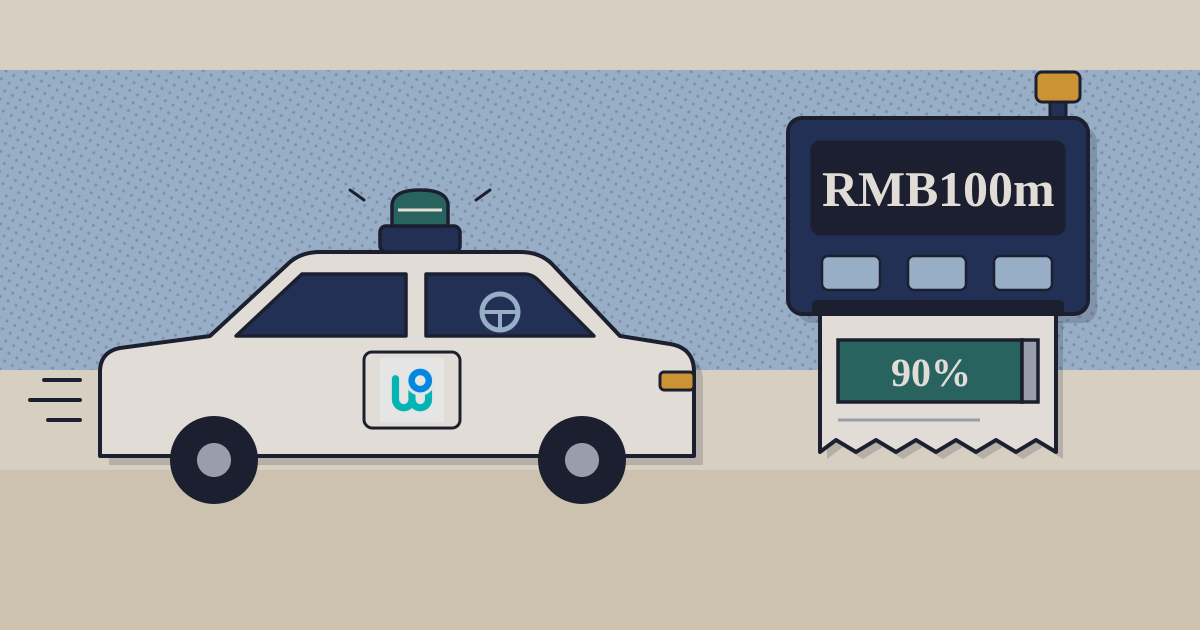
WeRide, the Guangzhou autonomous-driving company listed on Nasdaq and in Hong Kong, earned more than RMB100m from robotaxis in July–September, the first quarter it has passed that mark, up 204.0% on a year earlier.1 A year earlier robotaxis brought in RMB35.3m.2 More than 90% of the new total came from outside China.1 Total revenue rose 88.0% to RMB321.5m (US$48.0m), of which RMB146.9m, or 45.7%, came from overseas, up 171.5%. Gross margin widened to 43.0% from 32.9%. WeRide still lost RMB310.0m in the quarter, against RMB307.3m a year earlier.1
>RMB100m
robotaxi revenue in July–September, up 204.0% on a year earlier
WeRide
>90%
of robotaxi revenue earned outside China
WeRide
43.0%
gross margin, from 32.9%, on revenue up 88.0% to RMB321.5m
WeRide
~600
WeRide vehicles in the Middle East, from about 400 at 31 July
WeRide
01How WeRide earns abroad
Outside China, WeRide supplies the driving software and remote assistance; local partners buy the vehicles and run the operation. WeRide calls this its asset-light model and its overseas business “higher-margin”.1 Its Middle East fleet reached about 600 vehicles, from about 400 at 31 July, and it aims to cover the core urban areas of Abu Dhabi and Dubai by the end of the year.13 WeRide says it is Uber’s largest autonomous-vehicle partner outside the United States, counted by fully driverless robotaxis on Uber’s platform; the release does not name the partner that runs each Gulf fleet. In Singapore it runs robotaxis with Grab, with more than 20,000 rides by the end of September, and in the canton of Zurich it opened a public service with the Swiss railway SBB and Swiss Transit Lab.1
In Spain, WeRide says that it, Uber and AVOMO received the country’s “first L4 autonomous passenger vehicle operating permit” from the traffic authority, the DGT, in September; it authorises testing of WeRide’s GXR vehicles and starts mapping around Madrid before a first launch.1 The DGT’s register lists it as authorisation FVA-02/2026, held by Avomo Cars for WeRide and Uber: 35 robotaxis, nationwide, SAE level 4, tests authorised from 4 September 2026 to 3 September 2028. The register’s only other robotaxi authorisation is Waymo’s, FVA-03/2026, for 62 vehicles from 19 October.4
WeRide’s robotaxi revenue for July–September rose from about RMB4m to about RMB107m in two years
WeRide revenue, robotaxi and everything else, July–September of each year, RMB m
- Robotaxi
- Everything else
RMB m
Show tableHide table
| Robotaxi | Everything else | |
|---|---|---|
| Jul–Sep 2024 | 4.1 | 65.9 |
| Jul–Sep 2025 | 35.3 | 135.7 |
| Jul–Sep 2026 | 107.3 | 214.2 |
Source: WeRide, third-quarter results releases of 24 November 2025 and 20 November 2026 · as of 20 November 2026 · Robotaxi figures for 2024 and 2026 are our arithmetic from WeRide's stated shares and growth rates: see the method box
02China, costs and the loss
In China, WeRide’s robotaxis averaged 21 orders per vehicle a day, with a peak of 33, and it says its Guangzhou operation reached “positive unit economics”, without defining the term.1 Its fleet of level 4 vehicles, the kind that drive themselves within a defined area, was about 4,100 at 31 October, more than 2,300 of them robotaxis; the robotaxi fleet grew 26% in the quarter.1
Research and development rose to RMB465.3m from RMB316.4m, on staff, outsourcing and cloud costs; from 1 July WeRide also stretched the estimated life of its data-centre equipment to six years, which lowered depreciation. Administrative costs fell to RMB13.9m from RMB100.4m, mainly because share-based pay was reversed for staff who left. The operating loss narrowed to RMB332.9m from RMB379.5m, but the adjusted loss, which excludes share-based pay, widened to RMB336.5m from RMB275.6m, because this quarter’s share-based pay was a net credit.1 WeRide held RMB4,663.0m (US$695.5m) in cash, deposits and short-term investments at 30 September, and its finance chief says its operating plan gives it more than four years of cash runway.1 At 9:37am in New York on 20 November its Nasdaq shares were at US$2.95, 9.6% below the previous close.5 Baidu’s robotaxi service, Apollo Go, runs in 30 cities.
Sources
- WeRide, inside information: unaudited financial results for the third quarter ended 30 September 2026, with the press release (HKEX; also SEC 6-K, exhibit 99.1) — 20 November 2026
- WeRide, unaudited financial results for the third quarter of 2025 (SEC 6-K, exhibit 99.1) — 24 November 2025
- WeRide, interim results announcement for the six months ended 30 June 2026 (SEC 6-K, exhibit 99.1) — 12 August 2026
- Dirección General de Tráfico, framework for automated-vehicle tests: register of authorised tests and operations — read 20 November 2026
- Yahoo Finance, WRD quote, 19 and 20 November 2026 (quote data, not a primary source) — 20 November 2026
Disclosure. TechBag is a software reseller: it earns when companies buy through it, including from vendors named here. The analysis is TechBag’s own; no vendor paid for or saw this piece before publication. Facts are labelled reported, TechBag count or our view.
Keep reading