Data & privacyAnalysis
Italy fines Meta €805m over Facebook’s access to Android photo galleries
The Garante’s decision of 13 November: how Facebook’s gallery suggestions reached Android users’ photos, why Italy and not Ireland ruled, and how it set €805m, 0.47% of turnover.

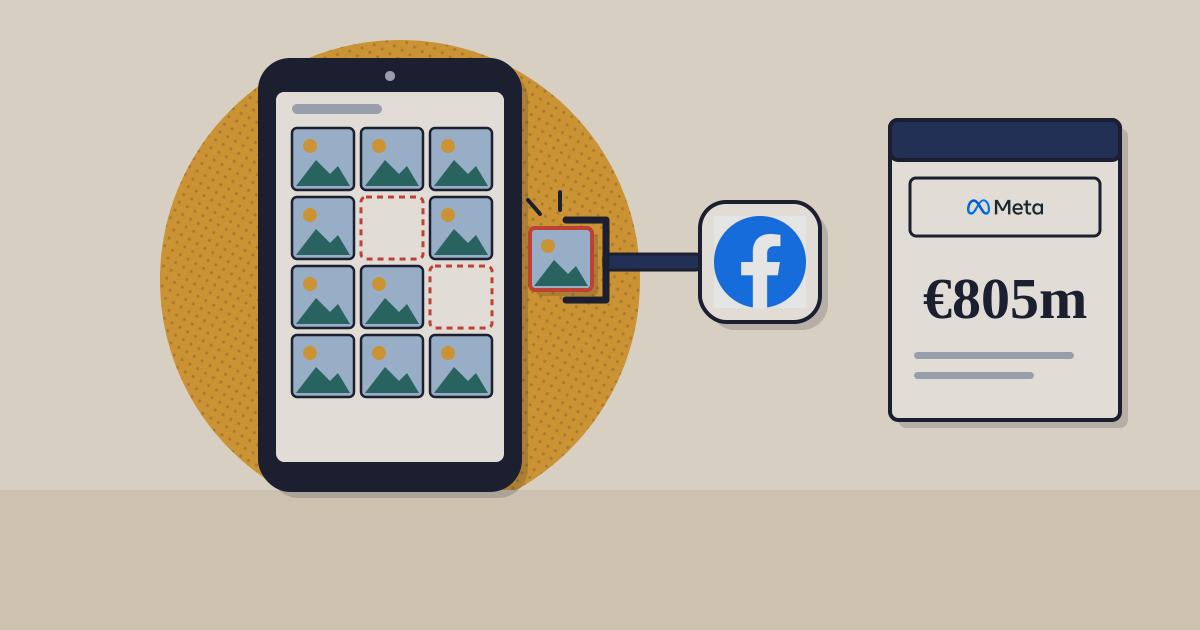
The decision runs to more than 22,000 words of Italian. We read it for three answers: what the Facebook app did with the photo gallery; why a national regulator could fine a company whose European regulator sits in Dublin; and how a privacy authority arrives at €805m. It is as clear about what it does not establish: that photos left the phone, that location data was read, or that anything trained AI.1
01One permission, many features: how the gallery suggestions worked
The feature is called “Get camera roll suggestions when you’re browsing Facebook”. Available since 2023, it shows photos and videos from the phone’s gallery as ideas for posts while the user scrolls.2 The case began on 10 July 2025 with a report by the Centro Tutela Consumatori Utenti, a consumer group in Bolzano. To test it, the Garante’s technology department installed Facebook (version 548.1.0.51.64) from scratch on an Android 14 phone and read the app’s manifest, the file that tells Android which permissions an app may ask for.1
One prompt to post a photo also opened the whole gallery to a feature that was already on
How Facebook for Android reached the gallery for camera roll suggestions, as the Garante's technical report found, May 2026
- 01
One prompt
The first post, story or reel brings a screen saying gallery access is to “share photos and videos, get suggestions on photos to upload and enable other features”, then Android’s request for “photos and videos”.
- 02
The whole library
Granted as “Allow all”, the permission lets the app read every photo and video, usually until it is revoked in the phone’s settings. It covers the whole app, not one feature.
- 03
Already on
The suggestions setting was preset to on, so it started once the permission existed, with no choice of its own. People with Facebook’s old storage permission got the new one automatically on Android 13.
- 04
Suggest
The app queries the gallery index for the newest items and offers one as a post. Meta says this happens on the phone; the Garante says it cannot check.
Source: Garante, decision n. 815, sections 1.3 and 3.5 (13 Nov 2026) · as of 16 November 2026
Meta’s account, as the decision records it, is that the feature reads only the most recent photos and “basic metadata”, such as when a photo was taken, whether it is a favourite and its orientation, works entirely on the device and sends nothing to Meta’s servers. The Garante did not find otherwise. It wrote that the app’s code is closed and its traffic encrypted, so neither users nor the authority can see what is read or sent, and that Meta answered a request for a technical description with screenshots and no traffic records, architecture or independent audit.1
The legal point is that the rule does not depend on the answer. Under Article 122, reading information already stored on a phone needs the user’s prior, informed consent, whether or not the data leaves the device and whether or not harm follows. The single system prompt was given to post a photo; the Garante held it could not count as consent to a different, continuous scan of the library. Android has offered a “photo picker” since 2023, which hands an app only the photos a user picks, without any storage permission, and Android 14 added a “Select photos and videos” option in the permission dialog.14
20 million
Italian Android users of Facebook in the case, by the Garante's estimate
35.6 million monthly Facebook users in Italy (AGCOM) or 28.5 million (DataReportal), times Android’s 63% share of mobile use: 18 to 22 million. Meta disputed the figure but gave none of its own.1
02Why Rome, not Dublin, decided it
Meta’s defence turned on jurisdiction. Under the GDPR’s one-stop shop (Article 56), a company’s cross-border processing in the EU is supervised by the authority where it has its main establishment; for Meta that is Ireland’s Data Protection Commission (DPC). Meta argued that the case belonged there, and that Article 122 did not apply because nothing left the phone and no communications network was used.1
The infringed provision – Article 122 of the Italian Data Protection Code, which transposes the European ePrivacy Directive – protects the smartphone as part of the individual’s private sphere; consequently, any access to the information stored on such devices requires free and informed consent, regardless of whether data is transmitted or any harm occurs.
The decision splits the case in two. Reading the gallery is governed by the ePrivacy Directive, which has no one-stop shop: each country’s designated authority enforces its own law. The Garante quotes the European Data Protection Board’s Opinion 5/2019 and the EU Court of Justice’s Facebook Belgium judgment of June 2021 for that line, and notes that Meta’s own defence accepted that the directive has no one-stop shop. What Meta does with the data before and after the access stays under the GDPR and with the DPC; the Garante did not examine it and says it will send its decision to Dublin.1
Italy ruled only on the reading of the phone; everything after it stays with Ireland
Which authority decides which part of the case, as decision n. 815 draws the line, November 2026
- 01
Reading the phone
Access to photos, videos and metadata on the device: Article 122 of the Italian Privacy Code, the ePrivacy rule. The Garante decides, for Italian users.
- 02
What happens next
Posting, storage and any other use of the data: the GDPR, with Ireland’s DPC as Meta’s lead authority. Not examined.
- 03
No double fine
The fine covers one breach, of Article 122, for Italian Facebook users on Android only. The decision goes to the DPC for any checks of its own.
Source: Garante, decision n. 815, sections 3.3 and 3.4 (13 Nov 2026) · as of 16 November 2026
Italy is not the first to take this route against a US platform. On 1 September 2025 France’s CNIL fined Google €325m under its own ePrivacy law, over Gmail ads and cookies set when an account is created, and wrote that the GDPR’s one-stop shop “is not intended to apply” to such cases.5
03How the Garante got to €805m
A breach of Article 122 is fined on the GDPR’s highest scale: up to €20m or 4% of worldwide annual turnover, whichever is higher. The turnover is that of the whole “undertaking”, not the Irish company. The Garante traced a 100% ownership chain from Meta Platforms Ireland up to Meta Platforms, Inc., took the group’s 2025 revenue from its 10-K, US$200,966m, and converted it at the European Central Bank’s rate for 31 December 2025, US$1.1750 to the euro: about €171,035m. Four per cent of that is €6,841m.1
€805m is 11.7% of the €6.84bn the law allowed
The steps in the Garante's calculation, € million, decision of 13 November 2026
Source: Garante, decision n. 815, sections 6.1 and 6.2 (13 Nov 2026) · as of 16 November 2026 · Half the fine is our arithmetic, under Article 166(8) of the Privacy Code
The Garante followed the EDPB’s 2023 guidelines on calculating fines. It rated the breach in the middle of three gravity levels, at its low end: national and systemic in reach, running for years, central to Meta’s business and negligent, but with no proven damage, no proven transmission and no special categories of data. That band starts at 10–20% of the maximum, and it set the starting point at €700m.1 Then it adjusted. Version 581 of the app, which stops the setting showing “on” before any permission, counted for Meta, moderately, because it came late and reaches only people who update. Against it: Meta’s control over how permissions are requested; a 2019 order fining Facebook €1m over the data of 214,077 Italian users, given slight weight; and poor cooperation, weighed heavily. Meta called its answers “voluntary”, misstated the setting’s default in November 2025, corrected it only in its defence, and gave no user count. The net result was €805m: 0.47% of turnover and 1.56% of the group’s 2025 net income of about €51,454m.1
04Where €805m sits among Europe's privacy fines
In February 2024 the Garante fined Enel Energia €79.1m over telemarketing and called it “the highest fine it has ever issued”. The Meta fine is about ten times that.11 Across Europe, two fines by data protection authorities have been larger: Ireland’s €1.2bn on Meta in May 2023, over transfers of Facebook users’ data to the US, and the Dutch authority’s €825m on Uber in August 2026, over driver accounts deactivated by automated systems, which Uber says it will appeal.67
Only two European privacy fines have been larger than Italy's €805m on Meta
Largest fines by EU data protection authorities, € million, with the month of each decision, to 16 November 2026
Source: DPC, CNIL, Garante releases; Amazon 10-Q; NOS; CMS Enforcement Tracker · as of 16 November 2026 · Uber's fine was €824.99m; the ranking is our count
The chart’s other entries: Luxembourg’s €746m on Amazon in July 2021, which Amazon disclosed in its own filing; Ireland’s €530m on TikTok in May 2025; and Ireland’s €403m on Google on 21 September 2026, over location data in three account and Android features between May 2018 and February 2020.8910 Two of the eight, France’s on Google and Italy’s on Meta, were reached through national ePrivacy law rather than the GDPR’s cooperation system. The week’s other European decision went the other way in size: Ireland fined Tinder’s operator €11m on 13 November over its data-download tool.
05What Meta must change, and what a user can change now
The orders run from the day Meta is notified. Within 60 days, for Italian Facebook users on Android, it must ask for consent to the feature with its own request, without phrases like “enable other features”; say what the feature does and how to switch it off; keep it off by default and ask again even people who already granted access; and make the setting match what the app does on every version in use in Italy. After the deadline, the feature may not run for anyone who has not consented that way. Meta must report within 30 days and again within 90, saying whether gallery information, or anything derived from it, reaches its systems before a user posts, and how many users consented.1
From a consumer group's complaint to an €805m fine took 16 months
Steps in the Garante's case against Meta Platforms Ireland, July 2025 to November 2026
Show tableHide table
| Date | Event | Detail |
|---|---|---|
| 10 Jul 2025 | Consumer group reports the feature | Centro Tutela Consumatori Utenti, Bolzano |
| 27 Oct 2025 | Garante asks Meta for details | Default setting, legal basis, AI use, retention |
| 14 Nov 2025 | Meta replies, contests jurisdiction | Says the DPC alone is competent |
| 18 May 2026 | Technical report delivered | Fresh install on an Android 14 phone |
| 29 Jul 2026 | Proceedings opened | Breach of Article 122 alleged |
| 12 Oct 2026 | Meta files its defence | Asks for the case to be closed; no hearing requested |
| 13 Nov 2026 | €805m fine decided | Decision n. 815; 60-day orders |
| 14 Nov 2026 | Published; Meta to appeal | Press release in Italian and English |
Source: Garante, decision n. 815 and press release (13 and 14 Nov 2026); Adnkronos (14 Nov 2026) · as of 16 November 2026
Meta’s spokesperson told Adnkronos the company “strongly disagrees” with the Garante’s assessment of the facts and its application of the law and considers the fine disproportionate. “It is a simple feature that helps people post photos and videos on Facebook. Users must grant a permission on their device before the feature can work and can change this permission at any time in settings. We intend to appeal.”3
Two things sit outside the decision. It did not examine whether gallery content trains Meta’s AI, which Meta denies for unpublished content. And it notes a separate feature launched in the EU in early 2026, which offers creative ideas by processing the camera roll in Meta’s cloud and could rest on the same system permission; the Garante says it will investigate that one separately.12
Sources
- Garante per la protezione dei dati personali: Provvedimento del 13 novembre 2026 [doc. web 10321455], register n. 815 (in Italian) — 13 November 2026 Published 14 November 2026.
- Garante per la protezione dei dati personali: Facebook: the Garante imposes a fine of €805 million on Meta (press release, Italian and English) [doc. web 10321080] — 14 November 2026
- Adnkronos: Garante Privacy sanziona Meta per 805 milioni di euro. L'azienda replica: “Faremo ricorso” — 14 November 2026 Meta spokesperson's statement, in Italian.
- Android Developers: Grant partial access to photos and videos (Android 14) — last updated 3 March 2026
- CNIL: Cookies and advertisements inserted between emails: Google fined 325 million euros by the CNIL — 3 September 2025
- Data Protection Commission: Data Protection Commission announces conclusion of inquiry into Meta Ireland (€1.2 billion) — 22 May 2023
- NOS: Uber schond rechten chauffeurs, AP legt megaboete van 825 miljoen op (in Dutch) — 21 August 2026 Public broadcaster; reports the Dutch Data Protection Authority's confirmation and Uber's response.
- Amazon.com, Inc.: Form 10-Q for the quarter ended 30 June 2021 (CNPD decision of 16 July 2021) — 30 July 2021
- Data Protection Commission: Irish Data Protection Commission fines TikTok €530 million — 2 May 2025
- Data Protection Commission: Data Protection Commission fines Google €403 million following Inquiry into Google's processing of location data — 21 September 2026
- Garante per la protezione dei dati personali: Telemarketing: il Garante privacy sanziona Enel Energia [doc. web 9988921] — 29 February 2024
- CMS: GDPR Enforcement Tracker (3,422 fines listed) — read 16 November 2026
- Digital Personal Data Protection Act, 2023: section 6 and the Schedule — 11 August 2023
- MeitY: commencement notification under the DPDP Act, G.S.R. 843(E) (copy on MediaNama) — 13 November 2025
Disclosure. TechBag is a software reseller: it earns when companies buy through it, including from vendors named here. The analysis is TechBag’s own; no vendor paid for or saw this piece before publication. Facts are labelled reported, TechBag count or our view.
Keep reading