Data & privacyTrend
Germany’s data-breach reports up as much as 80%; seven states pass all of last year
What Germany’s data-protection authorities said on 26 November, and four states’ own counts: GDPR breach notifications at records, Lower Saxony’s 1,685 to September above all of 2025.

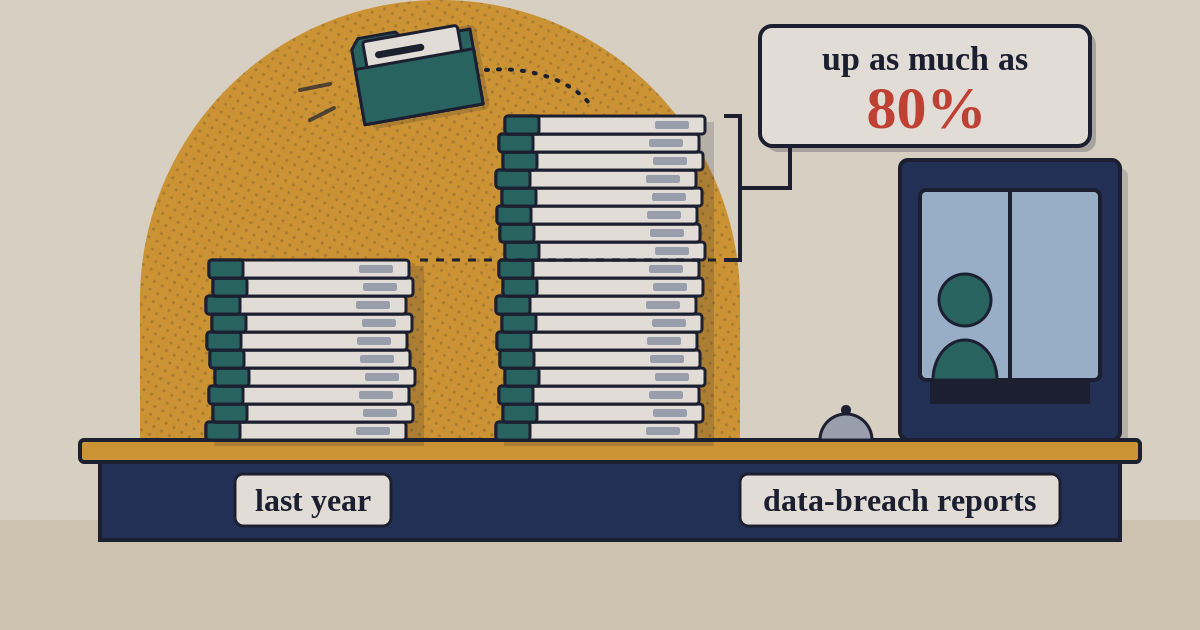
Breach notifications to Germany’s data-protection authorities are at record levels. Meeting from 24 to 26 November, the conference of the federal and state authorities, the DSK, said “numerous supervisory authorities are recording record levels this year, with increases of up to 80 percent in breach notifications compared with the previous year”, many of them IT-security incidents. Seven state authorities had received more by October than in the whole of 2025.1 We read the states’ own counts to see how fast the line is rising, and what is being counted.
80%
the largest rise on last year in breach notifications, as the DSK states it
DSK, 26 November
7
state authorities with more notifications by October than in all of 2025
DSK, 26 November
1,685
notifications in Lower Saxony, January to September; 1,607 in all of 2025
LfD Niedersachsen
+40%
Berlin, January to September, on the same months of 2025
Berlin commissioner
01Seven states past last year’s total by October
The DSK is the conference of Germany’s independent data-protection authorities, federal and state. Its task, in its own words, is to protect data-protection rights, to reach a uniform application of European and national data-protection law, and to develop it together.1 The seven authorities it named as having passed last year’s total by October are Baden-Württemberg, Bavaria’s BayLDA, Berlin, Lower Saxony, Mecklenburg-Western Pomerania, Rhineland-Palatinate and Saxony.1
Four of them have published their own numbers. Lower Saxony received 1,685 notifications from January to September, about 45% more than a year earlier and above 2025’s 1,607.2 Rhineland-Palatinate’s record year of 988 notifications was passed at the end of September, with 1,010.5 Saxony had 1,400 by the end of October, “more than ever”, against 1,058 in all of 2025.6 Berlin counted 1,550 from January to September, about 40% more than in the same months of 2025 and as many as in the whole of last year; 1,303 came from companies and other private bodies, 247 from public bodies.7
In nine months, Lower Saxony logged more breach notifications than in any full year since the GDPR began
Personal-data breach notifications to Lower Saxony's data-protection authority, per year, 2018 to 2025, and January to September 2026
Show tableHide table
| Breach notifications | |
|---|---|
| 2018 | 370 |
| 2019 | 824 |
| 2020 | 989 |
| 2021 | 1,672 |
| 2022 | 1,149 |
| 2023 | 1,302 |
| 2024 | 1,528 |
| 2025 | 1,607 |
| 2026 to Sep | 1,685 |
Source: LfD Niedersachsen, 2025 case counts (20 August 2026) and press release 21/2026 (26 November 2026) · as of 27 November 2026, 7:30pm IST · 2018 from 25 May, when the GDPR applied; 2021 includes many reports after the Microsoft Exchange server flaw
Lower Saxony’s series shows the scale of the change. The 2021 peak of 1,672 came from a flaw in Microsoft Exchange servers that led many companies to report; the count then fell to 1,149 and climbed again each year.3 In the first half of 2026 it was already 1,245, about 58% above the first half of 2025.4
For three more states the numbers come from heise online, not the authorities’ own pages. heise reports that BayLDA received about 2,300 notifications from January to October that go back to a cyberattack, about 83% more than in the same months of 2025 (about 1,250); that Baden-Württemberg had more than 2,000 IT-security incidents reportable under Article 33; and that North Rhine-Westphalia, which is not among the seven, had more than 3,726, against 2,844 in 2025.8
02What a breach notification is, and what drives the count
A “personal data breach” under the GDPR is “a breach of security leading to the accidental or unlawful destruction, loss, alteration, unauthorised disclosure of, or access to, personal data”. Article 33 requires the organisation responsible to notify its supervisory authority “without undue delay and, where feasible, not later than 72 hours after having become aware of it”, unless the breach is unlikely to result in a risk to people. It must also document every breach, reported or not; where the risk to people is high, Article 34 requires telling them as well.9
So the count covers mistakes as well as attacks. Lower Saxony says its notifications are often about letters or emails sent to the wrong recipient or personal data accidentally exposed online, with hacking and cybercrime playing a growing part.4 Saxony says more and more of its notifications are cyberattacks touching personal data, including health and financial data.6 Berlin says the share caused by cyberattacks is rising, and gives a reason: attackers use AI to find and exploit weaknesses without special skills, write professional-looking phishing emails and automate attacks, while companies and public bodies keep adding digital services and interfaces to get in through.7
heise quotes a spokesperson for Tobias Keber, the DSK’s chair this year, on the most common kinds of attack besides ransomware: email accounts taken over after phishing, attacks on websites and online shops, and data taken through unprotected interfaces.8 Lower Saxony’s reading of the longer rise names digitalisation, more cyberattacks and organisations meeting the duty to report more reliably.3
Three states had passed all of 2025’s breach notifications by September or October
Breach notifications in all of 2025 against 2026 to date: Lower Saxony and Rhineland-Palatinate to September, Saxony to October
- All of 2025
- 2026 so far
Show tableHide table
| All of 2025 | 2026 so far | Change | |
|---|---|---|---|
| Saxony (to October) | 1,058 | 1,400 | 32% |
| Lower Saxony (to September) | 1,607 | 1,685 | 5% |
| Rhineland-Palatinate (to September) | 988 | 1,010 | 2% |
Source: LfD Niedersachsen; LfDI Rheinland-Pfalz; Saxon data-protection commissioner (SDTB) · as of 27 November 2026, 7:30pm IST · 2026 is part of the year; the change compares it with all twelve months of 2025
Sources
- Datenschutzkonferenz (DSK), Pressemitteilung: 112. Datenschutzkonferenz, Mit Datenschutz zur besseren Cybersicherheit (in German) — 26 November 2026
- LfD Niedersachsen, Pressemitteilung 21/2026: Höchststand bei Datenschutzvorfällen (in German) — 26 November 2026
- LfD Niedersachsen, Zusätzliche Informationen zum Tätigkeitsbericht 2025: Fallzahlen 2025 im Überblick (in German) — 20 August 2026
- LfD Niedersachsen, Pressemitteilung 15/2026: Tätigkeitsbericht 2025 (in German) — 20 August 2026
- LfDI Rheinland-Pfalz, Datenschutzkonferenz: Mit Datenschutz zur besseren Cybersicherheit (in German) — 26 November 2026
- Sächsische Datenschutz- und Transparenzbeauftragte, Rekorde bei Datenschutzbeschwerden und Datenpannen (in German) — 8 November 2026
- Berliner Beauftragte für Datenschutz und Informationsfreiheit, Höchststand bei Datenschutzvorfällen: 40 Prozent mehr Meldungen (in German) — 22 October 2026
- heise online, Cyberangriffe: Datenschutzbehörden melden deutlich mehr Datenpannen (in German) — 27 November 2026
- Regulation (EU) 2016/679 (GDPR), Articles 4(12), 33 and 34 — 27 April 2016, in force from 25 May 2018
Disclosure. TechBag is a software reseller: it earns when companies buy through it, including from vendors named here. The analysis is TechBag’s own; no vendor paid for or saw this piece before publication. Facts are labelled reported, TechBag count or our view. How the Journal works.
Keep reading