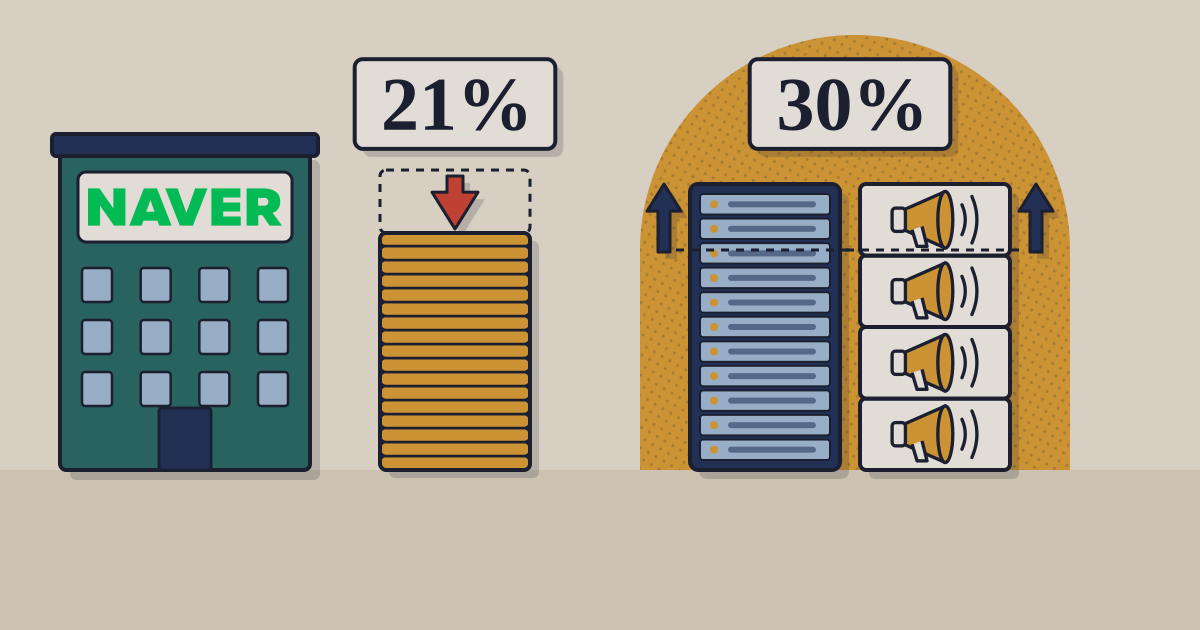
Naver’s operating profit fell 21% as infrastructure and marketing costs rose about 30%
Naver’s results for July to September: why operating profit fell 20.9% to ₩451.3bn on 10.7% more revenue, which costs rose, and what its AI Factory with Nvidia and Brookfield has signed.
Naver runs South Korea’s Naver search portal and the businesses around it: online shopping, Naver Pay, webtoons, resale marketplaces abroad and a cloud and enterprise arm. It reported its third quarter on 12 November. We read the results presentation, the release and the four earlier presentations they build on, in Korean, to answer three questions: why profit fell while revenue grew, which costs did it, and what Naver is buying with them.12
01Profit fell for a third quarter running
Operating profit was ₩451.3bn, against ₩570.6bn a year earlier and ₩520.3bn in April–June. It peaked at ₩610.6bn in October–December 2025 and has fallen in each quarter since; this one is the lowest since January–March 2024, when it was ₩439.3bn.145 Revenue grew 10.7% on a year earlier, or 9.0% without Wallapop, the Spanish resale marketplace Naver paid for in January–March. Naver says the quarter also carried the Chuseok holiday and the fading effect of its earlier changes to shopping fees.1
Naver's operating profit has fallen three quarters running, to its lowest since early 2024
Consolidated operating profit, ₩bn, July to September 2023 to July to September 2026
₩bn
Show tableHide table
Operating profit
Q3 23
380.2
Q4 23
405.5
Q1 24
439.3
Q2 24
472.7
Q3 24
525.3
Q4 24
542
Q1 25
505.3
Q2 25
521.6
Q3 25
570.6
Q4 25
610.6
Q1 26
541.8
Q2 26
520.3
Q3 26
451.3
Source: Naver earnings presentations, Q3 2024, Q3 2025 and Q3 2026 · as of 12 November 2026
The TechBag Journal
13.0%
operating margin, July to September
From 18.2% a year earlier and 19.1% at the peak; the lowest of the 13 quarters back to July–September 2023.
Net profit fell further, 45.2% to ₩402.5bn. Below the operating line, Naver’s share of profits at associates dropped to ₩39.8bn from ₩276.2bn, and financial items swung to a loss of ₩227.0bn from a gain of ₩65.7bn; Naver puts the fall down to those valuation changes. Free cash flow, which Naver defines as operating profit plus non-cash costs, less capital spending and tax paid, was negative ₩151bn, against ₩202bn a year earlier.1 Naver’s shares closed at ₩180,900, down 6.90%, after opening at the day’s high of ₩197,000, while the KOSPI fell 0.61% to 5,342.73. That left the company valued at about ₩27.5tn, 41% below the 52-week high, by Naver Pay Securities’ data, which is Naver’s own market service.78
02What Naver sells, and where the profit is made
Naver reports three segments. The Naver Platform holds advertising (₩1,474.8bn, up 5.5%) and what it calls services (₩473.6bn, up 13.1%), the commerce side, which Naver says grew on its Naver Plus Store shopping app, its paid membership and its N delivery service. Sales through Smartstore, the merchant storefronts on Naver, grew 6.4%. The Financial Platform, Naver Pay, earned ₩487.7bn, up 14.1%, on ₩26.2tn of payments, up 15.6%.12
The third, Global Challenge, made ₩1,036.4bn, up 15.9%. Inside it, resale marketplaces (C2C: Poshmark, Wallapop and Soda, whose trading-card trades Naver says are selling well) grew 47.8% to ₩370.4bn; content fell 5.1% to ₩472.6bn, which Naver puts down to a difficult Japanese market for its webtoons; and enterprise, home of the AI Factory business, grew 33.0% to ₩193.3bn, helped by a digital-twin project in Saudi Arabia.12
Advertising is still 42% of Naver's revenue; payments and resale grew faster
Revenue by business line, ₩bn, July to September 2025 to July to September 2026
Advertising
Platform services
Naver Pay
Global Challenge
Jul–Sep 20251,398.1894.13,138.1
Oct–Dec 20251,415.3896.23,195
Jan–Mar 20261,394.5941.63,241.1
Apr–Jun 20261,447.21,015.93,388.8
Jul–Sep 20261,474.8487.71,036.43,472.5
Show tableHide table
Advertising
Platform services
Naver Pay
Global Challenge
Jul–Sep 2025
1,398.1
418.6
427.3
894.1
Oct–Dec 2025
1,415.3
434.9
448.6
896.2
Jan–Mar 2026
1,394.5
445.3
459.7
941.6
Apr–Jun 2026
1,447.2
455
470.7
1,015.9
Jul–Sep 2026
1,474.8
473.6
487.7
1,036.4
Source: Naver earnings presentation, Q3 2026 · as of 12 November 2026 · Platform services: shopping commissions, membership and delivery. Global Challenge: resale, webtoons and enterprise
The TechBag Journal
The profit sits almost entirely in the first segment, and that is where it fell. The Naver Platform’s segment margin was 24.0%, against 33.6% a year earlier; Naver Pay’s was 2.2%, against 6.6%. Global Challenge still lost money, ₩26.1bn, but much less than the ₩68.1bn of a year earlier.1
03Costs grew faster than revenue
Operating costs were ₩3,021.1bn, up 17.7%. In won, they rose by ₩453.7bn while revenue rose by ₩334.3bn, and the ₩119bn difference is the fall in profit. Naver groups its costs into four lines, and three of them account for almost all of the rise.1
Costs rose 17.7% against revenue's 10.7%; marketing and infrastructure rose fastest
Growth on the same quarter a year earlier, %, July to September 2026
Marketing ₩663.9bn32.3%
Infrastructure ₩282.3bn29.1%
Partner costs ₩1,324.0bn18.8%
Development and operations ₩750.9bn2.5%
All operating costs ₩3,021.1bn17.7%
Revenue ₩3,472.4bn10.7%
Show tableHide table
Value (%)
Marketing
32.3
Infrastructure
29.1
Partner costs
18.8
Development and operations
2.5
All operating costs
17.7
Revenue
10.7
Source: Naver earnings presentation, Q3 2026 · as of 12 November 2026
The TechBag Journal
Partner costs, the largest line, rose by ₩209.9bn, which Naver ties to more spending on Npay Connect, the in-store payment terminals it is placing with merchants, and to broadcast-rights costs; its April–June presentation named the World Cup rights.13 Marketing rose by ₩161.9bn, on bigger promotions and the same terminal roll-out; it took 19.1% of revenue, against 16.0% a year earlier. Naver says it wants Npay Connect to be the country’s largest offline payment terminal by active devices by the first half of next year.12
Infrastructure rose by ₩63.7bn, the smallest of the three in won, but Naver’s summary names it first among the investments in “AI competitiveness” that cut profit, ahead of content and offline data. Development and operations, mostly staff pay, grew just 2.5%: the extra spending went on equipment, promotions and partners, not people.1
04The infrastructure bill, and the year Naver added to its GPUs
The infrastructure line is where Naver reports the cost of its computing, including depreciation: the price of servers and GPUs spread over the years they are expected to work. The Korea Times describes the line as including the depreciation of GPUs and other computing resources used for AI.9 For July–September Naver gives two reasons for the 29.1% rise: computing equipment for its own use was delivered, and new floor space opened in its data centres.1
Naver's infrastructure bill is up 79% in three years, and jumped 28% in the last quarter
Infrastructure costs, ₩bn a quarter, July to September 2023 to July to September 2026
₩bn
Show tableHide table
Infrastructure costs
Q3 23
157.3
Q4 23
163.7
Q1 24
169.9
Q2 24
171.7
Q3 24
178.1
Q4 24
185.1
Q1 25
189.3
Q2 25
197.7
Q3 25
218.6
Q4 25
205.2
Q1 26
250.8
Q2 26
219.8
Q3 26
282.3
Source: Naver earnings presentations, Q3 2024, Q3 2025, Q2 2026 and Q3 2026 · as of 12 November 2026 · Depreciation of GPUs and CPUs over six years instead of five from April to June 2026
The TechBag Journal
The dip in April–June was an accounting change, not a pause. From that quarter Naver depreciates its GPUs, CPUs and other computing equipment over six years instead of five, which it said reflects how long they are actually used and defers about ₩100bn of cost a year. Infrastructure that quarter rose only 11.2% on a year earlier, “despite expanded investment in computing assets”, in Naver’s words.3
CoreWeave, the US GPU cloud, uses the same six-year life, and lists it among the estimates that could significantly affect its results, as we explained in our reading of its quarter.12 Kyobo Securities, quoted by the Korea Times, expects Naver’s depreciation to rise from ₩824bn in 2026 to ₩1.041tn in 2028.9
05What the AI Factory is, and what Naver has signed
Naver defines an AI factory as GPU computing, networking, storage, power and cooling and a software platform sold as one service. It already runs two data centres it designed itself, Gak Chuncheon (2013) and Gak Sejong (2023), and says it is the only Korean company offering GPUs as a service at scale.6 In July it signed a preliminary agreement with Brookfield, the investment firm, for US$9bn of infrastructure, and an agreement for Nvidia to invest US$1bn in new Naver shares: together, a US$10bn AI Factory.6
Brookfield funds the build, Nvidia buys in, and Naver runs it for customers
How the AI Factory is split between Naver and its partners, as Naver described it in July and November 2026
01
Nvidia
Agreed on 24 July to buy about US$1bn of newly issued Naver shares; supplies its DSX design and Blackwell, then Vera Rubin, GPUs.
02
Brookfield
Preliminary agreement on 22 July; once the main contract is signed, raises up to US$9bn through a special-purpose vehicle.
03
Naver
Runs the platform, operations and customer service, starting at Gak Sejong: 55 MW in the first half of 2027, 200 MW in 2028.
04
Customers
About ₩2tn of computing-supply contracts signed with first customers; revenue from the first half of 2027.
Source: Naver post on the Nvidia and Brookfield agreements (24 Jul 2026); Q3 2026 release · as of 12 November 2026
The TechBag Journal
Naver says the split lets it grow “while minimising the initial capital burden”: the partners put up most of the money, and Naver supplies the platform and the customers.6 Chief executive Choi Soo-yeon said the ₩2tn of contracts secure the first customers, and that Naver will seek multi-year contracts with large customers and widen the base to global AI companies. The presentation calls them contracts for initial volumes in 2027.12 Before the results, the Korea Times quoted a Korea Investment & Securities analyst who attributed the shares’ fall since June to the time the data-centre business needs to earn and to delays in announcing contracts with large tenants.9
Naver also plans an AI agent app before the end of the year, after the AI Briefing summaries and AI tab it has added to search, and a logistics subsidiary to run leased warehouses for faster delivery.2 The scale of the build-out it is joining is in our quarterly line of Big Tech’s capital spending.
Disclosure. TechBag is a software reseller: it earns when companies buy through it, including from vendors named here. The analysis is TechBag’s own; no vendor paid for or saw this piece before publication. Facts are labelled reported, TechBag count or our view.