SecurityThreats & vulnerabilitiesNote
PayU lost ₹25.67 crore in 265 payouts to 156 accounts after a cloud break-in
What Gurugram Police said by 19 November: three cloud servers, payouts requested from inside, ₹1.5 crore frozen, two arrests, and the controls CERT-In asked for on 9 October.

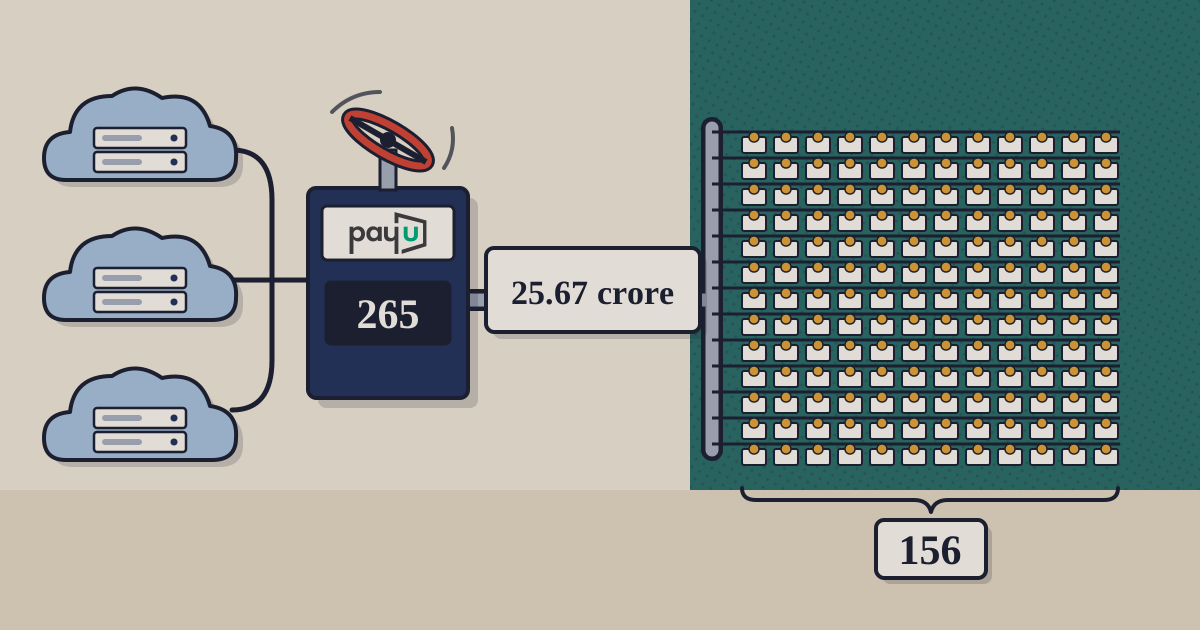
Attackers who got into PayU Payments’ cloud servers registered new beneficiary bank accounts and moved about ₹25.67 crore to them without the company’s knowledge, Gurugram Police said on 18 November.1 The police’s cybercrime chief, Assistant Commissioner Gaurav Fogat, told the Hindustan Times the money went out in 265 unauthorised payouts from the firm’s escrow account to 156 bank accounts, after the attackers reached three servers on the night of 5–6 November. ₹1.5 crore, found in the first layer of accounts, has been frozen. “The rest was moved elsewhere,” he said.2
₹25.67 cr
moved out without authorisation, police say
Gurugram Police via PTI
265
unauthorised payouts from the escrow account
Gurugram Police via HT
156
bank accounts registered as new beneficiaries
Gurugram Police via HT
₹1.5 cr
frozen in the first layer of accounts
Gurugram Police via HT
01How the money left
PayU sells a payouts service that lets a business send money in bulk to customers, vendors and staff, add beneficiaries and “automate payouts” through an API.6 A payment firm’s escrow account holds money it has collected until it is settled to merchants or other recipients. According to the police, the attackers used a VPN to reach three servers hosted by a global web services provider, ran scripts on them directly, registered 156 bank accounts in the firm’s database and used the payout API to request payments to them from the escrow account.2 The cloud provider spotted access from outside IP addresses and alerted the firm, whose security team saw unusual payout API activity at 11:30pm on 5 November; by then, HT reports, the money had already been transferred.2
A senior manager filed the complaint on 9 November, and a case of cheating under Section 318(4) of the Bharatiya Nyaya Sanhita was registered at the Cybercrime (South) police station.2 On 15 November police arrested Atar Singh and Lovepreet Singh in Ludhiana. They are accused of supplying bank accounts, not of the break-in: ₹6.20 lakh reached Atar Singh’s account, which he had handed to Lovepreet Singh for a 2% commission and which was then sold on for another 2%.13 Police are following the money through later layers of accounts; the firm and its cloud provider are investigating how the servers were reached.2 PayU had posted no statement on its press page by the time of writing.7
The payouts were spotted after the money had gone; arrests came ten days later
CERT-In’s warning and the PayU case as police described it, 9 October to 18 November 2026 (IST)
Show tableHide table
| Date | Event | Detail |
|---|---|---|
| 9 Oct 2026 | CERT-In warns on payout APIs | Advisory CIAD-2026-0046, rated critical |
| 5 Nov 2026 | Unusual payout API activity | Seen at 11:30pm; the transfers had already gone |
| 9 Nov 2026 | PayU files a complaint | Cheating case under BNS Section 318(4) |
| 15 Nov 2026 | Two arrested in Ludhiana | Accused of supplying bank accounts |
| 18 Nov 2026 | Police disclose the case | ₹25.67 crore; ₹1.5 crore frozen |
Source: CERT-In CIAD-2026-0046; Gurugram Police via PTI and the Hindustan Times · as of 19 November 2026
02What CERT-In told payment firms on 9 October
Four weeks before the break-in, CERT-In and CSIRT-Fin rated as critical a run of attacks on lenders, fintechs, payment service providers and wallet operators. Attackers, they wrote, steal payment and bank API credentials and “invoke disbursal/fund-transfer APIs directly from within the entities’ own whitelisted infrastructure”, skipping beneficiary checks and transaction limits, and send the money to mule accounts at several banks.5 Police have not said how the attackers got in, so whether this case followed the advisory’s route is not established.24
CERT-In’s warning grew out of attacks on India’s lenders: the Journal’s note on ₹300 crore reportedly lost by small NBFCs and CERT-In’s follow-up advisory of 4 November trace it from the first warning.
Sources
- PTI, as carried by The Pioneer: Two held in Punjab’s Ludhiana for breaching PayU’s cloud servers, siphoning over Rs 25 crore: Gurugram Police — 18 November 2026
- Hindustan Times: Hackers siphon off ₹25.67 crore from Gurugram payments firm, two held — 19 November 2026
- UNI: Two arrested in Rs 25.67 crore cyber fraud involving payment company’s server — 18 November 2026
- MediaNama: PayU loses Rs 25.67 crore in alleged cloud server breach; two arrested — 19 November 2026
- CERT-In, advisory CIAD-2026-0046: Threat Actors Exploiting Payment and Disbursement APIs for Unauthorized Fund Transfers in BFSI Entities — 9 October 2026
- PayU, PayU Payouts (product page) — undated page
- PayU India, press page: In the news (no statement on the incident) — checked 20 November 2026
Disclosure. TechBag is a software reseller: it earns when companies buy through it, including from vendors named here. The analysis is TechBag’s own; no vendor paid for or saw this piece before publication. Facts are labelled reported, TechBag count or our view.
Keep reading