SecurityIdentity & accessTrend
pCloud Pass is the third password manager breached this month, after mSecure and 1Password
Three vendors’ own statements, 3 to 27 November: what attackers reached at mSecure, 1Password and pCloud Pass, whether encrypted vaults left, and the checks a user makes.

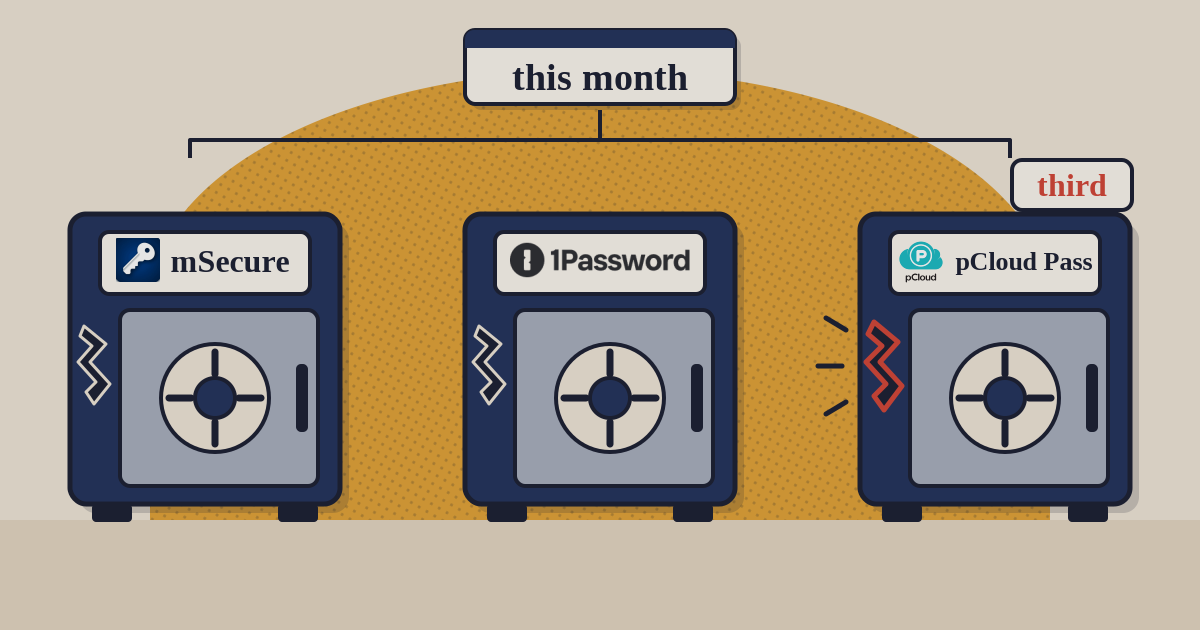
pCloud Pass users began receiving emails saying a new device had connected to their accounts. They reported, on Reddit, that the device was named “pd”, that it connected from addresses in Luxembourg they say belong to pCloud’s own infrastructure, and that some had two-factor authentication on. pCloud’s reply: “A cyber attack targeting pCloud Pass occurred, which was promptly contained by the pCloud team. Unfortunately, a small number of pCloud Pass user email addresses were exposed and login attempts were made.”12 That makes three password managers with an incident between 3 and 27 November. Each company keeps the contents of a vault encrypted with keys it does not hold, and each says, in its own words, that those contents were not read. What did each one lose, and what does that design protect?
01Three incidents in under four weeks
The month began with an email. On 3 November mSeven Software, which makes mSecure, told current and former customers it had “recently learned of suspicious activity associated with the mSecure password management application” and recommended that they “immediately take steps to protect all confidential information stored” in it, which “may include changing passwords, resetting or re-enrolling two-factor authentication methods, or removing existing passkeys”. The email said nothing about what was reached.4 A reply its support team then sent to customers, posted in full on mSecure’s own forum by 4 November, said more: “an unauthorized actor acquired an encrypted copy of a database containing information belonging to current and former users”, and “this issue only pertains to users that were synching with the mSecure Cloud.”5
On 19 November 1Password began investigating signs that an attacker had gained access to an employee’s corporate GitHub account, and on 25 November it said the attacker had used it to push malicious code to backend services, which downloaded account records for “a subset of our users”.6 We read that statement against 1Password’s white paper in our analysis of 26 November. pCloud’s confirmation was reported on 27 November.1
Three password managers reported incidents between 3 and 27 November
Dates of each vendor’s first statement and the steps that followed, November 2026
Show tableHide table
| Date | Event | Detail |
|---|---|---|
| 3 Nov 2026 | mSecure: email to customers | “Suspicious activity”; change passwords, reset 2FA, remove passkeys |
| 4 Nov 2026 | mSecure: support reply posted | An “encrypted copy of a database” acquired; mSecure Cloud sync users only |
| 19 Nov 2026 | 1Password: investigation starts | Signs of access to an employee’s corporate GitHub account |
| 25 Nov 2026 | 1Password: statement | Account records for “a subset of our users” downloaded; vaults not accessed |
| 27 Nov 2026 | pCloud Pass: confirmation reported | “A small number” of email addresses exposed; login attempts made |
Source: mSeven (via mSecure’s support forum); 1Password; pCloud (as quoted by BleepingComputer and The Hacker News) · as of 28 November 2026, 7:15pm IST
02What each one reached, and what it did not
Only 1Password has named the route in. None of the three gives a number of affected users; each uses a phrase. We found no notice of the incident on msecure.com or its blog on 28 November.456
One named route in, no counts, and different answers on whether encrypted vaults left
Each incident in the vendor’s own words, as published or quoted by 28 November 2026
Show tableHide table
| mSecure (mSeven Software) | 1Password | pCloud Pass | |
|---|---|---|---|
| First statement | 3 November, email to customers | 25 November, blog post | By 27 November, reply on Reddit |
| Route in | Not disclosed | An employee’s corporate GitHub account, then malicious code on backend services | Not disclosed |
| What was reached | “An encrypted copy of a database containing information belonging to current and former users” | Names, emails, account identifiers, sign-in times, public keys, SRP parameters, tokens in emailed links; source code; CI/CD | “A small number of pCloud Pass user email addresses”; login attempts made |
| Who is affected | Users syncing with mSecure Cloud | “A subset of our users” | “A small number” of users |
| Vault contents | “No evidence” the confidential information in the database was accessed | “At no time” accessed by, or available to, the attacker | Passwords, notes and other data “not compromised”; not said whether encrypted vaults were copied |
| What it asks of users | Change the master password and vital stored passwords, reset 2FA, replace passkeys | Nothing to update; watch for phishing about invitations or recovery | Watch for phishing; pCloud never asks for the master password or recovery words |
Source: mSeven (via mSecure’s support forum); 1Password (25 Nov 2026); pCloud (as quoted by BleepingComputer, 27 Nov 2026) · as of 28 November 2026, 7:15pm IST
pCloud says the attack was limited to pCloud Pass and did not touch its cloud storage. Its statement also says that with AI, vulnerabilities in operating systems, languages and libraries are being found “faster than ever”, without saying that one was used here.12 pCloud International AG is registered in Switzerland, and its European data region is in Luxembourg.9 One more detail from BleepingComputer, which checked a copy of the alert: its “Open settings” link pointed to passqa1.pcloud.com, which appears to be a test environment rather than the live site.1
03Why a company breach is not a vault breach, and what to check
All three describe the same design: items are encrypted on the user’s device before they are synced, so the company stores only ciphertext. What differs is how many secrets a thief needs. 1Password mixes the account password with a 26-character Secret Key generated and kept on the device, so that information on its servers “cannot be used to check whether an account password guess is correct or not”.8 mSecure pairs the account password with a 46-character Account Key generated on the device and “never stored on our servers”.7 pCloud’s own description of Pass says data is encrypted on the device and “only you can decrypt it with your Master Password”, used with PBKDF2 to generate a private key; it describes no second secret.3
The checks a user makes.
- Your master password. If it is short, reused or guessable, change it. mSeven recommends this to mSecure Cloud users along with changing vital stored passwords, resetting 2FA and replacing passkeys.5
- Your devices. pCloud’s alert offers an “Open settings” link to change the master password; open the app or type the address yourself instead, and check the list of connected devices there.2
- Unexpected emails. 1Password and pCloud both say they will never ask for the master password, Secret Key or recovery words; 1Password warns of invitations or recovery requests you did not start.26
What to watch. 1Password has promised a root cause analysis “in the coming weeks”.6 pCloud has not said how the attackers got in, when, or whether encrypted vaults were accessed; mSeven has not said how its database was taken or how many users it covers.12 Each answer, when it comes, says how much of the risk sits with the master password.
Sources
- BleepingComputer, pCloud confirms password manager hack after suspicious login alerts (quotes pCloud’s statement) — 27 November 2026
- The Hacker News, pCloud Password Manager Hit by Cyber Attack Involving Email Address Exposure and Login Attempts (quotes pCloud’s statement) — 28 November 2026
- pCloud, First Steps: Setting Up pCloud Pass (encryption) — 28 September 2022
- mSeven Software, Important Security Notice email, as posted by a customer on mSecure’s support forum — 3 November 2026
- mSeven Software, support reply on the incident, as posted by a customer on mSecure’s support forum — posted 4 November 2026
- 1Password, Update on a security incident involving 1Password’s backend systems — 25 November 2026
- mSecure Support, mSecure’s Security Model - Secure by design — as published on 28 November 2026
- 1Password Security Design White Paper, chapters 3 and 4: Account password and Secret Key; A modern approach to authentication (release 0.5.3) — 28 October 2026
- pCloud, Data regions (operator: pCloud International AG, Baar, Switzerland, per its terms and conditions) — as published on 28 November 2026
- BleepingComputer, mSecure password manager hack prompts password reset warnings — 4 November 2026
Disclosure. TechBag is a software reseller: it earns when companies buy through it, including from vendors named here. The analysis is TechBag’s own; no vendor paid for or saw this piece before publication. Facts are labelled reported, TechBag count or our view. How the Journal works.
Keep reading