SecurityThreats & vulnerabilitiesNote
Perfios’ CreditNirvana exposed 6.6m borrower accounts and 315,000 call recordings
What the researcher and CERT-In published: two flaws reported on 30 May and fixed on 2 June, the lenders’ records they opened, and who answers for a vendor’s flaw in India.

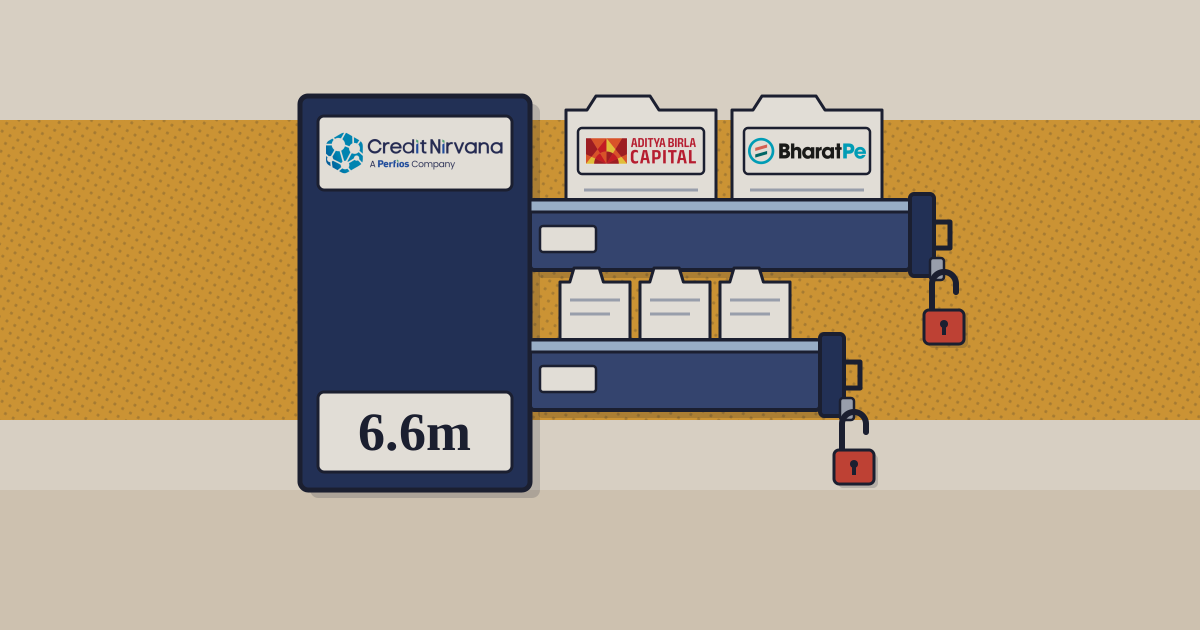
Two flaws in CreditNirvana, the AI debt-collection platform owned by Perfios, opened 6.6 million borrower accounts at three Indian lenders to anyone who knew how to use them, security researcher Eaton Zveare disclosed on 18 November: more than 3.4 million at Aditya Birla Capital Finance and about 3.2 million at BharatPe and International Asset Reconstruction Company (IARC) together. The records included full TransUnion CIBIL credit reports, ID cards and legal notices. A second system exposed 315,000 recorded collection calls.1 He reported the flaws through CERT-In on 30 May, and CreditNirvana fixed both on 2 June. CERT-In published its vulnerability note on 26 October; the CVE records score the flaws 8.7 (high) and 9.3 (critical) out of 10.123
6.6m
borrower accounts at Aditya Birla Capital Finance, BharatPe and IARC open to the flaw
Eaton Zveare
315,000
collection calls, recorded and transcribed, in the AI call centre
Eaton Zveare
9.3
CVSS 4.0 score of the login flaw, rated critical in its CVE record
CVE-2026-110475
3 days
from the report via CERT-In on 30 May to the fix on 2 June
Eaton Zveare
01What the two flaws opened
The first was in the Agentic AI Call Centre, which Aditya Birla Capital Finance uses to have AI agents call borrowers who have fallen behind. A fixed API key sat in the JavaScript sent to every visitor’s browser, so anyone could pull it out and ask the system for call transcripts and recordings (CVE-2026-110474).2 The second was in the main collections platform, CollectionWorkz in Aditya Birla’s deployment. Its login service did not check the sign-in token it was sent and trusted the user name in the request instead, so a visitor could become any user, administrators included (CVE-2026-110475).12
Inside Aditya Birla’s deployment Zveare found more than 161,000 settlement cases with ID cards and credit reports, the records of 433 collection agencies, and the locations of field agents on their visits. In May 2026 alone it logged 3.7 million payment receipts, 214,000 voice-bot calls and 119,000 legal notices. BharatPe’s and IARC’s deployments are separate but had the same login flaw.1 CERT-In lists the fixed versions as Call Centre 2.0.0 and Collections Platform 4.8.2.2
Fixed 3 days after the report; made public 169 days after the fix
Disclosure of the two CreditNirvana flaws, from the researcher’s report to publication, 30 May to 18 November 2026
Show tableHide table
| Date | Event | Detail |
|---|---|---|
| 30 May 2026 | Reported via CERT-In | Two flaws, one researcher |
| 1 Jun 2026 | Proof-of-concept video | Sent at CERT-In’s request |
| 2 Jun 2026 | Both flaws fixed | The day CERT-In confirmed action |
| 14 Oct 2026 | CVE numbers reserved | By CERT-In, as numbering authority |
| 26 Oct 2026 | CIVN-2026-0523 published | Rated 8.7 and 9.3 |
| 18 Nov 2026 | Researcher discloses | 6.6m accounts, 315,000 calls |
Source: Eaton Zveare, 18 November 2026; CERT-In CIVN-2026-0523; CVE records · as of 18 November 2026
02Who answers for a vendor’s flaw in India
Under the Digital Personal Data Protection Act, 2023, a lender is the data fiduciary and stays responsible for processing done for it by a data processor “irrespective of any agreement to the contrary”. It must protect the data, including what a processor handles, “by taking reasonable security safeguards to prevent personal data breach”, and tell the Data Protection Board and each affected person of a breach (section 8).5 The DPDP Rules, notified on 14 November 2025, gave organisations eighteen months to comply; the largest penalty, up to ₹250 crore, is for failing to keep reasonable security safeguards.6
What a lender using such a platform can ask: is it on the fixed versions, are tokens checked on the server, are any keys shipped in browser code, and who reached its borrowers’ records before 2 June. That last question needs logs. CERT-In’s Directions require logs of all ICT systems for a rolling 180 days,7 a minimum that, for the days before the fix, runs out around 29 November. The Journal’s notes on AU Small Finance Bank’s vendor-run platform and Fireworks AI’s breach follow the same route: a lender’s or a platform’s data, reached through a supplier.
Sources
- Eaton Zveare, The AI Repo Man: Exploiting Agentic AI Debt Collection Platforms — 18 November 2026
- CERT-In, vulnerability note CIVN-2026-0523: Multiple Vulnerabilities in CreditNirvana Products — 26 October 2026
- CVE Program, records CVE-2026-110474 (CVSS 4.0: 8.7) and CVE-2026-110475 (CVSS 4.0: 9.3), assigned by CERT-In — 26 October 2026
- Perfios, press releases (nothing on the flaws) — checked 21 November 2026
- Digital Personal Data Protection Act, 2023, section 8 (duties of a Data Fiduciary, including processing by a Data Processor) — 11 August 2023
- Press Information Bureau: DPDP Rules, 2025 notified (backgrounder) — 17 November 2025
- CERT-In, Directions under section 70B(6) of the IT Act (logs kept for a rolling 180 days; direction iv) — 28 April 2022
Disclosure. TechBag is a software reseller: it earns when companies buy through it, including from vendors named here. The analysis is TechBag’s own; no vendor paid for or saw this piece before publication. Facts are labelled reported, TechBag count or our view.
Keep reading