SecurityThreats & vulnerabilitiesNote
Rakuten Securities: up to 4.47m accounts’ data may have leaked from a test system
Rakuten Securities’ notice of 17 November: what may have left a test system on 11 November, the 11.25m login IDs, why test data matters, and what customers should do.

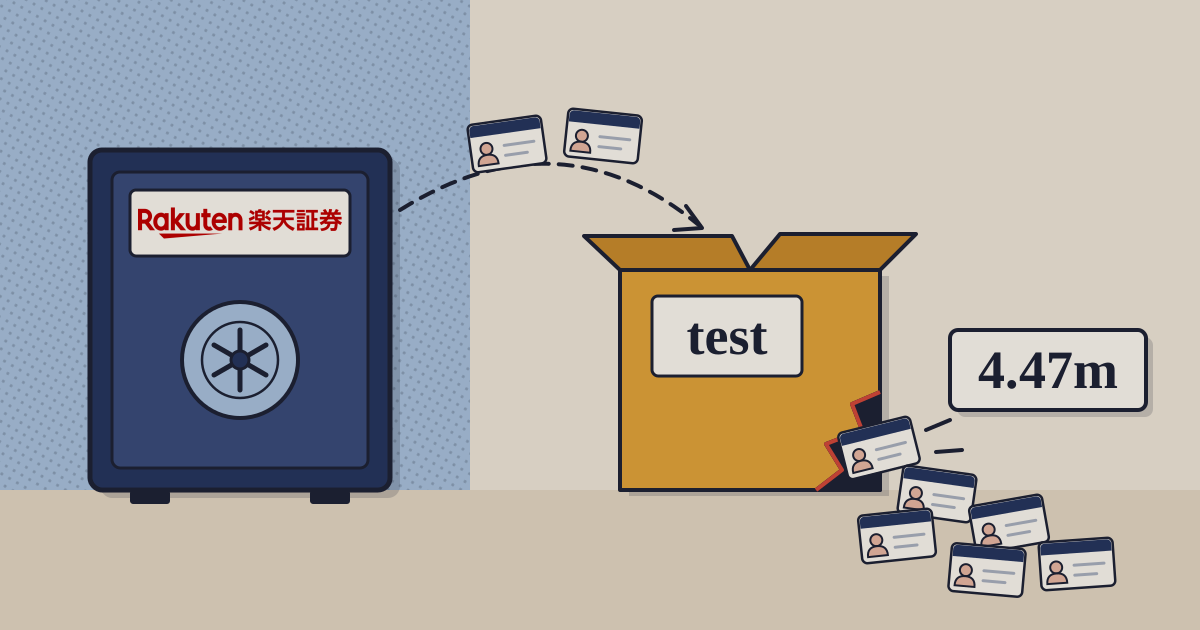
Names, addresses, withdrawal bank accounts, self-declared income and financial assets, and holdings for up to about 4.47 million Rakuten Securities accounts may have leaked from one of the Japanese online broker’s test environments, the company said on 17 November.1 The customer code and login ID of up to about 11.25 million accounts may also have gone. Rakuten Securities detected possible unauthorised access on Monday 16 November, cut off access and fixed the affected part of its systems; its investigation then showed that data held in a test environment may have leaked on Wednesday 11 November. It has found no leak of passwords, PINs or anything else needed to trade, and no unauthorised log-ins or trades linked to the incident. How the attackers got in is still under investigation.1
4.47m
accounts whose name, address, withdrawal account, income and assets may have leaked (up to about)
Rakuten Securities
11.25m
accounts whose customer code and login ID may have leaked (up to about)
Rakuten Securities
5 days
from the possible leak on 11 November to detection on 16 November
Rakuten Securities
90%+
of customers who log in daily already use passkeys, which Rakuten is making compulsory
Rakuten Securities
01What may have left, and what did not
Rakuten lists two groups. For up to about 4.47 million accounts: branch and customer code, login ID, name in kanji and kana, date of birth, address, phone number, email address, employer, the bank account withdrawals are paid to (bank, account number and holder), annual income and financial assets as the customer declared them, assets held by product, and the date of the last log-in. For up to about 11.25 million accounts: the branch and customer code and the login ID. Both groups include customers who have closed their accounts, and the login ID is not the Rakuten ID used across the group’s other services.1 Rakuten does not say whether the larger group contains the smaller one, so the two figures are not added. It says it has identified every affected customer and will write to each.1
The combination is what makes such a record valuable to a fraudster: a login ID, a real name, a phone number and knowledge of how much someone holds lets a fake “security check” call or email sound genuine. That is why Rakuten’s advice is about contact, not passwords.
02Why a test environment held customers’ data
A test environment is a copy of a system where new code is tried before it goes live, and it is often guarded less closely than the live system. Japan’s Personal Information Protection Commission lists, among the measures that prevent leaks, prohibiting the use of personal data as test data, or replacing part of it with other data, so that test data holds as little personal data as possible.2 Rakuten has not said why real records were in its test system.
03The broker’s third notice in under three weeks
Two earlier notices concerned suppliers, not Rakuten’s own systems. On 31 October it reported that a platform run by a contractor of NTT Data, used for bonds sold with digital perks, may have exposed 362 customer records. On 5 November it reported that 2,109 email addresses registered for an economic-indicator alert may have leaked from ARARA, the mailing firm used by its provider Minkabu.56 That was the breach in our analysis of ARARA’s 81.3 million addresses.
Rakuten Securities’ third leak notice in under three weeks was the first from its own systems
Dates of each possible leak, its discovery and Rakuten Securities’ notices, 27 October to 17 November 2026 (Japan time)
Show tableHide table
| Date | Event | Detail |
|---|---|---|
| 27 Oct 2026 | ARARA break-in | At the mailing firm behind an alert email |
| 31 Oct 2026 | Notice 1: 362 records | Via an NTT Data contractor’s platform |
| 5 Nov 2026 | Notice 2: 2,109 emails | Via Minkabu’s mailer, ARARA |
| 11 Nov 2026 | Test-environment data may leak | Found only in the later investigation |
| 16 Nov 2026 | Possible intrusion detected | Access cut off and the system fixed |
| 17 Nov 2026 | Notice 3: up to 4.47m accounts | Login IDs of up to 11.25m |
Source: Rakuten Securities, notices of 31 October, 5 November and 17 November 2026 · as of 17 November 2026
What customers are told to do: Rakuten’s emails carry no links, and it never asks for personal or log-in details by phone; treat any message or call that does as fake. Set up passkey (FIDO2) log-in, which Rakuten is making compulsory and which more than 90% of customers who log in daily already use. Customers can also suspend trading and withdrawals themselves from the security settings page.1 Our note on Shonan Beauty Clinic’s 1.62m customers and the KARTE breach cover Japan’s other large leaks this month.
Sources
- Rakuten Securities, 当社お客様の情報漏えいの可能性に関するお詫びとお知らせ (apology and notice on a possible leak of customer information), in Japanese — 17 November 2026
- Personal Information Protection Commission, Q&A 10-21 on the general guidelines: measures to prevent leaks through information systems, in Japanese — undated page
- Financial Services Commission (Korea), release on the sector-wide meeting on security in the AI era, in Korean — 5 November 2026
- CERT-In, advisory CIAD-2026-0058: Escalation of AI-Driven Attacks on BFSI Entities — 4 November 2026
- Rakuten Securities, 外部サービス提供元への不正アクセスによるお客様情報漏えいの可能性について (possible leak through an external service provider), in Japanese — 31 October 2026
- Rakuten Securities, 委託先への不正アクセスによるメールアドレスの漏えいの可能性について (possible leak of email addresses through a contractor), in Japanese — 5 November 2026
Disclosure. TechBag is a software reseller: it earns when companies buy through it, including from vendors named here. The analysis is TechBag’s own; no vendor paid for or saw this piece before publication. Facts are labelled reported, TechBag count or our view.
Keep reading