Qnity pays US$840m for Meridian’s electronics adhesives, about 8.4 times revenue
Qnity’s and Meridian’s releases of 23 November: what the adhesives do inside AI hardware, how the US$840m is paid, and who Qnity is a year after leaving DuPont.

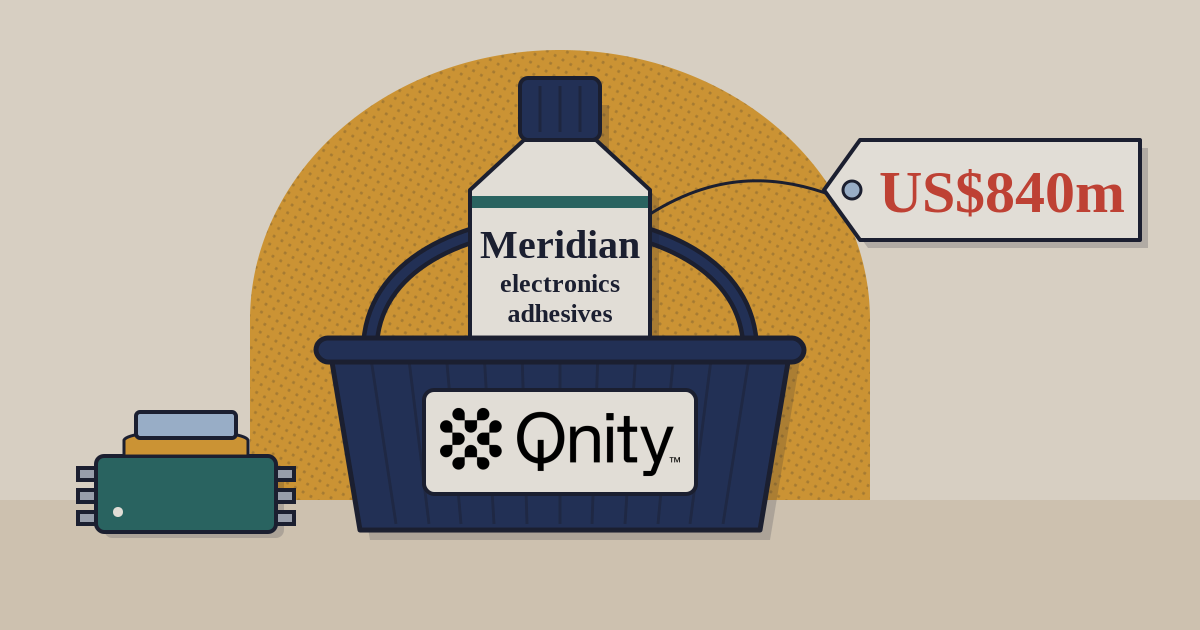
Qnity Electronics, the chip-materials company DuPont spun off a year ago, agreed on 23 November to buy the electronics business of Meridian Adhesives Group for US$840m.1 Qnity says the business will have revenue of “approximately $100 million for calendar year 2026, with double digit growth expected to continue in calendar year 2027”, which makes the price about 8.4 times this year’s expected revenue. Meridian, of Charlotte, North Carolina, says the business includes Epoxy Technology, Inc., Epoxies Etc. and Pacific Adhesive Systems.5 Neither release gives a profit figure for the business, and Qnity had filed no purchase agreement with the US Securities and Exchange Commission when we read its filings.1
US$840m
purchase price, from cash on hand and the revolving credit facility
Qnity release
US$100m
revenue the business expects for 2026, approximately
Qnity release
8.4×
price to expected 2026 revenue
TechBag, from Qnity’s figures
Q1 2027
expected closing, after the US antitrust waiting period
Qnity release
01What the adhesives do
Meridian’s electronics business makes “epoxy-based optical-grade, electrically conductive, and thermally conductive adhesives”.1 In general terms, an optical-grade adhesive fixes parts that light must pass through or line up with, and a conductive one carries current or heat across a joint where solder is not used. Qnity says most of the business’s revenue comes from AI data centres, semiconductor equipment, and aerospace and defence, and that the deal brings it into “optical and photonics applications”.1
The business will join Qnity’s Interconnect Solutions segment, in its thermal management and advanced packaging lines. Jon Kemp, Qnity’s chief executive, gave the reason: “As AI increases the complexity of packaging, connecting, and cooling systems, the industry is shifting towards new architectures and designs, including the adoption of optical connectivity solutions.”1 Optical links were also the object of Marvell’s US$115bn offer for Lumentum, which makes lasers and transceivers for AI data centres, three weeks earlier.
Three more points are Qnity’s own claims: customer retention of about 97% over five years, measured by revenue; a new market it can sell into of about US$1.2bn; and an expectation that the deal adds to its adjusted margins and adjusted earnings per share from the start.1 Meridian keeps its infrastructure, packaging and product assembly adhesives, and says the electronics business runs as part of Meridian, “with no changes to day-to-day operations”, until closing.5
02How it is paid for, and who Qnity is
Qnity will pay from “cash on hand and incremental borrowings under the Company’s existing revolving credit facility”.1 At 30 September it held US$1,124m of cash and had drawn nothing on the US$1.25bn facility; its long-term debt was US$3,996m.2
DuPont separated Qnity on 1 November 2025, giving its shareholders one Qnity share for every two DuPont shares, about 209 million in all. Qnity trades on the New York Stock Exchange as Q.2 It has two segments. Semiconductor Technologies sells materials used to make chips, such as polishing pads and slurries and photoresists. Interconnect Solutions sells plating chemistry, packaging dielectrics, thermal interface materials, laminates and films for chip packages and circuit boards.2
In July–September, sales rose 22% to US$1,556m, and Interconnect Solutions’ rose 30% to US$759m, which Qnity put down to AI-related demand in advanced packaging, circuit boards and thermal management. Net income fell to US$196m from US$223m; interest expense was US$64m against US$14m, and transformation and integration charges US$53m against US$1m.2 Qnity guides to sales of US$5.77bn to US$5.83bn for 2026, so the business it is buying would add under 2%.3
The deal is expected to close in the first quarter of 2027, subject to customary conditions and the expiry of the waiting period under the US Hart-Scott-Rodino Act.1 Qnity’s shares closed at US$114.68 on 23 November, up 10.8% from Friday’s US$103.47; we give no cause for the move.4 What to watch: a filing with the agreement’s terms, and how much of the revolving facility is drawn at closing.
Sources
- Qnity Electronics: Qnity to Acquire Meridian’s Electronics Business, Expands Advanced Packaging and Thermal Management Capabilities — 23 November 2026
- Qnity Electronics: Form 10-Q for the quarter ended 30 September 2026 — filed 4 November 2026
- Qnity Electronics: Qnity Reports Third Quarter 2026 Results, Raises Full-Year Financial Guidance (Form 8-K, Exhibit 99.1) — 4 November 2026
- Nasdaq: historical closing prices, Qnity Electronics (Q) (quote data, not a primary source) — closes of 20 and 23 November 2026
- Meridian Adhesives Group: Meridian to Divest Electronics Business to Qnity Electronics — 23 November 2026
Disclosure. TechBag is a software reseller: it earns when companies buy through it, including from vendors named here. The analysis is TechBag’s own; no vendor paid for or saw this piece before publication. Facts are labelled reported, TechBag count or our view. How the Journal works.
Keep reading