Data & privacyNote
SEBI gives firms 5 working days and KRAs 2 to delink a closed account’s KYC record
SEBI’s circular of 25 November, in force from 24 December: when your KYC record is unlinked from a firm you have left, what changes for mutual funds, and what a ‘validated’ record is.

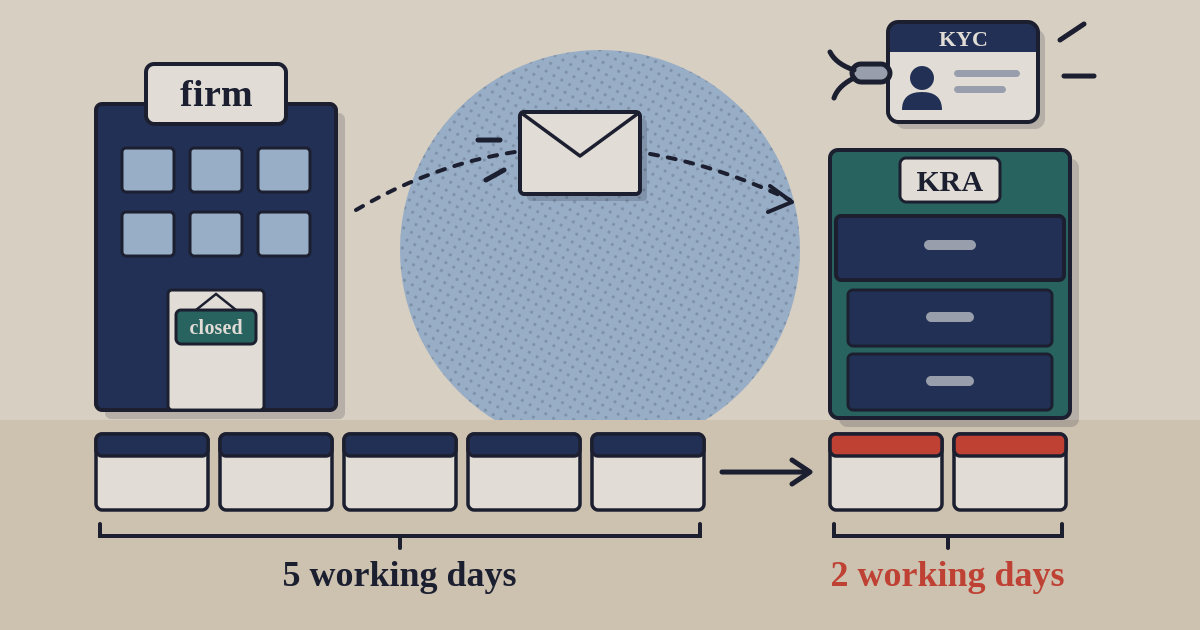
When you close an account with a SEBI-registered firm other than a mutual fund, the firm will have five working days to tell the KYC registration agency (KRA) that holds your know-your-client record, and the KRA two working days after that to “update/ delink the relevant KYC record”. The rule is in a SEBI circular dated 25 November and applies from 24 December.1 SEBI gives its reason in the same paragraph: “to ensure that client KYC information is being shared with intermediaries only for clients which are having account-based relationship with it”.1
A KRA exists so that an investor does KYC once. A new broker, depository participant or fund fetches the record instead of collecting the documents again, and when the record changes the KRA sends the update to the firms linked to it, under Regulation 15(f) of SEBI’s 2011 KRA Regulations.1
01Three triggers, one short clock
The circular sets three triggers. An account closed with a broker or other intermediary: five working days to tell the KRA, two for the KRA to delink. A record downloaded with no account to follow: “if a client account is not opened within twenty-one working days”, the firm has five more working days to tell the KRA, which delinks within two.1 So a record fetched for an application that goes nowhere stays linked for at most 28 working days (21 + 5 + 2).
Mutual funds get a different test. If an investor’s account “across folios has zero balance for a period of six (6) months”, the fund or its registrar and transfer agent (RTA) tells the KRA within five working days, and the KRA must within two “stop sending KYC information updates” to it.1
A closed account’s KYC record is delinked within seven working days of closure
What happens to a KYC record when the relationship ends, under SEBI’s circular of 25 November 2026, in force from 24 December
- 01
The trigger
Account closed; or no account opened 21 working days after the download; or, at a mutual fund, six months of zero balance. - 02
The firm tells the KRA
Within five working days of the trigger. - 03
The KRA acts
Within two working days: delinks the record, or stops sending updates to the fund or its RTA. - 04
The result
Your KYC changes reach only the firms you still have an account with.
Source: SEBI circular HO/38/14/(25)2026-MIRSD-POD3, paragraphs 3.4.1 to 3.4.3 · as of 28 November 2026, 7:15pm IST · Working days are the circular’s unit; the 28-day ceiling for an unused download is our sum
Records already linked are covered too. Intermediaries, funds and RTAs must tell the KRAs about past closures and unused downloads within three months of the circular’s date.1 The final rule is looser on time and wider in reach than the draft. SEBI’s consultation paper of 16 January proposed three working days for a closure and had neither the 21-day test nor the mutual-fund rule.2
02More data at the KRA, and records that travel
The circular also moves more of the account-opening form to the KRA. Within three working days of a new client’s KYC, the firm uploads the client’s income range (six bands, from up to ₹5 lakh to above ₹2 crore), tax-residency details, whether the client is a politically exposed person, occupation, and, where available, the Central KYC number, the DIGIPIN (the postal department’s geo-coded address) and the identity document’s expiry date.1
A record is “validated” when the KRA has checked it against official databases (the PAN database, Aadhaar XML, DigiLocker or mAadhaar) and verified the PAN-Aadhaar link; for the address, the current or the permanent one is enough. A validated record is portable across firms, and each attribute is tagged validated or not, so the next firm knows what it still has to ask.1 Firms must update their records when the KRA sends a change, and offer the client an option to confirm it.1
03What to do before 24 December
For an investor: a firm where you keep an open but unused account goes on receiving your KYC updates; closing the account starts the clock. When a firm asks you to confirm a KYC change, check it. If your new name already shows on your PAN and Aadhaar, no marriage certificate or gazette notice is needed.1
For a broker, depository participant, fund or RTA: build the closure notice and the 21-day check into account operations, report the existing records within the three months, and upload the extra fields for every new client. The KRAs must publish a standard operating procedure within 30 days of the circular, which will set the mechanics.1 A recent case of what a weak identity check can cost is SEBI’s order on the impostor who took ₹11.19 crore of shares.
Sources
- SEBI, circular HO/38/14/(25)2026-MIRSD-POD3: Simplification of client on-boarding and rationalisation of risk management framework at KYC Registration Agencies (copy published by MediaNama) — 25 November 2026
- SEBI, consultation paper on simplification of client on-boarding and rationalisation of the risk management framework at KRAs, Annex A draft circular (as reproduced by TaxGuru) — 16 January 2026
Disclosure. TechBag is a software reseller: it earns when companies buy through it, including from vendors named here. The analysis is TechBag’s own; no vendor paid for or saw this piece before publication. Facts are labelled reported, TechBag count or our view. How the Journal works.
Keep reading