Data & privacyNote
Germany: shops may check your credit only after you pick pay-later, not before
What Germany’s data-protection authorities resolved on 26 November: why a credit check before payment options appear breaks the GDPR, what shops must change, and whom it binds.

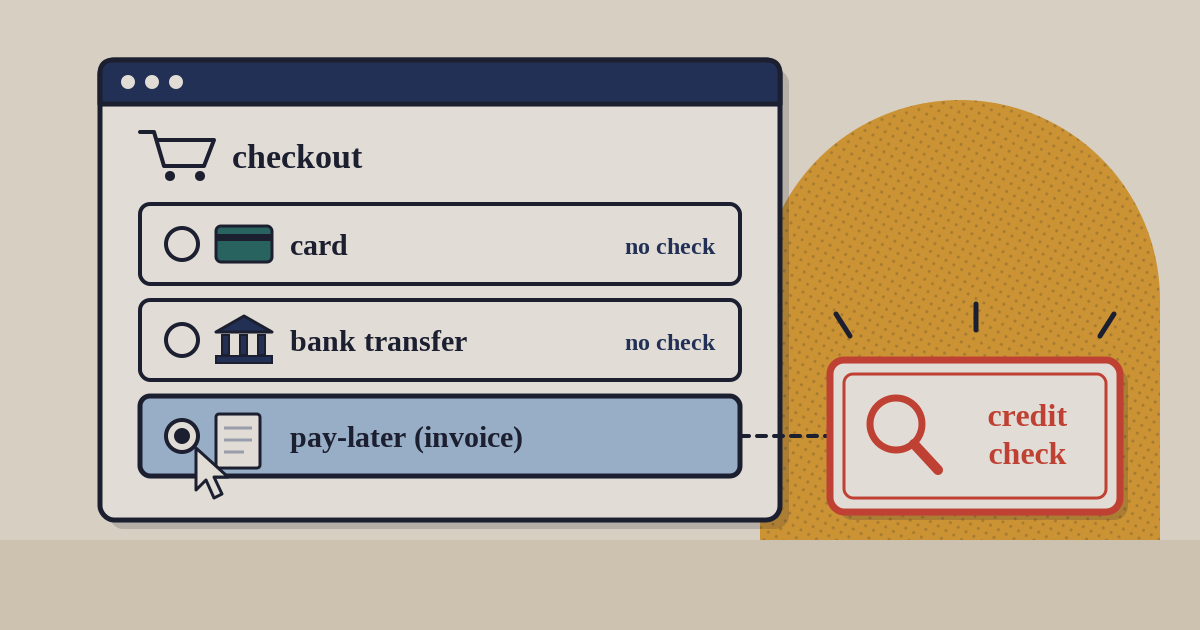
An online shop in Germany may check a customer’s creditworthiness only after the customer has chosen a payment method that leaves the shop carrying a credit risk, such as buying on invoice or in instalments, Germany’s data-protection authorities resolved on 26 November. Checking in advance, to decide which payment options to show at all, is “grundsätzlich datenschutzrechtlich unzulässig”: in principle not permitted under data-protection law.1 The resolution, from the conference of the federal and state supervisory authorities (the DSK), applies to shops, marketplaces and booking portals, including those that hand payment to an outside provider.2
01How the checkout check works, and what is ruled out
A credit check, in the DSK’s definition, is a company’s use of a credit agency’s report on a person: a score, other information, or both. What it rules out has a name, “antizipierte Zahlartensteuerung”, anticipatory payment-method steering. The shop runs the check before showing any payment options, then offers only the methods that suit the result instead of all those its business accepts, such as cash, card, invoice, direct debit or instalments.1 In that model a shopper is checked before choosing anything, and one the check marks as a risk may never see the invoice option.
The allowed order is the reverse: first every method the shop accepts. Only if the customer picks one that carries a risk of non-payment, such as invoice, direct debit or instalments, may a check follow, and the customer must be told at that point that a check is made.1 Customers must be able to browse, choose goods and fill a basket without being checked for that reason alone.2
The check moves from the start of checkout to after the customer picks pay-later
A German online checkout as the DSK resolution of 26 November 2026 allows it, step by step
- 01
Browse and fill the basket
No credit check for browsing, choosing goods or starting the order. - 02
See every payment method
All the methods the shop accepts, shown at the latest when the order begins. - 03
Pick a method
A method with no credit risk to the shop: no check. Invoice, direct debit or instalments: a check may follow. - 04
Told, then checked
The customer is told a check is made; the query to the credit agency should name its purpose.
Source: DSK, resolution and press release of 26 November 2026 (German); § 312j BGB · as of 28 November 2026, 7:15pm IST
03Whom it binds
The reasoning rests on GDPR articles that apply across the EU, but the resolution is the German authorities’ position and § 312j is German law.
Sources
- DSK, Beschluss: Keine Bonitätsprüfung vor Auswahl der Zahlart (antizipierte Zahlartensteuerung) (resolution, in German) — 26 November 2026
- DSK, Pressemitteilung: 112. Datenschutzkonferenz vom 24.–26.11.2026 (press release, in German) — 26 November 2026
- Bürgerliches Gesetzbuch, § 312j Besondere Pflichten im elektronischen Geschäftsverkehr gegenüber Verbrauchern — current text, read 28 November 2026
- DSK, Geschäftsordnung (rules of procedure, in German) — as amended 27 February 2024
- DSK, Beschlüsse (resolutions page) — 26 November 2026 entry
- Regulation (EU) 2016/679, the General Data Protection Regulation (Articles 58, 77, 78 and 83) — 27 April 2016
Disclosure. TechBag is a software reseller: it earns when companies buy through it, including from vendors named here. The analysis is TechBag’s own; no vendor paid for or saw this piece before publication. Facts are labelled reported, TechBag count or our view. How the Journal works.
Keep reading