Data & privacyNote
WhatsApp flaw: Meta AI’s privacy check could have been bypassed from inside Meta
WhatsApp’s November advisory and the CVE record of 20 November: how a chip-certificate check behind Meta AI’s Private Processing failed, why Meta says it went unused, and which builds fix it.

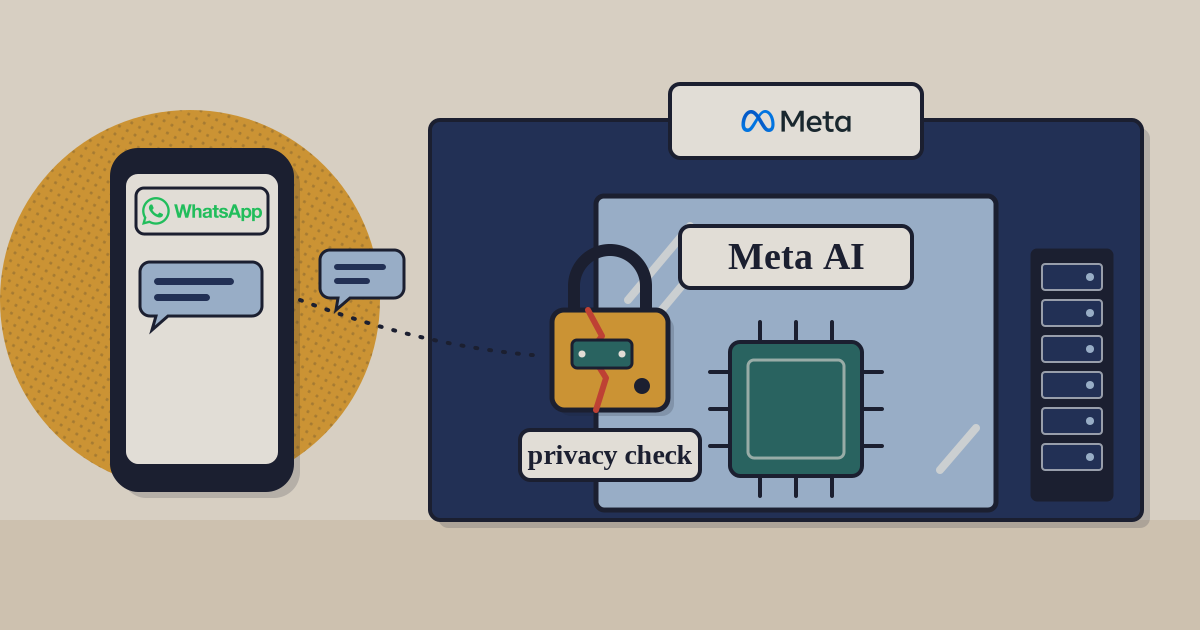
A flaw in WhatsApp could have let “someone positioned within Meta infrastructure” bypass the hardware root of trust that is meant to keep Meta itself out of Private Processing, the confidential-computing service that runs Meta AI features on users’ messages. WhatsApp’s November advisory says the app’s remote-attestation verifier did not properly follow a certificate’s chain of trust: it could have accepted a chip certificate, a VCEK, “signed by a key other than the hardware manufacturer’s”. Meta’s own researchers found it. The record, CVE-2026-44908, was published on 20 November, and the fix is in WhatsApp for iOS 2.26.24.72 and WhatsApp for Android 2.26.23.74.12
01What the check is meant to prove
Private Processing is Meta’s name for servers that handle a WhatsApp request, such as summarising unread messages or suggesting how to word a reply, inside a confidential virtual machine where, Meta says, no one, “including Meta and WhatsApp”, can read them. Using it is optional.34
The promise rests on the chip, not on Meta’s word. In Meta’s white paper, each AMD processor’s security processor combines a secret fused into the silicon with the versions of its firmware to make the Versioned Chip Endorsement Key, or VCEK. It signs an attestation report with that key: a measurement of the exact software loaded into the virtual machine, and proof that it runs on “a genuine AMD SEV-SNP CPU”. Before a phone sends anything, it checks the report, then checks that the VCEK certificate chains through AMD’s signing key to the AMD Root Key, which the app carries built in.4 That chain is the root of trust. The flaw was in its last link: a VCEK certificate signed by some other key could have passed, so a machine that was not a genuine, measured AMD confidential machine could have presented itself as one.1 Meta’s threat model lists “malicious or compromised insiders with access to our infrastructure” first among the attackers the design must withstand.3
02Why Meta says it was not used, and what to update
A second control stood in the way. Meta records security-critical artifacts, VCEK certificates among them, on an append-only log run by Cloudflare, and clients check its proofs before connecting.4 Any certificate not signed by AMD “would first have to be published” there, WhatsApp says, and “the ledger shows that every published VCEK certificate chains to the hardware root of trust, confirming no exploitation.”1 Meta scored the flaw 4.8 (Medium) under CVSS 3.1, with high attack complexity and high privileges required; CISA’s enrichment of the record lists exploitation as “none”.2
An Android phone on 2.26.35.74 or later has all three fixes; an iPhone needs 2.26.24.72
WhatsApp’s November advisories: what each flaw could have done, the first fixed build and Meta's own score, 20 November 2026
Show tableHide table
| CVE | What it could have done (WhatsApp's words, shortened) | Fixed from | Meta's score | Exploited? |
|---|---|---|---|---|
| CVE-2026-44908 | Let someone within Meta infrastructure bypass Private Processing's hardware root of trust with a VCEK certificate not signed by AMD | iOS 2.26.24.72; Android 2.26.23.74; Business iOS and Mac 2.26.23.72; Business Android 2.26.23.70 | 4.8 Medium | No, per the ledger |
| CVE-2026-102769 | SQL injection via a crafted “order details” message from an unofficial client: local files deleted, one bit of chat-database data leaked | Android and Business Android 2.26.35.74 | 6.8 Medium | No evidence seen |
| CVE-2026-23871 | A crafted Click to WhatsApp ad reply could reveal the device's IP address | Android and Business Android 2.26.17.4 | 3.5 Low | “May have been abused” with spam |
Source: WhatsApp security advisories 2026; CVE records (cve.org), published 20 Nov 2026 · as of 28 November 2026, 7:00pm IST
Sources
- WhatsApp, Security Advisories 2026 (November update) — November 2026; CVE records published 20 November 2026
- CVE Program, CVE-2026-44908 record (Meta as CNA; CISA ADP enrichment) — 20 November 2026
- Engineering at Meta, Building Private Processing for AI tools on WhatsApp — 29 April 2025
- Meta, Private Processing for WhatsApp: Technical White Paper and Security Guide, V3 — 20 October 2026
- Trail of Bits, What we learned about TEE security from auditing WhatsApp’s Private Inference — 7 April 2026
- CERT-In, CIVN-2026-0576: Multiple Vulnerabilities in WhatsApp — 26 November 2026
Disclosure. TechBag is a software reseller: it earns when companies buy through it, including from vendors named here. The analysis is TechBag’s own; no vendor paid for or saw this piece before publication. Facts are labelled reported, TechBag count or our view. How the Journal works.
Keep reading