Markets & the AI economyAnalysis
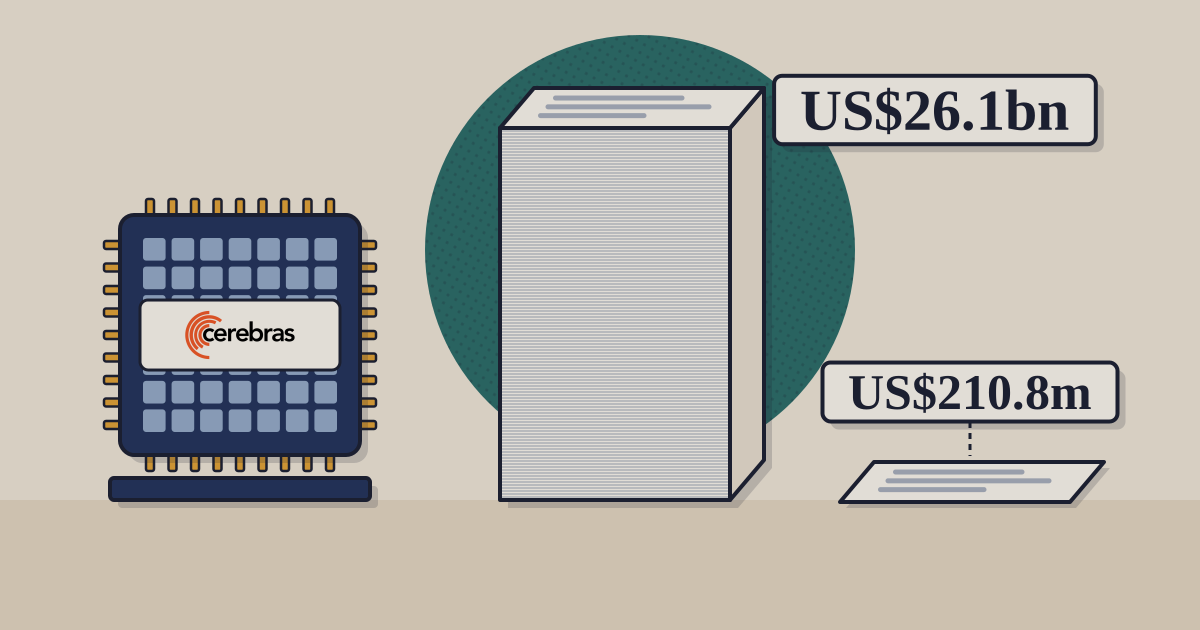
Cerebras’s contract book reached US$26.1bn, 124 times its US$210.8m quarter
Cerebras’s filings for July to September: a US$224.1m operating loss on US$210.8m of revenue, two customers at 72% of sales, and what the OpenAI deal needs to become revenue.

Cerebras makes a chip the size of a whole silicon wafer and, increasingly, rents out what it computes. It reported its third quarter, its first full one as a listed company, on 12 November after the US close. Its shares had closed that day at US$97.75, 47% below the US$185 IPO price of May, and were 11.6% higher at US$109.09 in premarket trading at 9:28am New York time (7:58pm IST) on 13 November, according to Nasdaq.com.26 This piece reads the release and the 10-Q to answer three questions: how Cerebras earns, why a quarter of record revenue ended in a loss larger than that revenue, and what has to happen for a US$26.1bn contract book to become sales.
01Record revenue, and a loss larger than it
Revenue was US$210.8m against US$135.7m a year earlier, up 55%, and US$30.7m more than in April–June. Gross profit fell US$13.0m to US$42.1m, and the gross margin halved to 20% from 41%. Operating expenses rose to US$266.2m from US$81.6m, so the operating loss was US$224.1m, 106% of revenue. Interest on the IPO cash helped: other income was US$63.9m, and the net loss was US$161.2m.12
Since the IPO, Cerebras's operating loss has been larger than its revenue
Quarterly revenue and operating income (loss) under US accounting rules, US$m, January 2025 to September 2026
- Revenue
- Operating result
US$m
Show tableHide table
| Revenue | Operating result | |
|---|---|---|
| Q1 25 | 99.5 | -28.5 |
| Q2 25 | 103.3 | -57.2 |
| Q3 25 | 135.7 | -26.5 |
| Q4 25 | 171.4 | -33.7 |
| Q1 26 | 193.4 | -15 |
| Q2 26 | 180.1 | -477.2 |
| Q3 26 | 210.8 | -224.1 |
Source: Cerebras results releases (23 Jun, 12 Aug, 12 Nov 2026); IPO prospectus (14 May 2026) · as of 12 November 2026 · Q2 2026 includes stock awards that vested on the IPO
Most of the gap is pay in shares. Restricted stock units granted over years vest only once the company lists; the IPO met that condition in May, and stock-based compensation was US$155.1m in the quarter against US$11.3m a year earlier. General and administrative costs rose to US$55.6m from US$3.5m.2
Cerebras also reports “core” results, which it defines as excluding stock-based compensation, the non-cash amortisation of warrants it gave customers, and data-centre costs it passes through to a customer. Core revenue takes the US$210.8m, removes US$16.4m of pass-through revenue and adds back US$36.4m of warrant amortisation, which accounting rules deduct from revenue: US$230.9m, up 70%. The core operating loss was US$33.1m, or 14% of core revenue, against a guided loss of 23–25%; core revenue beat the US$214–216m guide.14 The core gross margin was 41%, against 40.7% a year earlier; the 10-Q credits more cloud revenue and better cloud margins, offset by lower hardware margins.2
02From selling wafer-sized chips to renting them out
The product is the Wafer-Scale Engine, which the 10-Q describes as “a chip encompassing an entire silicon wafer”. The current WSE-3, made by TSMC on a 5nm process, has 4 trillion transistors, 900,000 cores and 44 GB of memory on the chip itself, which Cerebras says is 58 times the size of Nvidia’s B200. Its argument is that keeping memory on the chip removes the bottleneck in serving AI models: moving data on and off a GPU.25 The WSE-3 sits inside the CS-3 system. Cerebras sells those systems to run in a customer’s data centre, or runs them in its own cloud and sells the output: dedicated capacity, “generally structured as take-or-pay”, or tokens paid for as they are used.2
Cloud now brings in two-thirds of Cerebras's revenue; a year earlier it was under a third
Revenue by line, US$m, January 2025 to September 2026
- Hardware
- Cloud and other services
Show tableHide table
| Hardware | Cloud and other services | |
|---|---|---|
| Q1 25 | 69.7 | 29.8 |
| Q2 25 | 70.3 | 33 |
| Q3 25 | 96.8 | 38.9 |
| Q4 25 | 121.7 | 49.8 |
| Q1 26 | 110.6 | 82.8 |
| Q2 26 | 54.1 | 126 |
| Q3 26 | 68.9 | 141.9 |
Source: Cerebras results releases (23 Jun, 12 Aug, 12 Nov 2026); IPO prospectus (14 May 2026) · as of 12 November 2026 · Both lines are net of customer-warrant amortisation from 2026
Cloud and other services revenue rose 265% to US$141.9m, 67% of the total; hardware fell 29% to US$68.9m. The OpenAI arrangement alone brought in US$72.4m, net of US$3.2m of warrant amortisation. Hardware margins fell to 11% from 50%, which Cerebras attributes to the warrants, stock pay, higher material costs and “preferential pricing” for a large strategic customer signed in 2025.2 Its inference is also sold through AWS Marketplace, Microsoft Marketplace, OpenRouter and Hugging Face, among others. The next systems are on the way: the CS-4, introduced in August and “soon” in full production, and the CS-5, targeted for early summer 2027, whose WSE-5 processor is in system testing.12
03A contract book 124 times the quarter
124×
remaining performance obligations on 30 September as a multiple of July–September revenue
US$26.1bn against US$210.8m. The book was US$24.6bn at the end of 2025 and US$25.4bn on 30 June.
Remaining performance obligations (RPO) are the revenue a company has signed for and not yet delivered, including deferred revenue and amounts still to be invoiced. Cerebras’s was US$26.1bn, and the 10-Q says “a significant amount” of it is owed under the Master Relationship Agreement (MRA) with OpenAI. It does not give OpenAI’s share as a figure. Cerebras’s first-quarter release valued the deal at “more than $20 billion”.2345
Even the third of the book due within two years is nine times this year's guided revenue
Remaining performance obligations, the part expected by September 2028, 2026 guidance and quarterly revenue, US$m
Source: Cerebras Form 10-Q and results release (12 Nov 2026) · as of 12 November 2026 · The 24-month slice is 33% of RPO, as the 10-Q states; guidance is core revenue
The schedule has moved forward as the deal ages. At the end of 2025 Cerebras expected 15% of its book within 24 months; now it expects 33% by September 2028, 44% in the two years after, and the rest later. Timing “may vary”, the filing says, with deliveries.25 The figure also leaves things out: data-centre costs that will be passed on to OpenAI for sites not yet leased are excluded, because the amounts depend on “factors outside the Company’s control”.2
04Two customers, 72% of revenue
The 10-Q’s customer table uses letters; its risk factors give the names. The Mohamed bin Zayed University of Artificial Intelligence (MBZUAI) paid 38% of revenue in July–September, against 70% a year earlier. OpenAI paid 34%. G42, which the filing treats as a related party of MBZUAI, paid 7%, against 14%. Two customers also held 80% of what Cerebras was owed on 30 September.2
Two customers paid 72% of Cerebras's revenue in July to September; a year earlier one paid 70%
Share of total revenue by customer, % of the period's revenue, 2025 and 2026
- MBZUAI
- OpenAI
- G42
- All other customers
Show tableHide table
| MBZUAI | OpenAI | G42 | All other customers | |
|---|---|---|---|---|
| Jan–Sep 2025 | 56 | 0 | 30 | 14 |
| Jul–Sep 2025 | 70 | 0 | 14 | 16 |
| Jan–Sep 2026 | 45 | 25 | 9 | 21 |
| Jul–Sep 2026 | 38 | 34 | 7 | 21 |
Source: Cerebras Form 10-Q, Note 3 and risk factors (12 Nov 2026) · as of 12 November 2026 · All other customers is the remainder; OpenAI's agreement was signed in December 2025
The OpenAI agreement, signed in December 2025, has three parts. OpenAI is “contractually committed to purchase” 750 MW of inference capacity over three or four years, extendable to five, with an option on 1.25 GW more by the end of 2030. It lent Cerebras about US$1.0bn in January at 6% for the build-out, so far repaid through services rather than cash: US$175.5m had been offset by 30 September, leaving US$829.1m. And it holds a warrant for up to 33.4m shares at a nominal price, vesting as milestones are met; 10.0m had been exercised by 30 September.2 If the agreement ends for any reason other than OpenAI’s own uncured breach, the loan can fall due at once.2
05What turns the book into revenue
The contract pays only as capacity arrives. Cerebras must deliver it in tranches, across a set number of data centres, by milestone dates; a late tranche shortens that tranche’s term day for day. The 10-Q is direct about where things stand:
As of September 30, 2026, without adjustment for any excused delays … we delivered less capacity to OpenAI than the quantity contemplated by the MRA.
It expects delays “may continue through a portion of 2027”. Before any adjustment for excused delays, service credits, which reduce OpenAI’s later monthly fees, began accruing on 1 October; a shortfall left uncured for 90 days lets either side end that tranche, and Cerebras expects less than 5% of the committed capacity to be terminable this year.2
The US$26.1bn becomes revenue only as Cerebras leases, builds and delivers capacity on time
How the OpenAI agreement moves through Cerebras's accounts, as its 10-Q describes it, September 2026
- 01
Commit
750 MW for three or four years. The value enters RPO, apart from pass-through costs for sites not yet leased.
- 02
Lease and build
US$8.5bn of signed data-centre leases, for all customers, had yet to start on 30 September. OpenAI’s US$1.0bn loan funds the build-out.
- 03
Deliver on time
Tranches by milestone date. Thirty days late: credits accrue. Ninety days: either side may end the tranche.
- 04
Recognise
Revenue over the term as capacity is served, less warrant value: US$1.1bn across customers, deducted through October 2031.
Source: Cerebras Form 10-Q, Notes 3, 10, 12 and 15, and risk factors (12 Nov 2026) · as of 12 November 2026
The capacity is being lined up. Cerebras says it has secured 700 gross MW of data-centre capacity for delivery by the end of 2027, up from more than 600 MW in August, with new sites in Norway and Finland; it does not say how much of that serves OpenAI’s 750 MW. It spent US$1.05bn on property and equipment in nine months and held US$7.8bn of cash, restricted cash and investments, with an undrawn US$850m credit line.124 For October–December it guides core revenue of US$310–330m and a core operating margin of minus 1% to plus 1%; for the year, US$940–960m, up from US$880–890m in August and US$855–865m in June. Chief executive Andrew Feldman said the company expects “to triple revenue in 2027”.134
Sources
- Cerebras Systems: Third Quarter 2026 results release (Form 8-K, Exhibit 99.1) — 12 November 2026
- Cerebras Systems: Form 10-Q for the quarter ended 30 September 2026 — 12 November 2026
- Cerebras Systems: First Quarter 2026 results release (Form 8-K, Exhibit 99.1) — 23 June 2026
- Cerebras Systems: Second Quarter 2026 results release (Form 8-K, Exhibit 99.1) — 12 August 2026
- Cerebras Systems: IPO prospectus (Form 424B4) — 14 May 2026
- Nasdaq.com: Cerebras Systems (CBRS) quote — 13 November 2026 Premarket price as of 9:28am ET; previous close 12 November. Not a primary source.
- India Briefing: Digital services in India: OIDAR, GST applicability and compliance — updated 29 September 2023
Disclosure. TechBag is a software reseller: it earns when companies buy through it, including from vendors named here. The analysis is TechBag’s own; no vendor paid for or saw this piece before publication. Facts are labelled reported, TechBag count or our view.
Keep reading